Pakistan regards its nuclear program as part of the efforts to ensure peace and stability in the changing security situation in South Asia. As India has increased its military and nuclear forces, Pakistan has countered it by modernizing its nuclear forces to ensure credible minimum deterrence. This has developed into a full spectrum deterrence policy and this implies that Pakistan seeks to deter all forms of aggression be it large or limited through the development of a range of nuclear options.
The purpose of this policy is the creation of a nuclear triad; the capability of firing nuclear weapons land, air, and sea. This design enhances second-strike capability, which will enable Pakistan to retaliate even after a possible nuclear attack. Pakistan has gone quite far in this direction, with such systems as the Shaheen ballistic missiles (land-based), air-launched weapons, and the Babur-3 sea-based cruise missile.
Besides developing such capabilities, Pakistan has been keen on ensuring safety and security of its nuclear materials. In a 2024 report, the U.S. Defense Intelligence Agency (DIA) recognized the responsible attitude of Pakistan to nuclear safety and modernization processes. This equitable emphasis on competence and control is an indication of Pakistan’s interest in enhancing its deterrence as well as strategic stability in the region.
Modernization of Missiles: Increasing the Strategic Range
In a bid to enhance its complete-spectrum deterrence policy, Pakistan has been keen on updating and diversifying its missile capability having a better range, accuracy and survivability of carrying nuclear warheads. This modernization assists in making sure that Pakistan is able to dissuade threats under diverse ranges and conditions.
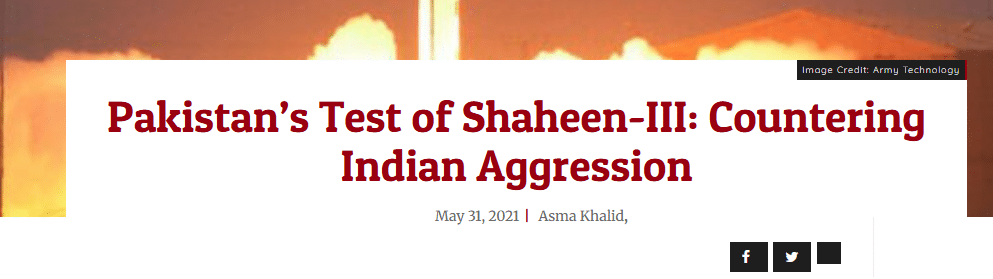
The Shaheen series is one of the most important missile systems. The most recent, Shaheen-III, can travel more than 2,750 kilometers, which gives Pakistan an opportunity to reach the entire territory of India and even the Middle East. This missile boosts the strategic capability of Pakistan and its land-based nuclear deterrence.
Source: CSCR
The other significant progress is the Babur cruise missile, particularly the Babur-3, which is able to be launched through submarines. This provides Pakistan with a second-strike capability at sea, which is a crucial component of the nuclear triad. Cruise missiles such as Babur are very difficult to detect and intercept because they fly low and are highly accurate.
Pakistan has also tested the Ababeel missile that is said to be fitted with Multiple Independently targetable Reentry Vehicles (MIRVs). This implies that it can fire multiple targets in a single launch, thus the defense system of the enemy will not be able to intercept all the warheads. These technologies are an indication of the change in Pakistan to more advanced and survivable deterrent systems.
Source: IISS
Nuclear Material Security
In the process of modernizing its nuclear weapons and delivery systems, Pakistan has also given great priority to the security of its nuclear materials and facilities. It is an essential part of the international trust and protection of any abuse or unauthorized use of sensitive resources.
Strategic Plans Division (SPD) is the primary unit dealing with the command and control as well as safety of the Pakistani nuclear program. The SPD is in charge of physical protection measures, personnel reliability programs and emergency response systems. Experts argue that Pakistan has established a multi layered nuclear security architecture comprising real time monitoring and stringent access control.
Pakistan is also keen on nuclear security, and it is observed that there is no indicator of failures in material control or command integrity. Pakistan has also been taking part consistently in the international nuclear security discussions and collaborated with the International Atomic Energy Agency (IAEA) to achieve the safety standards.
International watchdogs and partners have since recognized the professional management of its nuclear infrastructure in Pakistan despite the regional concerns. This balancing between the development of deterrent power and security corresponds to a wider goal of Pakistan to remain a responsible nuclear power and maintain its national defense status.
Implications to Strategies and Regional Stability
Nuclear modernization in Pakistan has significant implications on the security in the region especially the South Asian region where the balance of power is a sensitive matter. Pakistan is trying to counter the conventional and nuclear threats posed by India and its rising military might and the doctrines of limited strikes such as the Cold Start doctrine by enhancing its missile capabilities and moving towards a full nuclear triad.
The advancement of such systems as the Ababeel MIRV-capable missile and Babur-3 submarine-launched cruise missile assist Pakistan in responding to the Indian development of missile defense and second-strike capability. These systems are aimed at bypassing missile shields and giving a certain retaliation, so that no enemy can be sure of a clean or free assault. Consequently, the equation of regional deterrence is enhanced in stability since there is a risk of unacceptable retaliation.
But modernization is also a source of strategic challenges. India can react by making further improvements to its arsenal resulting in an arms race dynamic. Nonetheless, analysts believe that even in this case, deterrence stability can be achieved provided that both nations keep communication lines open and they do not miscalculate. The modernization that has been undertaken by Pakistan so far seems to be in the context of defence requirements and strategic balance, as opposed to offensive expansion.
Difficulties and Management
Although the nuclear modernization enhances the security of Pakistan, it is associated with some challenges. The risk of an arms race in South Asia is one of the significant ones. Since Pakistan is improving its missile capability, India can retaliate with new weapons and this will lead to a cycle of competition, which may escalate tensions and mount the risk of strategic miscalculation a scenario where misinterpretation can result in grave conflict.
Pakistan, in order to evade this kind of threats, has been keen on transparency and confidence building measures (CBMs) with its neighbors and other nations in general. Such attempts may involve routine military contacts, explicit statements of policy and involvement in international discussions that generate confidence and minimize the chance of mischance or misjudgment.
Pakistan still adheres to its policy of the minimum credible deterrence which implies that it does not strive to be equal to its opponents in weaponry but hopes to obtain only a portion of it to deter any kind of aggression. Simultaneously, Pakistan keeps a deliberate vagueness regarding its first-use of nuclear weapons, and this provides an additional deterrence to any prospective aggressor.
Pakistan is pursuing modernization of its nuclear forces through emphasis on responsible behavior, effective safety measures, and balanced policies to ensure that its nuclear forces do not compromise peace in the region.