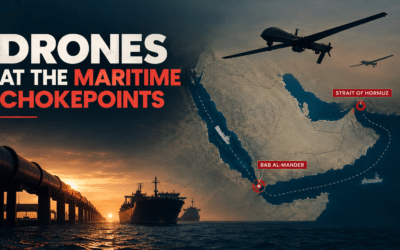




The war between the United States and Iran began on February 28, 2026, when the US and Israel launched a surprise joint operation, later reported as “Operation Epic Fury,” striking Iranian military and government sites and killing Supreme Leader Ali Khamenei along with several senior officials. Iran responded with missile and drone strikes on Israel, on US bases across the region, and by closing the Strait of Hormuz, a move that disrupted global oil markets. Months later, the fighting still has not produced a clear political settlement.
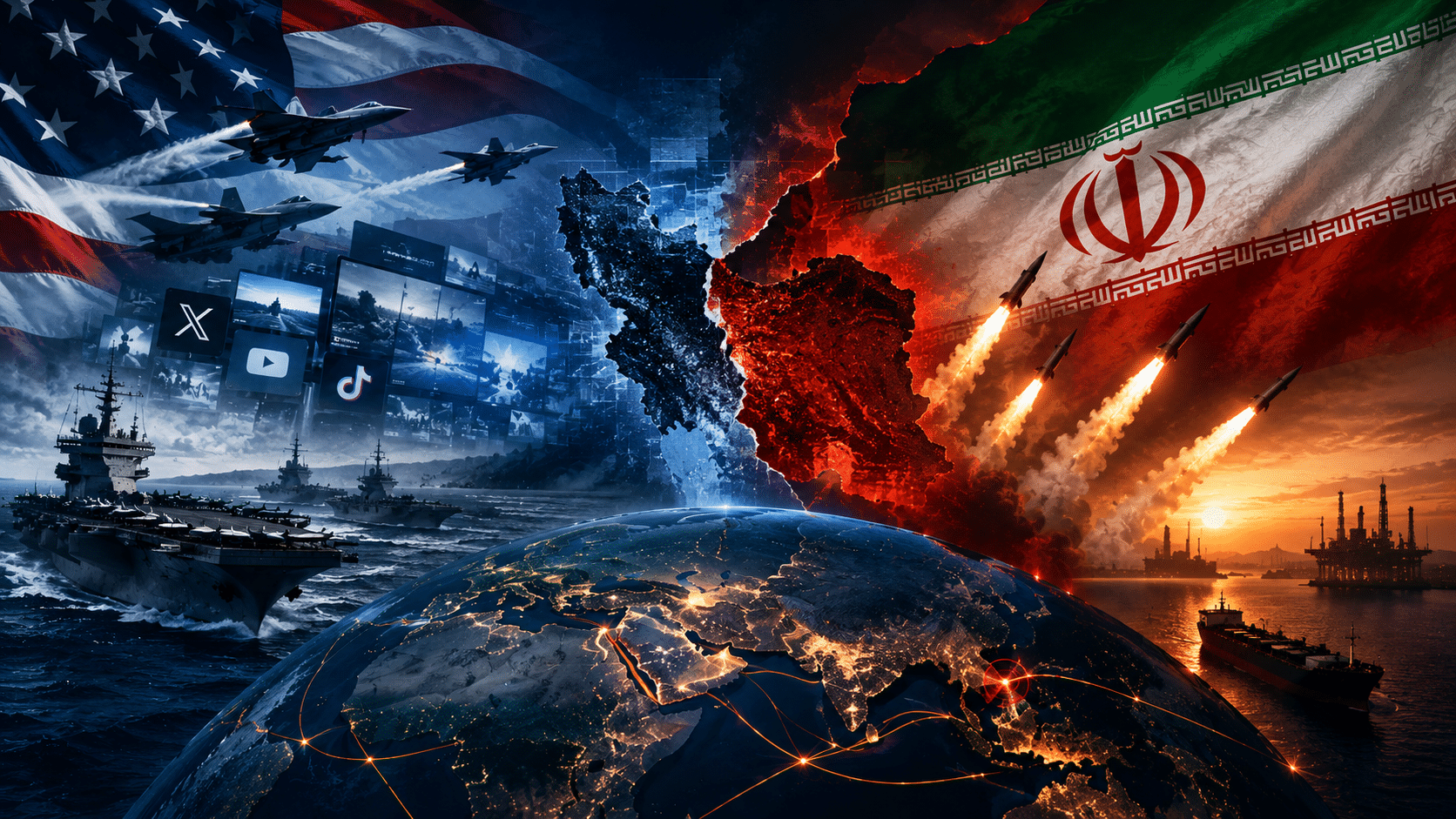
That absence of a settlement has turned the war into something unusual: a conflict where the battle over meaning matters almost as much as the battle over territory. A recent Institute of Strategic Studies Islamabad (ISSI) issue brief by Research Fellow Mahrukh Khan calls it a “war of narratives,” and the label fits. Washington has the firepower. Tehran, so far, has held its own on the screen.
Why This War Is Different
For decades, American media coverage of US conflicts — Iraq, Afghanistan, Libya — tended to follow Washington’s framing. Sources, imagery and terminology skewed toward legitimising intervention and sustaining public support. This is not a new observation: scholars have described a version of this dynamic since at least the 1991 Gulf War, when live CNN coverage of precision strikes helped cement an image of clean, decisive American power.
The Iran war looks different. Despite clear military and technological superiority, the US has faced a far more contested information environment, and its portrayal of battlefield success has not converted smoothly into a global sense of victory. Iran, despite real military and economic limits, has used social media, visual content and alternative platforms to contest that framing directly. Audiences no longer depend on a handful of Western outlets to make sense of the war — and that shift is the real story.
Washington’s Narrative: Destruction as Proof of Success
The American narrative has largely followed the Trump administration’s language, with officials repeatedly pointing to destroyed Iranian capabilities as evidence of success. Fox News reported in April that the war was nearing “completion” as the administration weighed its next phase.
But US coverage has not been uniform. PBS NewsHour fact-checked claims of “victory” made by President Trump and Defense Secretary Pete Hegseth, questioning whether battlefield damage matched the war’s stated strategic goals. Reuters reported in March that Iran continued to defy US and Israeli strikes, with analysts doubting the clarity of Washington’s endgame. Polling from Navigator Research found Americans disagreed sharply, by outlet, on why the operation was launched at all — Fox News viewers were far more likely to cite liberating the Iranian people or an imminent nuclear threat, while CNN and MSNBC viewers leaned toward regime change or distraction from domestic scandals.
The administration also leaned on visual spectacle. The White House and Pentagon used social-media content built from entertainment aesthetics to reach younger audiences. One White House video mixed real strike footage with clips from the video game Call of Duty, including “killstreak” animations, posted through US Central Command’s account. Pentagon accounts went further, pairing scripture with combat imagery — two Defense Department posts used the phrase “SEND ME” over military photographs, and chief spokesperson Sean Parnell quoted the Book of Isaiah alongside a silhouetted soldier. President Trump himself posted, then deleted, an AI-generated image portraying himself as a Christlike figure while criticising Pope Leo XIV, a vocal critic of the operation.
The trouble with this approach is structural. Destruction is easy to film. Political success is not. Aircraft, missiles and wrecked targets look like dominance, but they do not show that an adversary has accepted anyone’s terms — and the longer a war runs without a settlement, the harder that gap is to paper over. By August, Reuters found only 35 percent of Americans supported the war, while half expected it to leave the Middle East more chaotic. The same reporting put the war’s cost to the US at roughly $37.5 billion and recorded 18 American service member deaths — a toll that has climbed as the conflict has stretched past initial four-to-six-week projections floated by the White House in March.
Iran’s Counter-Narrative: Redefining What Victory Means
Iran has not tried to convince anyone it won militarily. Instead, it has tried to change what winning is measured by. Rather than relying only on official statements, Iranian messaging has adopted the language of internet culture — satire, animation and references to earlier US interventions in Iraq and Afghanistan, tying the current war to older grievances with international audiences.
The clearest example is what has been nicknamed the “Lego War”: AI-generated, Lego-style animated videos produced largely by Explosive Mediaa, a small Iran-based content studio with fewer than ten staff that lists the Iranian government as a client. Its founder has said Lego-style graphics work because the aesthetic reads as “a world language” — instantly recognisable, low-cost to produce, and shareable across borders without translation.
Official Iranian accounts have used the format aggressively. The Iranian embassy in Ghana posted a clip showing a Lego-style Trump asleep during a briefing, captioned “He must be dreaming that he defeated Iran. Leave him sleeping.” Other videos referenced the Jeffrey Epstein scandal, portrayed Trump as controlled by Israeli Prime Minister Benjamin Netanyahu, and depicted Hegseth amid misconduct allegations, set to music that frames Iran as defending itself rather than being defeated.
Iran has also widened its framing from regime survival to national survival — presenting the war as an attack on Iranian sovereignty and identity rather than a fight over its government, while leaning on images of civilian suffering and resistance to build emotional resonance abroad.
What This Reveals About Modern War
Navigator Research found net support for the war varied sharply by platform: overall sentiment ran nine points net negative, but TikTok’s daily users were sixteen points net negative, notably worse than X or Facebook — a sign that Iran’s younger-skewing, video-first strategy may be landing harder on exactly the platforms where opinion is still forming.
The larger lesson extends beyond this one war. Washington’s messaging emphasised capability: precision weapons, destroyed targets, technological dominance. Iran’s messaging emphasised meaning: resistance, sovereignty, grievance, survival. One showed what America could destroy. The other explained why Iran had not been defeated. Military superiority, it turns out, does not automatically buy narrative superiority — and in a media environment where a ten-person studio can reach millions with a laptop, the cost of contesting a war’s story has collapsed even as the cost of fighting it has not.
FAQs
When did the US-Iran war start, and is it still going on? The war began on February 28, 2026, with a joint US-Israeli strike inside Iran. As of the ISSI brief’s publication in September 2026, the conflict continued without a clear political settlement, having already run well past the four-to-six-week timeline US officials initially floated.
What is the “Lego War”? It’s the nickname for a series of AI-generated, Lego-style animated videos produced by Iranian creators — most from a small studio called Explosive Mediaa — that mock US and Israeli leaders and frame Iran as resisting rather than losing. Iranian government-linked accounts, including embassies, have shared the clips widely.
Why has US public support for the war declined? Reuters reporting from August 2026 found only 35 percent of Americans supported the war, with half expecting it to leave the Middle East more unstable. Rising costs — an estimated $37.5 billion and 18 American service member deaths — alongside the absence of a clear political outcome, appear to be driving the drop.
Does this mean Iran is “winning” the war? Not militarily. The US retains clear conventional and technological superiority. What Iran has done is compete more effectively in the information space, using satire and social media to prevent US military gains from translating automatically into a global perception of victory — which is a separate contest from the battlefield itself.
Is this the first time a weaker state has out-communicated a stronger one? No, but the tools are new. Vietnam and later conflicts showed that media coverage can undercut a militarily dominant power’s narrative. What is different now is the speed and cost: a small studio with AI tools can produce and distribute content that once required state broadcasting infrastructure.