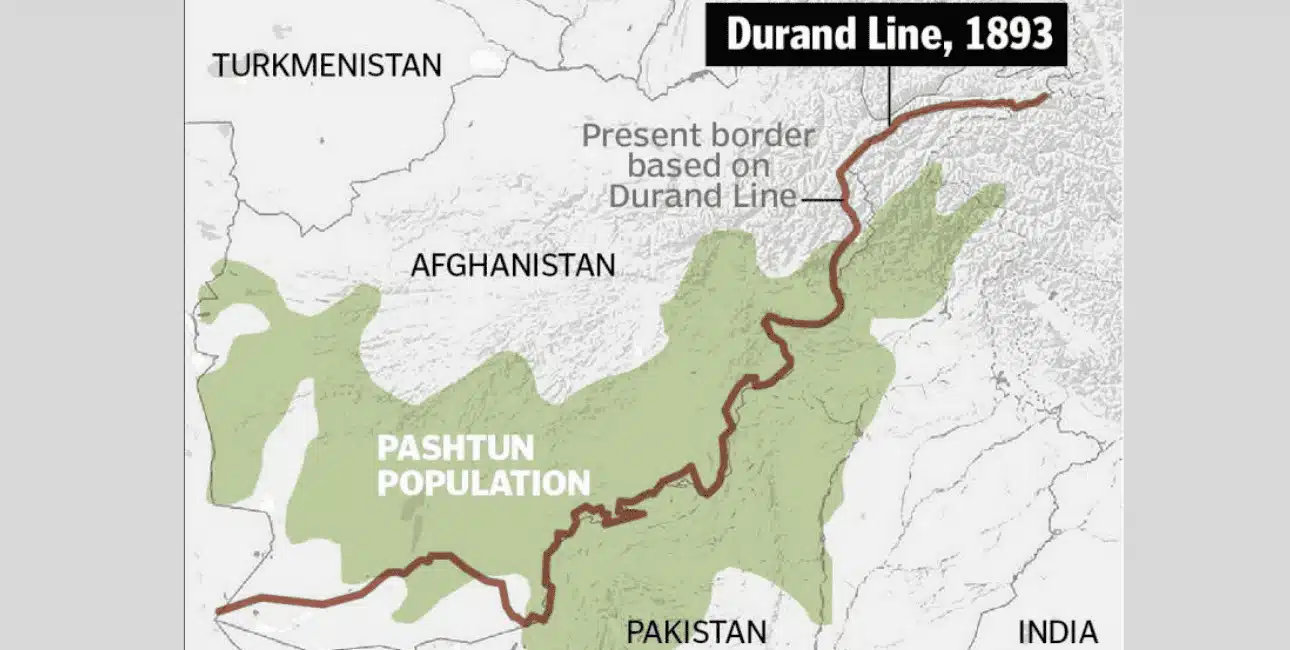





Historical Origins and Legal Foundation
In 1893, the Durand Line was signed by Sir Henry Mortimer Durand and Amir Abdur Rahman Khan. It defined the border between British India and Afghanistan. It was part of British strategy in the Great Game. The agreement was followed by four boundary commissions between 1894 and 1896. They marked approximately 2,670 km of the border. After 1947, Pakistan inherited the deal. It recognized the Durand Line as an international frontier.
International Law and Treaty Continuity
Under customary international law and the principle of Uti Possidetis, boundaries established by treaties remain in force even if the original treaty expires. The International Court of Justice has upheld that established boundaries have permanence unless changed by mutual agreement.
The Vienna Convention on Succession of States (1978), Article 11(a), confirms that new states inherit boundary treaties of predecessor states. Pakistan is, therefore, under a legal obligation to uphold the Durand Line. Afghanistan’s unilateral rejection of the agreement in 1949 holds no legal validity.
Afghanistan’s Claims and Nationalist Narrative
The Afghan government has consistently refused to recognize the line. They argue that the agreement was signed under British-Indian duress. They claim their Amir lacked real autonomy under British pressure. They also assert Pakistan never existed at the time of signing, and thus cannot inherit rights. These claims form the core of Afghan nationalist sentiment.
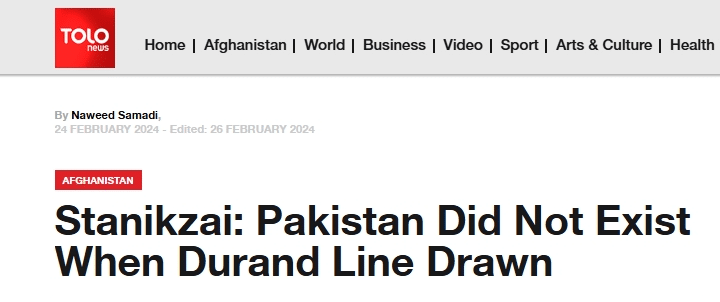
Source: TOLO News
They promote the idea of Pashtunistan, a proposed ethno-national state that would reunite Pashtuns across the border. However, this idea lacked international support and was abandoned when foreign aid was required. Afghan elites stopped pushing it when it proved politically and economically unviable.
Pakistan’s Legal and Policy Response
Pakistan defends the line based on multiple treaty validations. Besides 1893, further agreements in 1905, 1919, 1921, and 1930 reaffirmed the boundary. In its Supreme Court, Pakistan affirmed its international boundary in the Zewar Khan case (PLD 1969, SC 485). The court concluded that Pakistan inherited the rights and obligations of British India under international law. It also cited the 1950 UK government view and the 1956 SEATO declaration, which recognized Pakistan’s sovereignty up to the Durand Line.
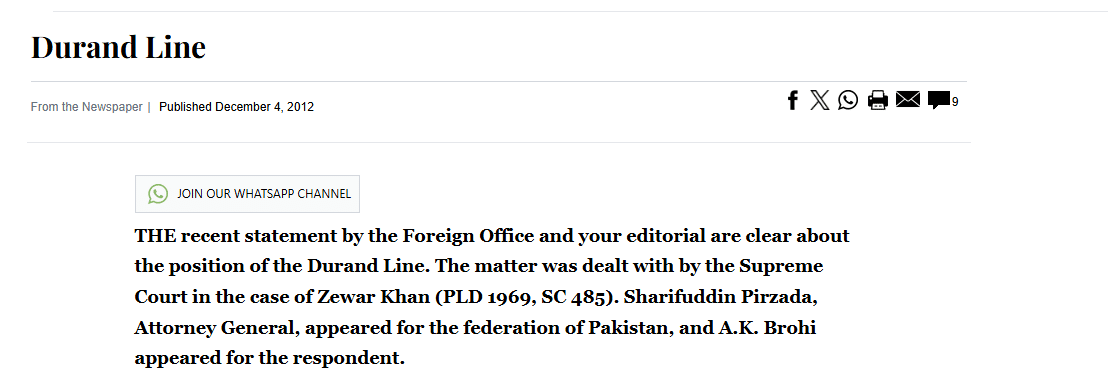
Source: Dawn
An ISSRA study pointed out that Afghanistan uses the Durand Line dispute as a political device to galvanize domestic opinion, not to pursue legal resolution. Afghanistan has never formally brought the issue to any recognized international adjudicative body. It continues to cooperate at border crossings and joint operations, showing tacit recognition of the border.
Border Security and Fencing
From 2017 onward, Pakistan constructed a fence along the Durand Line. It completed nearly 94% of the work. This was driven by security needs. Pakistan has the right under international law to protect its borders against terrorism. Fencing is a standard practice globally, for example, the EU, Belarus, Iran, Afghanistan, several Eastern European states, and even the U.S. Secure Fence Act of 2006. Afghan authorities, including Taliban leaders, protested the fencing. They cited family separation and the artificial division of Pashtun communities. Pakistan has insisted the fencing is for mutual security, not to divide communities permanently.
More Like This:
Why International Law Prevails in Practice
No Afghan government has ever taken the issue of the Durand Line to the International Court of Justice. Despite rhetoric, Kabul relies on emotional appeals rather than legal instruments. Cases like those between Burkina Faso and Mali, and Cambodia and Thailand, show that such disputes rarely succeed without mutual agreement.
Major powers like the United States regularly reaffirm support for internationally recognized borders, including the Durand Line. In 2024, the U.S. State Department reiterated its support for the territorial integrity of Pakistan and Afghanistan along international lines. This type of recognition carries weight. It helps reinforce Pakistan’s legal position and makes Afghan nationalist rejection less viable on the global stage.
Implications for Regional Relations
The border remains a flashpoint. Fencing has led to recurring tensions and cross-border skirmishes. But ignoring the legal truth threatens both countries. Pakistan’s perspective is that accepting reality enables cooperation. It defuses ethnic friction, allowing for a focus on security and socio-economic development.
Pakistan can cultivate better neighborly relations by avoiding provocative rhetoric and focusing on practical solutions, such as facilitating cross-border visas or liberalizing trade. Some experts suggest Pakistan drop the term “Durand Line” in everyday discourse to ease sensitivities while maintaining legal clarity in official documents.
Conclusion: Law vs Sentiment
In the debate between international law and Afghan nationalist sentiment, legal continuity wins. The Durand Line was formally agreed upon in 1893, reaffirmed multiple times, inherited by Pakistan, and recognized by international legal norms. Afghanistan’s continued rejection remains rooted in nationalist narratives, emotion rather than treaty-based legal reasoning. Pakistan’s position stands firm. It fulfils its international treaty obligations. It enforces the border for security. It respects Pashtun communities. At the same time, it faces persistent ideological resistance from across the border. The line remains contested in hearts and minds, but lawful in fact. Only a bilateral agreement could alter the status quo. Until then, international law upholds Pakistan’s legitimate territorial borders.