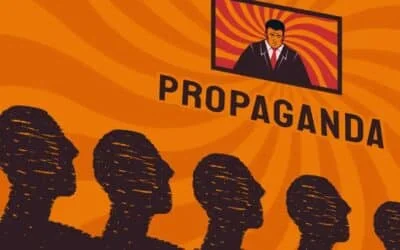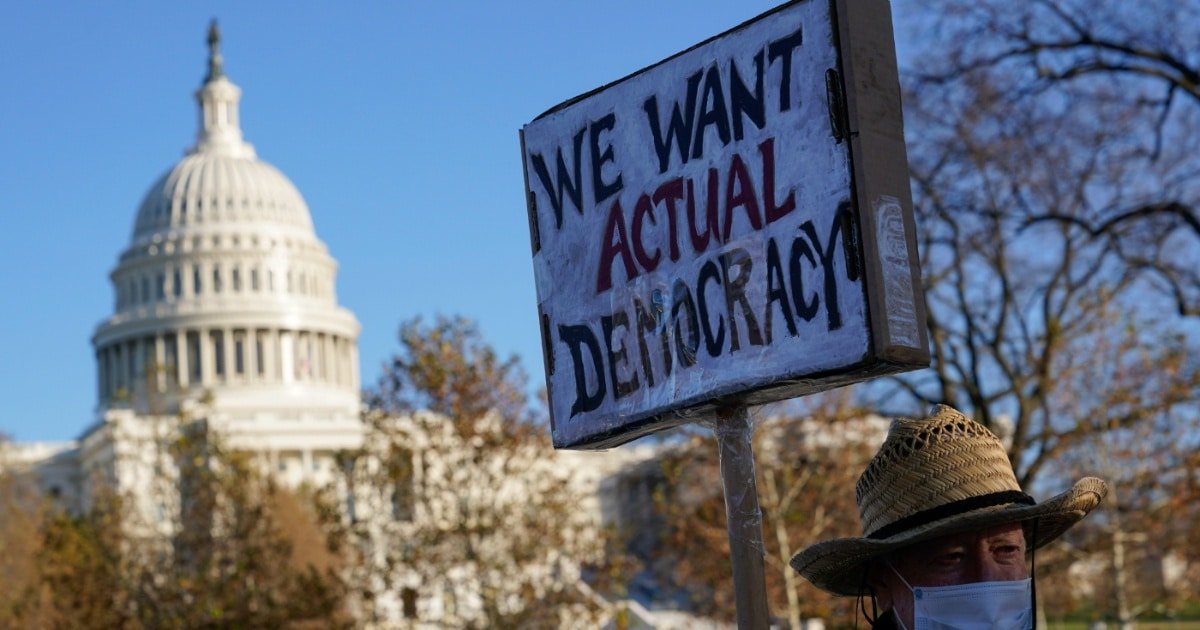


In recent years, political scientists have sounded the alarm on a “democracy recession” — a sustained global decline in liberal democratic governance. This trend is marked by the erosion of institutional checks and balances, curtailment of press freedoms, weaponization of disinformation, and consolidation of power in executive hands. While the post-Cold War decades saw democracy as the presumed endpoint of political evolution, the 2020s are revealing a far more complex reality: populist strongmen, illiberal democrats, and openly authoritarian regimes are not only consolidating power at home but also reshaping global norms to legitimize their governance models.
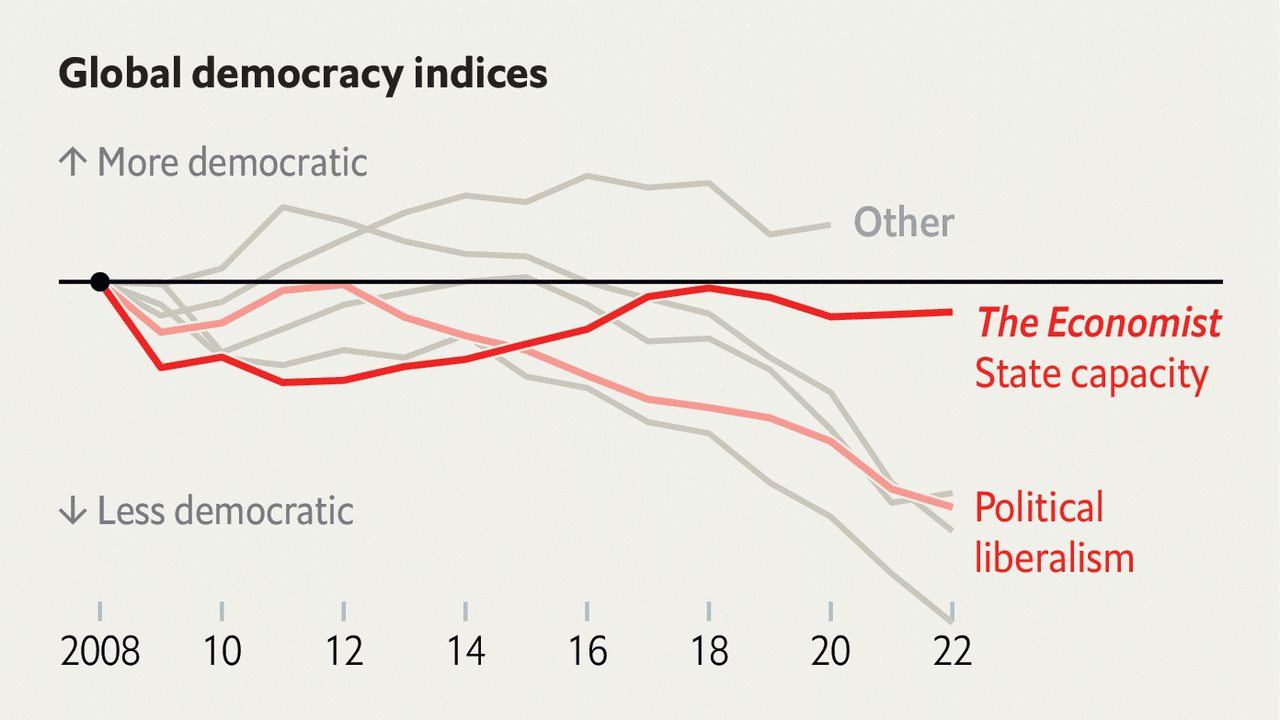
Source: The Economist
Mapping the Recession
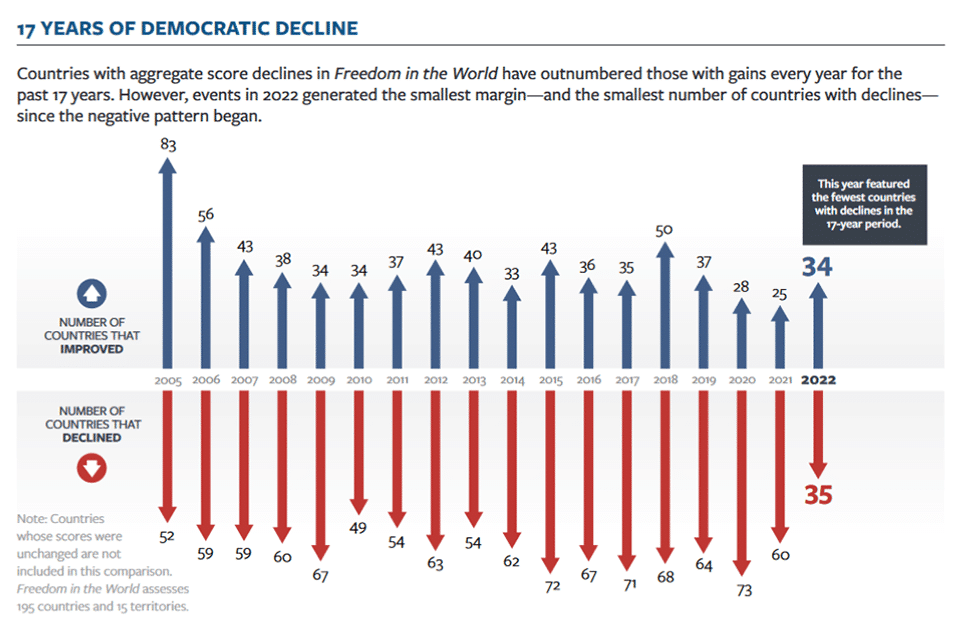
According to Freedom House’s 2025 report, the number of countries experiencing net declines in political rights and civil liberties has outpaced those registering gains for nearly 18 consecutive years. This downturn is not confined to fragile democracies; established ones, including the United States and parts of the European Union, are facing challenges from polarization, political violence, and institutional gridlock. Meanwhile, illiberal regimes in Russia, China, Hungary, and Turkey are actively promoting an alternative vision of governance — centralized authority with limited civic space, framed as more efficient and culturally authentic than liberal democracy.
Drivers of Backsliding
Several factors are converging to fuel this regression:
- Populist Nationalism – Leaders exploit public disenchantment with political elites and economic inequality, promising to restore “national sovereignty” often at the expense of minority rights and democratic institutions.
- Digital Authoritarianism – Governments deploy advanced surveillance tools, algorithmic censorship, and state-aligned influencers to suppress dissent and control narratives online.
- Geopolitical Realignment – The relative decline of U.S. influence and the rise of China’s state-capitalist model provide a viable alternative for countries seeking development without political liberalization.
- Crisis Politics – Pandemics, migration waves, and security threats have enabled emergency measures that become permanent fixtures, justifying restrictions on political freedoms.
You May Like To Read:
- Pakistan Establishes Diplomatic Relations with Micronesia
- Modi’s Extremist India: The Crumbling Facade of a Secularism
- Trump–Putin Summit in Alaska Seeks Ceasefire in Ukraine Amid High Diplomatic Stakes
Illiberal Globalism in Action
A notable feature of this democratic backslide is the rise of illiberal globalism — cooperation among authoritarian or semi-authoritarian states to reinforce their legitimacy internationally. In multilateral forums like the UN, illiberal states push back against human rights resolutions and promote non-interference doctrines, effectively shielding each other from criticism. The Shanghai Cooperation Organisation (SCO) exemplifies this model, offering member states economic and security cooperation without democratic conditionality.
Even global economic institutions are not immune; development financing from China’s Belt and Road Initiative (BRI) often comes with fewer governance-related strings attached than Western aid packages, making it attractive to governments resistant to liberal reforms.
Impact on International Cooperation
As illiberal norms gain traction, the dynamics of global governance shift. Democratic states face greater difficulty in rallying consensus on issues like human rights, humanitarian intervention, and electoral observation missions. Authoritarian governments, meanwhile, leverage strategic resources, technology exports, and diplomatic alliances to dilute liberal agendas in institutions like the Human Rights Council and the G20.
The result is a fractured international order where universal norms give way to plural “value systems,” eroding the universality of human rights. This creates policy paralysis on crises in Myanmar, Syria, or Sudan, where illiberal actors block decisive multilateral action.
Human Rights Advocacy Under Pressure
Human rights NGOs now operate in an increasingly hostile environment. Over 80 countries have adopted foreign agent laws or similar restrictions, framing advocacy work as interference or espionage. In digital spaces, coordinated disinformation campaigns discredit international observers, while “lawfare” — the strategic use of legal systems to silence critics — becomes a common tactic.
Pakistan, while maintaining a formal commitment to democracy, is not immune to these pressures. Polarization, restrictions on dissent, and strategic alignments with non-democratic powers risk constraining its own democratic resilience in an increasingly illiberal regional order.
A New Balance of Power
The democracy recession coincides with a global power transition. The United States and European Union find their ability to set global governance norms increasingly contested by a bloc of illiberal states with the economic and technological capacity to offer alternatives. While Cold War-era ideological competition was largely binary, today’s contest is multipolar, with varied governance models vying for legitimacy.
This shift is not merely academic; it will influence the future of trade norms, the regulation of emerging technologies, and the global climate agenda. If illiberal globalism becomes the dominant paradigm, international cooperation may become more transactional, driven by regime survival rather than shared principles.
Source: Democracy Without Borders
The Way Forward
Addressing the democracy recession requires a two-pronged approach: domestic democratic renewal and international coalition-building. Countries committed to democratic governance must tackle corruption, ensure equitable economic growth, and protect electoral integrity to rebuild public trust. At the same time, they need to form resilient alliances capable of countering illiberal influence in multilateral settings.
Investing in media literacy, protecting civil society, and supporting independent journalism are essential to counter digital authoritarianism. Moreover, multilateral development programs should prioritize governance reforms alongside economic aid, ensuring that efficiency is not achieved at the cost of liberty.
The democracy recession is not inevitable, but reversing it demands recognizing that democratic resilience is as much about safeguarding values as it is about delivering tangible outcomes for citizens. Without this, the 21st century could see not a clash of civilizations, but a convergence towards illiberal governance as the new global norm.