


A Rising Star: IT Exports Surge
Pakistan’s IT and IT-enabled services (ITeS) exports have grown exponentially. According to the State Bank of Pakistan: telecom, computer, and information services exports for July–May FY25 reached $3.47 billion, up nearly 19% year over year from $2.93 billion in the same period last year–reported Dawn.
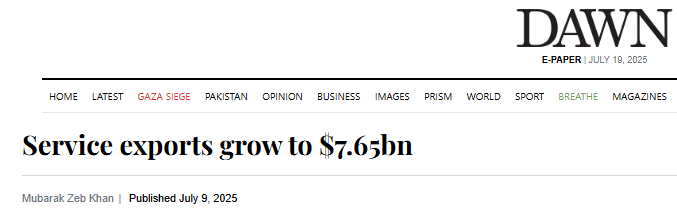
Source: Dawn
Meanwhile, the Annual Economic Survey reports IT exports at a record $3.2 billion in FY24; rising 24% from $2.59 billion the previous year. Freelancers alone brought in approximately $400 million, reflecting rapid growth in Pakistan’s digital gig economy. Combined, IT and ITeS now contribute over 10.5% of Pakistan’s total exports and nearly 41% of total services export earnings.
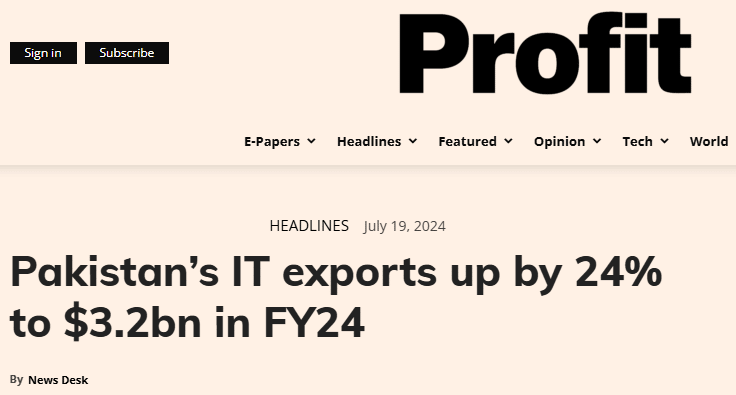
Source: Profit
Bridging the Trade Gap and Boosting Foreign Exchange Reserves
Pakistan’s overall trade deficit has been persistently large, especially in goods. However, services, where IT plays a major role, are making a difference. Telecommunication and IT services offset some of the widening deficit: the services trade deficit was moderated in FY25, narrowing by about 25% in May alone.
Importantly, Pakistan recorded a current-account surplus of $1.9 billion during July–April FY25, a remarkable turnaround from a $1.3 billion deficit in the same period a year earlier. This surplus has helped rebuild foreign exchange reserves to $16.6 billion by late May 2025—reported Trading Economics. IT’s positive trade contribution; nearly $2.8 billion in net exports in FY24 has been key. These inflows have alleviated pressure on the rupee and contributed to stabilizing Pakistan’s external account, alongside surging remittances.
Government Support: Enablers & Incentives
SBP Forex Policy
Incentives from the central bank have made a difference. It increased the permissible retention in Exporters’ Foreign Currency Accounts from 35% to 50%, encouraging IT firms to repatriate earnings to Pakistan.
Tax & Regulatory Support
The federal budget FY23–24 waived sales tax on software/hardware imports tied to exports (up to 1% of export value, capped at $50,000) and exempted freelancers earning up to $2,000/month from sales tax. These incentives reduce compliance costs and improve profitability for IT firms and freelancers.
URAAN Pakistan Strategy
Launched in December 2024, URAAN Pakistan, the National Economic Transformation Plan 2024–29 sees digital transformation (E‑Pakistan) as a key pillar. It targets boosting ICT exports, expanding the freelance economy, and promoting global competitiveness through strategic investments in digital infrastructure and skills.
Institutional Support
The Pakistan Software Export Board (PSEB) provides infrastructure development, market access, and incentives like 100% repatriation of capital/dividends and income‑tax credits (incentives extended through June 2025).
The Ministry of Information Technology & Telecommunication reported: During the first 11 months of the fiscal year 2019-2020 (July to May), Pakistan’s earnings from exporting Information Technology (IT) and IT-enabled Services (ITeS), including computer and call center services, increased to $1.11 billion. This represents a growth of 20.75% compared to the $917.875 million earned during the same period in the previous fiscal year (2018-2019).
Skilled Youth: The Talent Engine
Pakistan boasts a young, English-speaking population. Over 17,000 IT/ITeS companies serve global clients in software, ERP, BPO, and mobile services. Cities like Karachi host more than 3,000 software firms, and initiatives have been launched to train 10,000 students annually in AI, blockchain, and cloud computing.
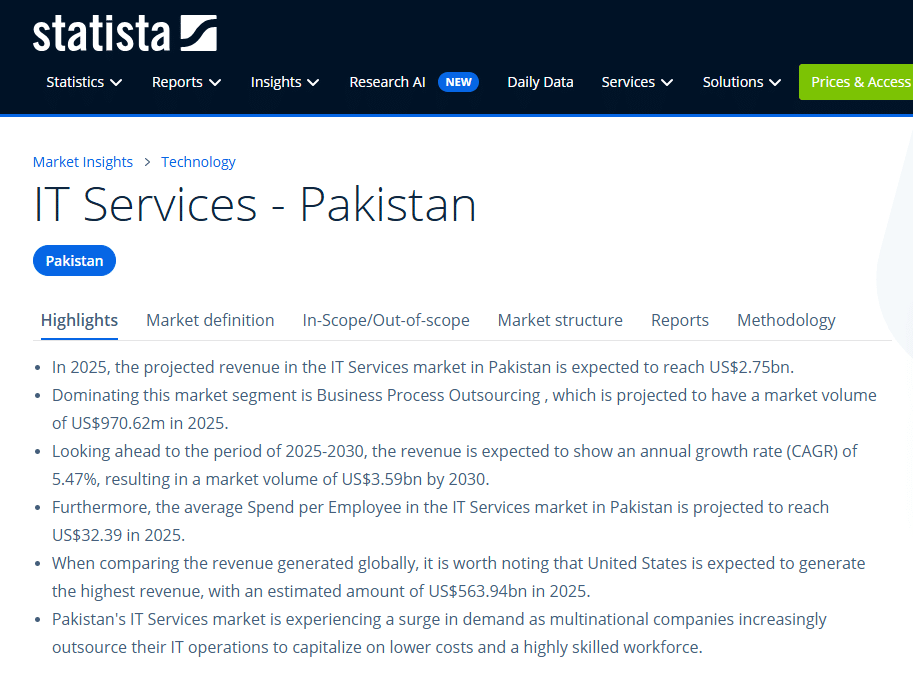
Source: Statista
Freelancers offer scalable, flexible talent. Their collective $400 million earnings signal an emerging digital workforce capable of delivering globally competitive services.
Export Destinations & Market Reach
Growth has not been limited to traditional markets. Pakistani IT companies are making inroads in the Gulf Cooperation Council (GCC), especially Saudi Arabia, where demand for software and IT services is growing. The digital gig economy has opened new frontiers overseas, exemplified by sustained and diverse project pipelines.
Future Potential & Challenges
Ambitious Targets
The economic survey sets a $15 billion IT export target over five years. Under URAAN, plans aim to more than double annual exports, driving Pakistan’s total exports to $60 billion by FY29. Arif Habib Research sees IT contributions reaching $3.1–3.2 billion in FY24, with room to grow toward $3.5 billion in FY25 as momentum continues.
Structural & Competitive Challenges
However, challenges remain:
- Infrastructure: Reliable electricity and high-speed internet are still limiting factors in many cities.
- Skill Gaps: Progressive training in advanced fields like AI and cybersecurity is still nascent, despite promising programs .
- Global Competition: Pakistan must stand toe-to-toe with larger regional players such as India and the Philippines.
- Retention & Repatriation: Ensuring talent and capital remain in Pakistan will require sustained policy consistency.
Broader Trade & Economic Impact
While goods exports remain dominated by textiles (about 53% of exports). Pakistan by exporting its services is now helping rebalance trade. The shift owes much to IT. With the current-account surplus fuelled by IT and remittances, Pakistan reduced extreme monetary instability. The State Bank paused interest rate cuts in March 2025 to guard against destabilization, demonstrating foreign-exchange resilience.
Conclusion
Pakistan’s IT sector has rapidly transformed from a niche export segment into a robust pillar of macroeconomic stability. Over just a few years, IT exports have nearly doubled; from $2.6 billion in FY23 to approximately $3.5 billion in FY25, marking a significant milestone in the country’s trade evolution. This growth has positively influenced Pakistan’s trade balance and strengthened foreign exchange reserves, providing much-needed stability to the external account. Central to this success is the country’s young, tech-savvy talent pool, which has thrived under supportive fiscal policies and institutional reforms.
Moreover, the government’s strategic pivot through the URAAN Pakistan initiative has placed digital growth at the heart of national economic planning. To sustain and scale this momentum, Pakistan must continue investing in high-speed digital infrastructure, advanced tech skills, and consistent policy frameworks. If these elements remain in place, the IT sector has the potential to become the crown jewel of Pakistan’s exports; helping to narrow the goods trade deficit, improve forex stability, and foster more inclusive economic development.
References:
- Ministry of Planning Development & Special Initiatives. 5es National Economic Transformation Plan 2024-2029. 2025,
- World Bank Group. PAKISTAN DEVELOPMENT UPDATE: Reimagining a Digital Pakistan. 2025,