




Pakistan’s forests are under siege. The timber mafia, an entrenched network of illegal loggers, corrupt officials, and powerful contractors, has long plundered the country’s woodlands. This illicit industry has led to the annual loss of approximately 43,000 hectares of forest, making Pakistan one of the most deforested nations in Asia according to the U.N. Food and Agriculture Organization (FAO). The National Forest Policy of 2015 stated that Pakistan’s total forest-covered area was only 5%, and the country was losing about 27,000 hectares of forests per year, mainly in private and community-owned natural forests in Khyber Pakhtunkhwa and Gilgit-Baltistan.
The Timber Mafia’s Grip
Illegal logging in Pakistan is a significant issue, with forests being felled at an alarming rate. The timber mafia has gained considerable power, especially in regions like Gilgit-Baltistan, Khyber Pakhtunkhwa (KP), and Balochistan. These areas are home to some of the country’s most valuable forest resources, including deodar, pine, and oak trees. However, these forests are being depleted rapidly due to the mafia’s activities, which not only harm the environment but also pose a threat to local communities.
In Gilgit-Baltistan, timber mafias operate with minimal resistance, often logging trees covertly under the cover of darkness. The mafia is well-connected, with reports indicating that they sometimes manage to bypass local law enforcement, making it difficult for authorities to track and prevent illegal logging. Similarly, in KP, the timber mafia has formed exploitative relationships with poor communities. These locals are often lured into felling trees in exchange for meager financial compensation. This corrupt system is destroying forests at an unsustainable pace, further threatening the environment.
Wajid Khan, the former Khyber Pakhtunkhwa Environment Minister, argues that the roots of the crisis lie in a flawed decision to permit private forest owners to cut down trees under the woodlot law. While the policy was initially aimed at managing forest resources, it unintentionally opened the door for illegal logging in both private and state-owned forests. The timber mafia swiftly took advantage of this loophole, accelerating the destruction.
By the time the provincial government intervened and imposed a ban on tree cutting, the damage had already been done. According to Khan, this delayed legislation and poor decision-making have severely endangered the once-thriving forests in regions such as Swat, Dir, Shangla, Kohistan, Chitral, Mansehra, and Abbottabad, which were vital to the area’s ecological balance.
You May Like to Read: The Durand Line Debate: International Law vs. Afghan Nationalism
The effects of illegal logging are devastating, leading to increased frequency of landslides, flooding, and soil erosion. The country’s already fragile ecosystem is being pushed to its breaking point, putting millions of people at risk.
A Legal Offensive: The New Legislation
In response to the growing crisis, Pakistan’s government has introduced a series of legal reforms aimed at curbing the influence of the timber mafia. In 2024, the Punjab Forest Department enacted amendments to the Punjab Forest Offences Rules, Punjab Forest Depot Rules, and Punjab Forest Transit Rules. These new rules significantly enhance penalties for illegal logging, making the consequences for engaging in this activity more severe. The revised regulations aim to strengthen enforcement mechanisms by improving monitoring systems and providing clear guidelines on how logging should be conducted legally.
These amendments are part of a broader national strategy to combat environmental crimes, including illegal timber extraction. The updated rules also impose harsher penalties, including extended prison sentences and heavy fines, on those found guilty of violating forestry regulations. The Punjab government promises a zero-tolerance approach towards the timber mafia, backed by robust legislative and enforcement measures.
Source: Business Recorder
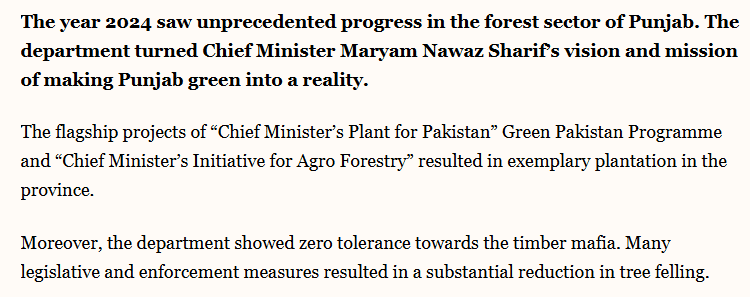
In 2024, significant amendments were made to the Punjab Forest Offences Rules, the Punjab Forest Depot Rules, and the Punjab Forest Transit Rules to increase penalties and streamline enforcement against illegal logging. As a result, 1,361 FIRs were registered against violators, leading to the recovery of fines totaling Rs 11.5 million. A substantial number of 1,184 cases in total have been brought before the courts. These measures have led to a marked reduction in tree felling, reflecting the government’s commitment to combating deforestation. Additionally, the province has launched GIS-based forest monitoring systems, incorporating artificial intelligence and remote sensing technologies to track illegal logging activities and prevent forest fires, further enhancing the protection of valuable forest resources.
A Landmark Judgment on Environmental Rights
The Mehar Badshah v. Government of Khyber Pakhtunkhwa ruling by the Supreme Court is a landmark decision that establishes the “Right to a Healthy Environment” under Article 9A of Pakistan’s Constitution. The case stemmed from the illegal felling of 218 Shisham trees in KPK, exposing widespread deforestation driven by the timber mafia and inefficiencies in the Forest Department. Justice Jawad Hasan noted that KPK’s forest cover was shrinking by 27,000 hectares annually, exacerbating landslides and reducing carbon absorption. The court criticized the KPK government’s negligence and held that this environmental degradation violated the fundamental right to life and the newly introduced right to a healthy environment. While the judgment sets an important precedent, its practical impact depends on overcoming institutional weaknesses and ensuring robust enforcement of environmental laws to bring about real change.
You May Like to Read: The Green Underworld
Military Involvement & Local Resistance
The military’s role extends beyond enforcement. In Gilgit Baltistan, the military has assisted in combating illegal logging and dismantling illegal sawmills. This collaboration underscores the state’s commitment to preserving forest resources. However, the timber mafia’s influence persists, with reports of political backing enabling their activities . This nexus between illicit loggers and influential figures complicates enforcement efforts and necessitates comprehensive reforms.
Broader Implications
The consequences of unchecked deforestation are far-reaching. Beyond the immediate loss of timber, illegal logging has long-term environmental and social implications. Deforestation exacerbates climate change by reducing the amount of carbon dioxide that can be absorbed by trees. The loss of forest cover also disrupts the water cycle, increasing the likelihood of floods and landslides in mountainous areas. The depletion of natural resources further harms local communities, who depend on forests for their livelihoods and protection from natural disasters.
Pakistan’s battle against illegal logging is thus not just about protecting trees but also about ensuring the country’s environmental stability and security. As forests disappear, so too does the country’s ability to cope with the increasingly unpredictable effects of climate change
Conclusion
Pakistan’s battle against the timber mafia is a critical component of its environmental governance. Through stringent legislation, military involvement, and community engagement, the country is taking decisive steps to protect its forests. However, sustained efforts are required to dismantle the entrenched networks that facilitate illegal logging. Only through a concerted and transparent approach can Pakistan hope to safeguard its invaluable forest resources for future generations.