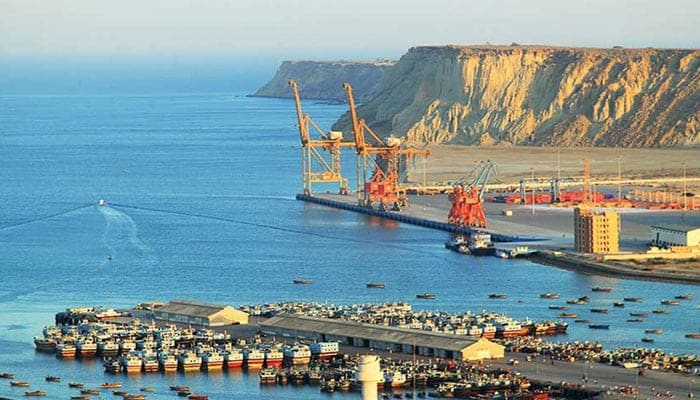





The ongoing development of Gwadar under the China-Pakistan Economic Corridor (CPEC) is establishing a robust structural foundation for Pakistan to emerge as a strategic trade, logistics, and investment hub, commercial ambassador of the Pakistan China Joint Chamber of Commerce and Industry (PCJCCI), Adeel Munawar, declared on Thursday.
Speaking at a meeting at the PCJCCI Secretariat, Munawar cited key milestones from Pakistan’s Economic Survey 2025–26, noting that Gwadar has entered an operational phase characterized by integrated transport networks, free zone expansion, and green energy infrastructure.
Key Infrastructure and Operational Milestones
Munawar outlined critical developments driving Gwadar’s economic integration and operational efficiency:
Gwadar Operational Development Pillars:
- Transport Links: Eastbay Expressway connects port, free zones & Makran Coastal Highway
- Sea-Air Logistics: New Gwadar International Airport integration with port facilities
- Industrial Base: Gwadar Free Zone master planning completed across 2,281 acres
- Energy Infrastructure: Proposed 40 MW power plant + 9.7 MW solar PV system with battery storage
Multimodal Logistics & Connectivity
-
Eastbay Expressway Operationalization: The completion of the expressway has streamlined freight transport between Gwadar Port, the industrial free zones, and the Makran Coastal Highway, cutting transit costs and accelerating cargo movement.
-
Sea-Air Freight Synergy: Linking the New Gwadar International Airport directly with maritime port infrastructure lays the groundwork for integrated sea-air transshipment operations, boosting Gwadar’s attractiveness for international trade.
Industrial Expansion & Utility Integration
-
Gwadar Free Zone Progress: Master planning and feasibility assessments covering 2,281 acres have been finalized, supporting ongoing construction of commercial and industrial units.
-
Commercial Shipping Confidence: Regular international container shipping services demonstrate growing commercial reliance on Gwadar’s deep-sea capabilities.
-
Energy and Water Security Projects: Plans for a 40 MW power plant, alongside a 9.7 MW solar photovoltaic system with battery energy storage to power 24 water pumping stations and a desalination plant, aim to lower operational costs and secure local utility supplies.
Vitol’s barge Marine Ista delivered Cnergyico-produced VLSFO to an LNG carrier at Gwadar, marking another step toward making Pakistan’s port a regional marine fuel hub for international shipping.
Read more at:https://t.co/5a7PlU1Ctv pic.twitter.com/g2OrvMJjnR— Profit (@Profitpk) July 28, 2026
Strategic Analysis: Unlocking CPEC’s Industrial & Logistics Potential
Adeel Munawar’s assessment highlights Gwadar’s ongoing transition from foundational civil infrastructure toward commercial monetization:
Transitioning to a Multimodal Transshipment Gateway
The integration of deep-sea port terminals, dedicated highway corridors, and an international airport positions Gwadar as a natural transshipment hub for landlocked Central Asian Republics (CARs) and western China. Establishing functional sea-air logistics enables high-value, time-sensitive freight to move efficiently across regional supply chains.
Mitigating Utility Bottlenecks via Solarization
Utility availability—specifically reliable power and industrial water—has historically presented operational challenges for investors in coastal Balochistan. Solarizing water pumping stations and establishing dedicated power generation directly resolve these constraints, lowering operating expenses for manufacturing entities operating within the Gwadar Free Zone.
Public-Private Collaboration for Sustained Investment
With transport links and port infrastructure operational, maximizing Gwadar’s economic output will depend heavily on public-private coordination. Maintaining investor-friendly regulatory environments, competitive port tariffs, and streamlined joint venture mechanisms will prove essential in converting infrastructure projects into long-term industrial production and regional trade volume.