


India is often lauded as a rising military power, backed by an arsenal of imported high-end equipment from the world’s most advanced defense suppliers—fighter jets from France, missile systems from Russia, and increasingly deepening ties with the U.S. defense-industrial complex. Yet, despite its sophisticated inventory, the Indian military—particularly its air force—faces a credibility gap when assessed through the lens of combat experience, operational readiness, and real-world deterrence.
A Technological Edge That Has Yet to Be Tested
India’s Rafale multirole fighters, purchased from France’s Dassault Aviation, were touted as game-changers upon their induction into the Indian Air Force (IAF) in 2020–21. Alongside the S-400 Triumf air defense systems from Russia and increased access to U.S. strategic reconnaissance and targeting data under the COMCASA agreement (source), New Delhi projected itself as a formidable air power in South Asia.
However, despite these acquisitions, India’s operational record reveals a surprising lack of strategic impact. During the 2019 Balakot air strikes, Indian jets failed to demonstrate tactical superiority and, notably, lost a MiG-21 to a Pakistani JF-17, leading to the capture and subsequent return of Wing Commander Abhinandan Varthaman. Indian claims of shooting down a Pakistani F-16 remain unsubstantiated by independent assessments, including those by U.S. defense officials.
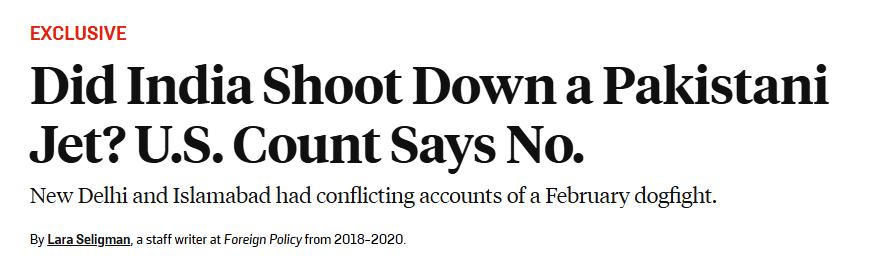
Source: Foreign Policy
Lack of Combat Experience: A Structural Weakness
Despite being one of the world’s largest standing forces, India’s military suffers from a critical lack of real-time combat experience. Exercises with Western allies—though advanced in simulation—cannot replicate the unpredictability, fluidity, and psychological pressures of kinetic warfare.
In contrast, India’s armed forces, particularly the Pakistan Air Force (PAF), have undergone decades of active combat. From high-altitude operations in Kargil (1999), sustained counterinsurgency in the northwest, to real-time aerial engagements with India in Operation Swift Retort (2019), Pakistan’s forces have consistently refined doctrine through real-world engagements.
Moreover, Pakistan’s ability to integrate Chinese systems such as the JF-17 Thunder, HQ-series air defense systems, and ongoing stealth and AEW&C upgrades indicate a shift toward indigenous modernization, rather than pure import dependence.
Institutional Gaps and Maintenance Dilemmas in India
- Aging legacy platforms continue to plague the IAF. The MiG-21 “Bison” fleet, originally inducted in the 1960s, has been responsible for dozens of pilot fatalities in peacetime accidents, earning the moniker “flying coffin”.
- Inter-services coordination gaps, procurement bottlenecks, and an incomplete modernization of command-and-control systems further undermine India’s warfighting readiness.
In 2024, India’s CAG (Comptroller and Auditor General) report flagged serious readiness shortfalls across multiple combat wings, especially in the absence of spare parts, delays in infrastructure upgrades, and poor integration of new platforms.

Source: Tribune India
Pakistan’s Doctrine: Precision, Deterrence, and Strategic Messaging
Rather than building an arsenal for image projection, Pakistan’s military doctrine—particularly in airpower—focuses on precision engagement, deterrence posture, and regional stability. This was most notably demonstrated during the February 2019 standoff, where Pakistan’s response was measured, retaliatory, and carefully calibrated to avoid escalation, but robust enough to make its deterrent credible.
Joint exercises with China (Shaheen Series), rapid incorporation of PL-series air-to-air missiles, and planned acquisitions of the J-35A stealth fighter and KJ-500 AEW&C platforms signal a shift toward network-centric warfare, emphasizing real-time targeting, long-range engagement, and electronic dominance.
Superiority Is More Than a Shopping List
While India has undoubtedly invested billions in acquiring cutting-edge hardware, military efficacy is not determined by procurement alone. Without doctrinal clarity, real-world combat experience, and seamless integration, technological platforms remain underutilized assets.
In contrast, Pakistan’s combat-proven doctrine, superior pilot training, and focused modernization underscore a more agile and tactically mature force. The so-called “technological edge” of the Indian Air Force may therefore remain more rhetorical than real, especially when tested against a battle-hardened adversary in the skies.