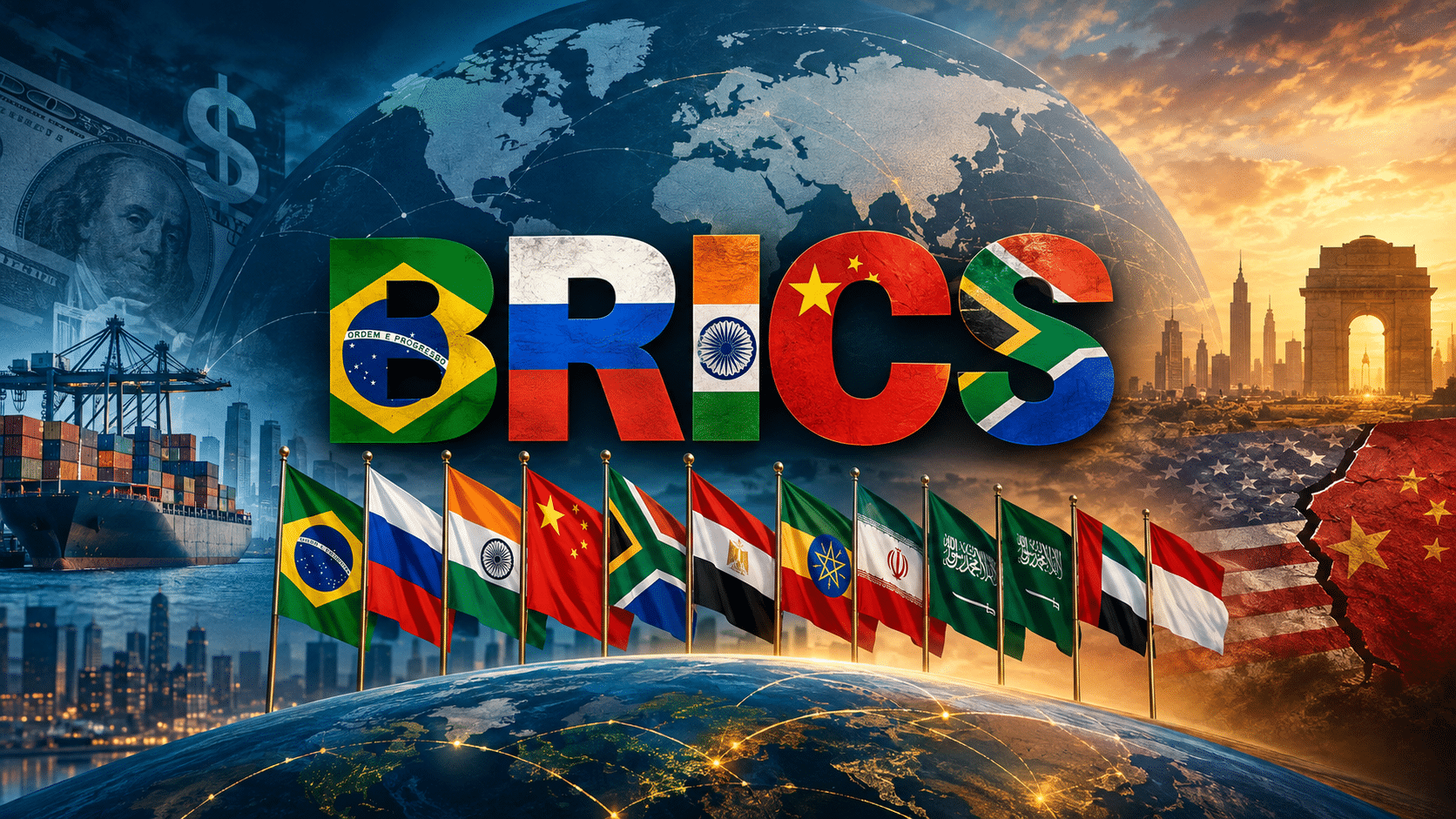



BRICS began as a group of five countries—Brazil, Russia, India, China, and South Africa—and now has eleven members. It has emerged as a bloc composed of a quarter of the global economy and half of the world population, which is quite understandable since two of the most populated countries on Earth, i.e., India and China, are in this bloc. India hosted the 18th BRICS Summit in New Delhi in September; subsequently, the bloc’s ambitions and internal fault lines have been at the heart of geopolitical debates. Here is a complete breakdown of;
- What BRICS is?
- How does BRICS work?
- What is the future of BRICS?
What is BRICS?
BRICS is an abbreviation made up of the initials of its five founding members, i.e., Brazil, Russia, India, China, and South Africa. The term was originally coined by Jim O’Neill, a Goldman Sachs economist, in the year 2001. He predicted that the emerging economies would eventually rival the G7. The first official BRICS Summit was held in 2009, hosted by Russia. A year later, South Africa joined the bloc, making it five nations.
The group has expanded considerably, especially in the years 2023 and 2024. Countries such as Egypt, Ethiopia, Iran, the Kingdom of Saudi Arabia, the United Arab Emirates, and Indonesia have also joined BRICS. Saudi Arabia has been invited; however, it has yet to formalize its membership.
A “Partner Country” category was also created for nations like Belarus, Nigeria, Malaysia, Kazakhstan, and Uganda, allowing them to join summit discussions without full membership. Beijing and Moscow call this expanded coalition the “Greater BRICS.”
Why BRICS Matters
Unlike the North Atlantic Treaty Organization (NATO) or the United Nations (UN), BRICS is not a treaty-based organization. Therefore, BRICS has no charter, secretariat, or permanent headquarters. It functions differently, like a loose, consensus-driven coalition built around mutual goals and shared grievances. What are the grievances? The Western-dominated institutions like the World Bank, IMF, and UN Security Council do not reflect the economic weight of the Global South.
BRICS key objectives or core priorities are:
- Reforming global governance by pushing for expanded representation in multilateral institutions and bodies like the UNSC.
- Coordinating economic policy; members would coordinate trade, tariffs, and investment decisions.
- Reducing dependence on the U.S. dollar. De-dollarization through trade in local currencies. Depicting more ambition, a proposed common BRICS currency.
- Establishing alternative financial institutions. The New Development Bank (NDB) and the Contingent Reserve Arrangement (CRA) have been established as counterweights to the World Bank and IMF.
The New Development Bank has approved more than $32 billion for almost a hundred projects since 2016. The grants focus on clean energy and infrastructure development. However, its grants are considerably smaller than the World Bank’s. Critics argue that the NDB has replicated the practices of the institutions it was meant to rival rather than reinventing them.
What happened at New Delhi Summit?
The 18th BRICS Leaders Summit was hosted in India at the Bharat Mandapam in New Delhi between September 12-13, 2026. The Summit’s theme was “Building for Resilience, Innovation, Cooperation and Sustainability.”
From plans on paper to a buzzing hub of global conversations – this is how we prepared for the 18th BRICS Summit!
🎥 International Media Centre during the 18th BRICS Summit in New Delhi.#BRICS2026 #BRICSIndia2026 #IndiaBRICSChairship pic.twitter.com/3V68vvWwpM
— BRICS 2026 (@BricsIndia2026) September 15, 2026
The gathering brought together prominent leaders from around the world. The most notable mentions were Russian President Vladimir Putin, Iranian President Masoud Pezeshkian, and Chinese President Xi Jinping—notably, it was Xi’s first visit to India in seven years. The meeting between Indian Prime Minister Modi and Xi was read as a cautious diplomatic thaw, especially since high-level contact between Delhi and Beijing had been frozen following the 2020 clashes in the Galwan Valley.
Security for the Summit was extensive; almost 30,000 personnel were deployed across New Delhi owing to the gravity of the high-level gathering. What makes this Summit even more important is the backdrop of renewed hostilities in the Gulf between Houthis and Saudi Arabia and the lingering tensions between the United States and Iran. The delegates issued a joint statement expressing concerns about escalation in the Middle East and urging the conflicting parties to exercise “Maximum Restraint.”
Beijing used the Summit to push the Greater BRICS initiative, including a proposed “BRICS AI Open Source Zone“ to promote cooperation on large language models. China also proposed a BRICS Special Economic Zone partnership, modeled on the Belt and Road Initiative, with a trade forum planned for next year.
Cracks Beneath the Cooperation
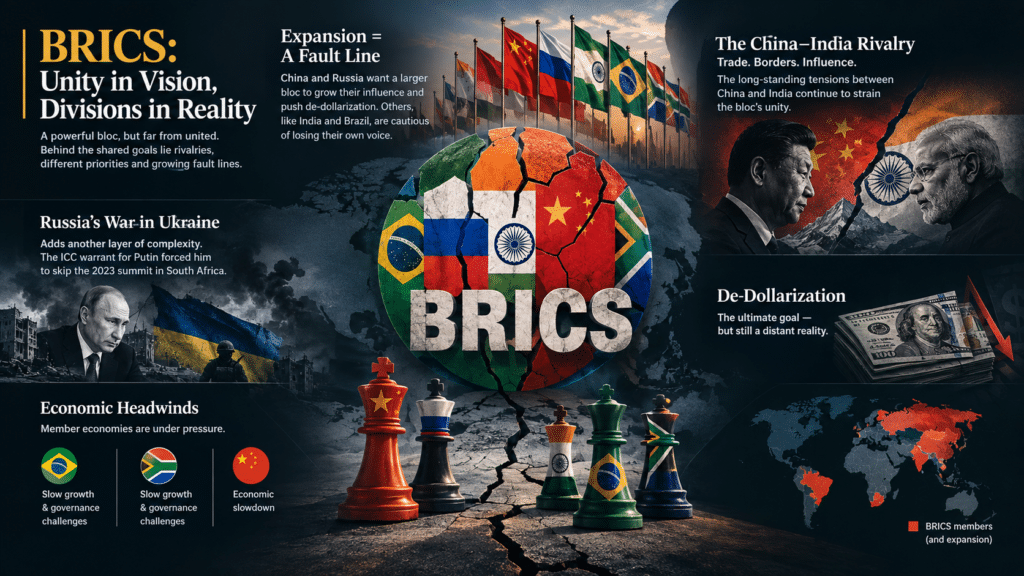
As far as the diplomatic posturing is concerned, everything was spot on. Nevertheless, BRICS is a bloc defined more by its internal fault lines and divisions than by its unity.
In BRICS’ case, expansion itself is a fault line. China and Russia certainly want to expand their influence and align the global economies in their camp to push for de-dollarization, understandably, to challenge U.S. dominance. However, countries like India and Brazil are wary of China and Russia’s growing influence, even if it means diluting their own. The rivalry between China and India—over trade, border security, and Chinese hegemony in the Global South—is at the heart of the bloc’s tensions.
Moreover, Russia’s war in Ukraine adds another layer of complexity, especially for countries trying to establish good ties with Washington. An International Criminal Court warrant for Putin’s compelled him to skip the 2023 summit in South Africa. Meanwhile, member economies are also under strain; for example, Brazil and South Africa are grappling with slow-paced growth and governance challenges. Meanwhile, China’s economic slowdown has dented the bloc’s overall momentum.
BRICS and De-Dollarization
De-dollarization is BRICS’ central agenda. It is one of the most publicized, doubted, and ambitious goals set by any multilateral bloc. However, the reality so far remains grim for BRICS’ ambitions since the U.S. Dollar continues to dominate global trade. Statistically speaking, 80% of global trade is carried out in U.S. dollars. Introducing a BRICS Currency would mandate an optimum level of fiscal, monetary, and logistical cooperation—the bloc is nowhere close to achieving that.
U.S. President Donald Trump dismissed BRICS’ relevance while threatening steep tariffs on countries attempting to de-dollarize. It underscored how serious Washington is about dollar hegemony and how seriously it takes the threats posed to dollar dominance.
What’s Next
The 18th Summit has concluded, so has India’s chairmanship of BRICS. The presidency will now rotate towards “Greater BRICS” consolidation. China will host the Summit in 2027. More than 30 countries, from Azerbaijan to Turkiye, have expressed interest in joining or partnering with the bloc. This suggests the coalition’s gravitational pull remains relevant, despite internal fault lines and cohesion issues. BRICS is a new organization; its first official Summit was held in 2009, and it is still a work in progress. Given evolving geopolitical power dynamics, BRICS’ dream of de-dollarizing global trade might eventually work out as multipolarity in the world increases. The fate of BRICS, whether it becomes a cogent counterweight to the Western-led institutions or not, depends on how the powerful members settle their rivalries and differences.
Frequently Asked Questions (FAQs)
1. What is BRICS?
BRICS stands for Brazil, Russia, India, China, and South Africa. The term was coined by Jim O’Neill, Goldman Sachs’ economist, in the year 2001. He predicted that the emerging economies would eventually rival G7. The first official summit of BRICS was held in 2009 hosted by Russia. A year later South Africa joined this economic-bloc, making it a bloc of five nations.
2. How many members of BRICS?
BRICS has five founding members i.e., Brazil, Russia, India, China, and South Africa. The group now also includes Egypt, Ethiopia, Iran, Kingdom of Saudi Arabia, United Arab Emirates, and Indonesia. Nations like Belarus, Nigeria, Malaysia, Kazakhstan, and Uganda are in the category of “Partner Country.”
3. Where was the first summit of BRICS hosted?
The first official summit of BRICS was held in 2009 hosted by Russia. A year later South Africa joined this economic-bloc, making it a bloc of five nations.
4. Where was the latest BRICS Summit hosted?
The 18th BRICS’ Leader Summit was hosted in India at the Bharat Mandapam in New Delhi between September 12-13, 2026. The theme of the summit was, “Building for Resilience, Innovation, Cooperation and Sustainability.”