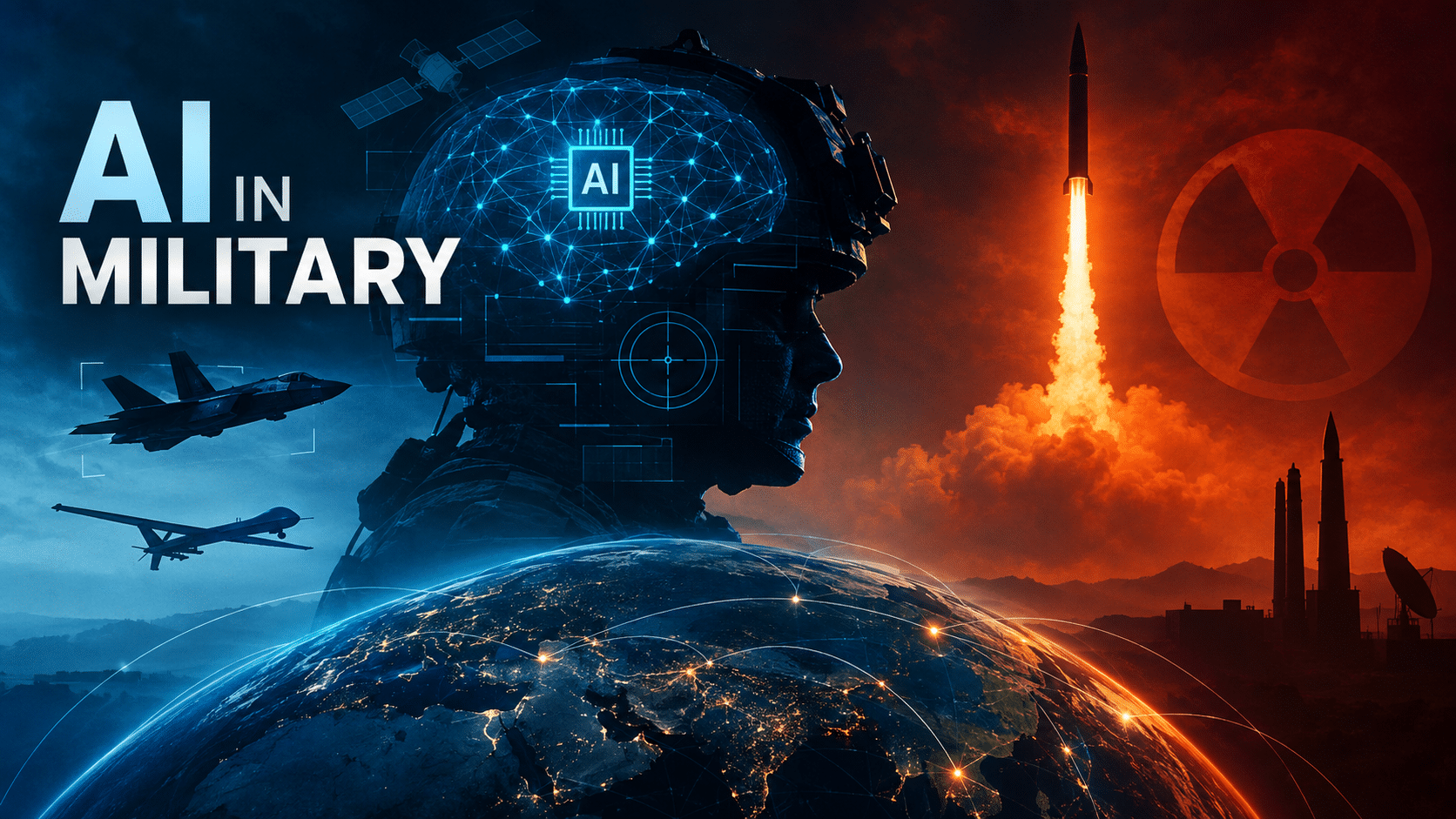





Global military spending on artificial intelligence is surging; it doubled in a single year, reaching $9.2 billion in 2023. Previously, it was around $4.6 billion. In 2026, the artificial intelligence in the military market is now valued at a staggering $13.78 billion. It is expected to reach $38.8 billion by the year 2028.
Military spending on artificial intelligence is driven by more than autonomous weapons manufacturing. This shifting trend underscores the conviction among defense establishments that whoever processes information faster and more accurately can dominate kinetic warfare.
Artificial intelligence is directly linked with nuclear stability. AI is being utilized to upgrade early warning surveillance, targeting, and missile defense systems—and every nuclear-armed state is employing it. The pace of this integration is so rapid that international law has not kept up.
There is a global consensus that AI should never be allowed to control missile launch. However, AI is embedded so deeply in the broader strategic weapons complex that it could push states toward nuclear use, even unwillingly.
Money Tells the Story
United States is the prime example in this context. The request for the U.S. defense budget for FY2026 was $1 trillion, of which $13.4 billion was dedicated solely to autonomy—the first time the Pentagon has set aside a defense budget exclusively for AI integration into the broader defense system. The defense budget request for FY2027 is even more staggering, seeking roughly $29.5 billion for next-generation AI supercomputers and securing data centers under the new “AI Arsenal” initiative. Thus, deploying commercial AI models for battle management, threat identification, and logistical support.
China, on the other hand, has fused civil and military, thus creating a continuous pipeline from commercial AI laboratories into military deployment. Precise figures are not available, but compared with India’s spending, China’s is 30 times higher.
India does not even come close to the major powers in terms of AI-military spending. Nevertheless, it is taking significant initiatives to this end. New Delhi established the Defense AI Council and the Defense AI Project Agency in 2019, with a $12 million annual budget for DAIPA. Each service headquarters has also earmarked another $12 million annually for AI-specific applications. India’s dedicated annual military-AI expenditure is $50 million. Indian analysts have proposed dedicating 1% of the defense budget exclusively for AI.
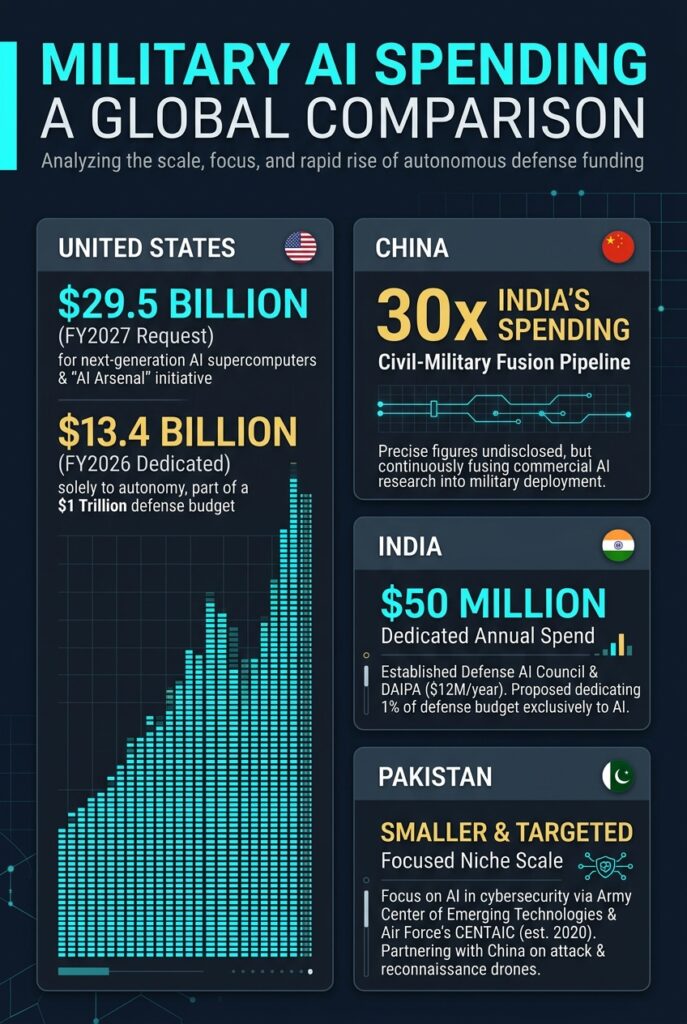
Pakistan’s plan is more novel and smaller in scale. Pakistan Air Force established CENTAIC in 2020 for military and civilian AI research. Pakistan Army also created an Army Center of Emerging Technologies under its Cyber Command. Focused predominantly on AI in cybersecurity. Islamabad, in collaboration with Beijing, has produced attack and reconnaissance drones.
Artificial Intelligence and Nuclear Architecture
AI is neither bolted into the arsenal nor is it a warhead. It is deployed in five layers:
- Early warning systems
- Intelligence and surveillance
- Command and control
- Delivery platforms
- Cybersecurity at nuclear facilities
In the defense architecture, AI is most useful for sensing. Machine learning integrates satellite feeds, ground sensors, and UAV data to process information faster than analysts can. AI can flag launches and anomalies within seconds. Ballistic and cruise missiles have always been pre-programmed. In this context, AI is refinement, not revolution.
AI is being integrated outside the nuclear domain, particularly in cyber operations, electronic and information warfare, reconnaissance, air defense, space assets, and ballistic missiles. Automatic target detection has been part of missile technology; adding AI makes interception faster and more precise.
AI Limitations
AI is not perfect. It also has limitations; combined with human neglect or error, the repercussions could be devastating. Hypersonic weapons are already squeezing the response windows from hours to minutes. AI-driven decision systems compel commanders to act faster, leaving little room for deliberation. This leaves ample room for miscalculation. Algorithmic bias, automation bias, and unfamiliar conditions can generate hallucinated results. Adversaries or non-state actors could trick the AI detection systems, manipulate targeting inputs, turn off early-warning radars, and even penetrate command networks.
The Second-Strike Problem
Survivability is increasingly vulnerable in this evolving landscape. Deterrence is effective because it lets the retaliatory force hide its submarines and keep launchers moving. However, AI-assisted satellite surveillance and pattern analysis can neutralize that element of surprise and concealment. When a state believes that its second-strike force can be found and destroyed, it is compelled to act first—a practical demonstration of use-it-or-lose-it logic—for this reason alone, a small crisis can expand into a war.
South Asia Test-Case and AI Governance
South Asia is, without a doubt, the most dangerous test case for AI-Nuclear Deterrence. Because of geographic proximity, missile flight time is reduced to three to five minutes. Thus, leaving no room for crisis verification or human contemplation. This would compel the nuclear-armed neighbors to adopt AI to preserve their “Full Spectrum Deterrence.” This would be a zero-sum game, stripping away decision-making time for both sides and increasing the risk of catastrophe.
Given surging global volatility and the widespread adoption of AI in military establishments, AI governance becomes crucial. Despite all these factors, international governance remains non-binding; there are no limitations on AI for the establishment of destructive mechanisms, and even if there were, no state would adhere to it in the race to gain a strategic edge over their adversaries.
Voluntary declarations, UN resolutions, and global summits have debated AI governance, attempting to mandate human control over nuclear command systems. These efforts are largely symbolic and lack enforceability. Meanwhile, billions of dollars are being poured into military AI integration.
Way Forward
The international community should devise and legally bind unified global control mechanisms to prohibit fully autonomous nuclear strikes, ensure human control, and uphold UN safeguards. Nuclear dyads require AI-specific confidence-building measures, a code of conduct on military-AI use, a crisis channel, and persistent Track 1.5/2 dialogues. These measures do not intend to freeze or halt the usage of AI in the military sector; rather, they focus on maintaining realism. They would ensure that a human—not AI—identifies a false existential threat and makes the final decision.
Frequently Asked Questions (FAQs)
1. What are global Military-AI spendings?
Global military spending on Artificial Intelligence is surging; it doubled in a single year, reaching $9.2 billion in 2023. Previously, it was around $4.6 billion a few years ago. In 2026, the military artificial intelligence market is valued at a staggering $13.78 billion. It is expected to reach $38.8 billion by the year 2028.
2. How much has the U.S. spent on AI?
The United States’ FY2026 defense budget request was $1.01 trillion, of which $13.4 billion was dedicated solely to AI and autonomy. The defense budget request for FY2027 is roughly $29.5 billion.
3. How is AI integrated into the military architecture?
AI is neither bolted into the arsenal nor is it a warhead. It is deployed in five layers: early warning systems; intelligence and surveillance; command and control; delivery platforms; and cybersecurity at nuclear facilities.