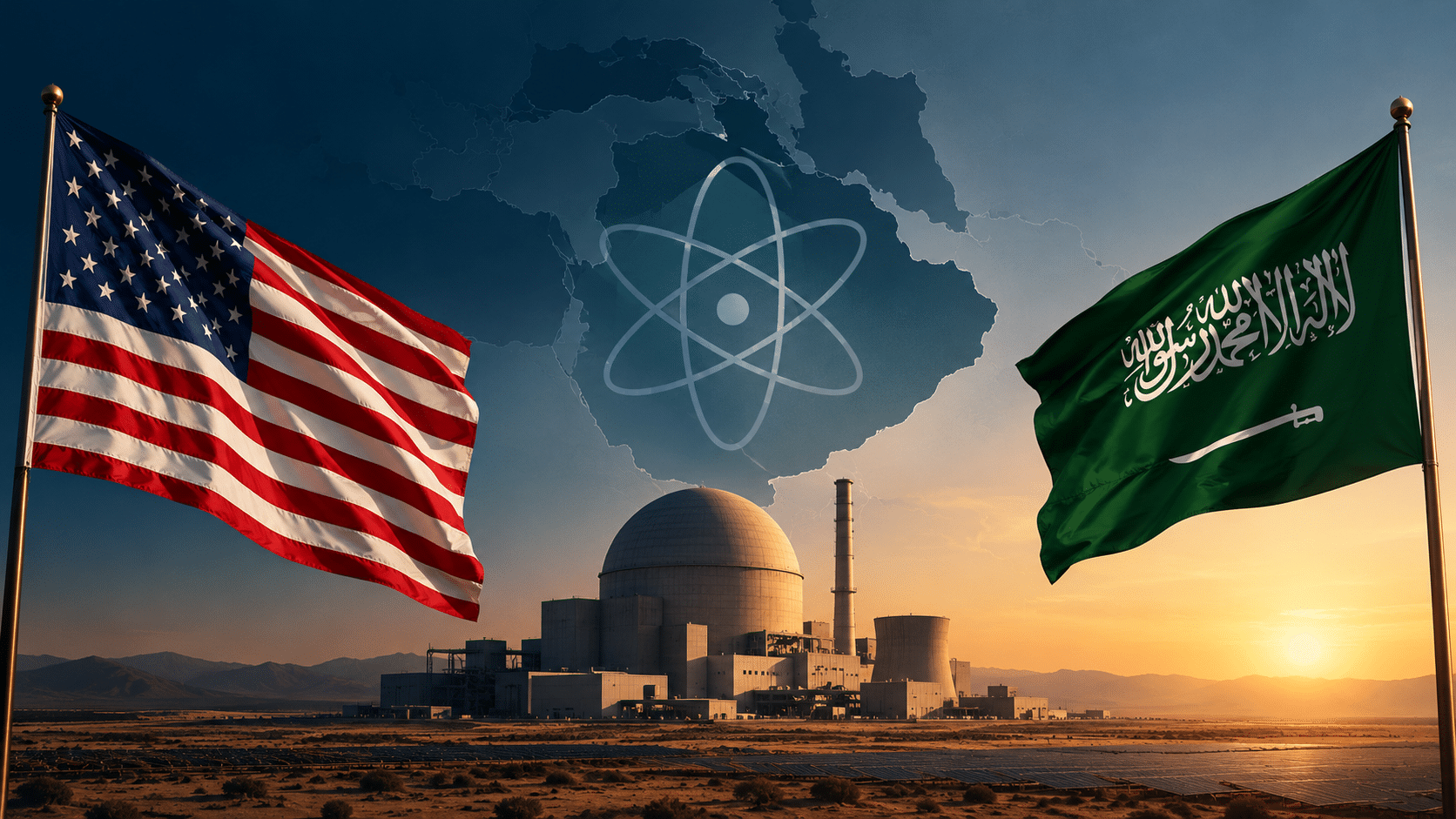




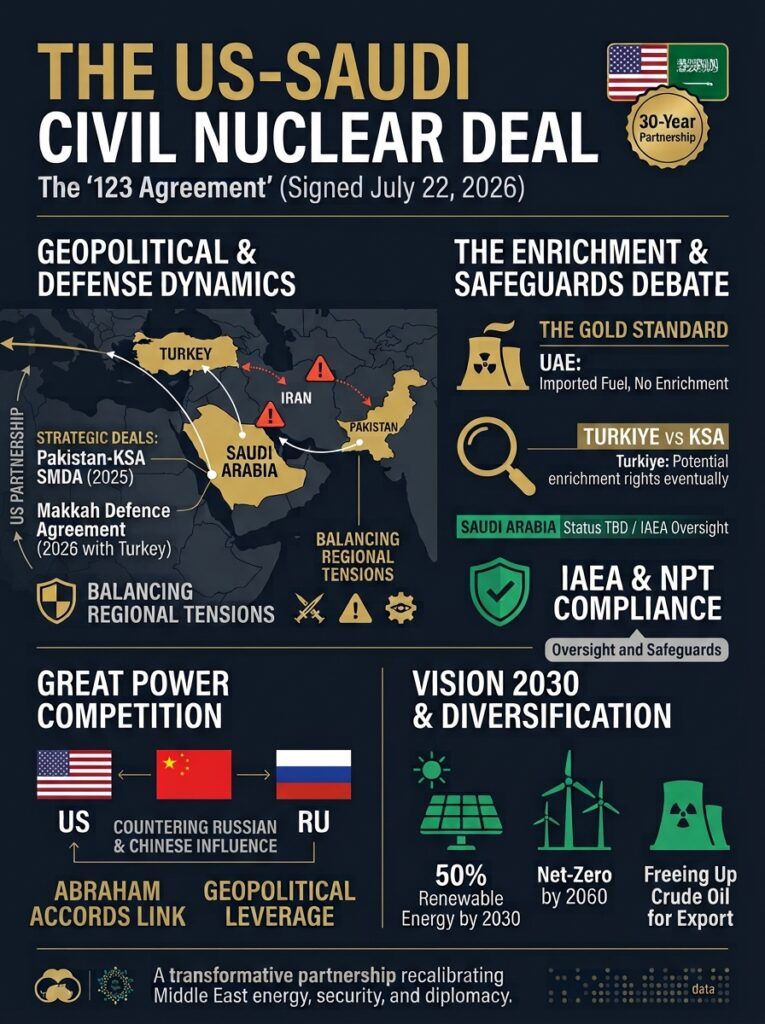
On July 22, 2026, the United States and Saudi Arabia signed a landmark Civil Nuclear Cooperation Agreement, commonly referred to as the US-Saudi Nuclear Deal of 2026. The Nuclear Cooperation Agreement is a 30-year partnership to develop KSA’s peaceful nuclear energy sector.
In policy circles, this agreement is called the “123 Agreement,” after Section 123 of the U.S. Atomic Energy Act of 1954. The US-Saudi Nuclear Cooperation Agreement has become one of the most watched developments, understandably, given the volatile security dynamics in the Middle East. This deal brings prominent nuclear firms like American Westinghouse into Saudi Arabia’s energy ambitions.
At the same time this deal has stirred the debate regarding nuclear proliferation in a very volatile region—where Iran was accused of, and then attacked for developing nuclear weapons, despite Tehran repeatedly denying the allegations levelled primarily by Israel. The conflict between the U.S. and Iran remains unresolved to date.
The defense and security cooperation agreement signed between Pakistan and Saudi Arabia in September 2025, referred to as the Strategic Mutual Defense Agreement (SMDA), and the Joint Makkah Defence Agreement—signed in 2026 between Saudi Arabia, Pakistan, and Turkiye—adds another dimension in the evolving nuclear and defense landscape of Gulf.
Details of US-Saudi Nuclear Deal
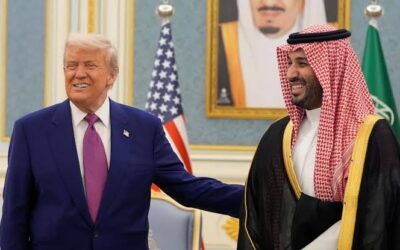
The Crown Prince of KSA, Mohammad bin Salman, visited Washington in November 2025, where the two sides committed to a government-to-government, multi-billion-dollar, multi-decade nuclear partnership. The joint statement issued by the U.S. Department of Energy and the Saudi Energy Ministry confirmed that the agreement includes a bilateral safeguards framework. U.S. officials also confirmed that the partnership will comply with rigorous safety and nonproliferation standards.
It is worth noting that the US-Saudi Nuclear Deal is not unprecedented. The U.S. has signed 26 similar 123 Agreements with countries around the globe as part of its policy to pursue 20 new nuclear cooperation agreements by 2028. Other Middle Eastern countries such as the UAE, Turkiye, and Egypt have signed similar agreements, but with different terms.
In the UAE’s deal, the U.S. implemented the “Gold Standard,” whereby enriched fuel will not be produced locally; rather, it will be imported. In contrast, the deal with Turkiye, signed in 2008, does not strip Ankara of the right to pursue enrichment eventually.
Whether Saudi Arabia’s deal will include domestic uranium enrichment and reprocessing capability remains the central unanswered question. President Trump stated after the signing that the agreement does not involve enrichment of nuclear material, even as independent analysts continue to debate what the still-unreleased full text will ultimately allow.
Enrichment and Safeguards
Debate in international circles over this deal has focused on three aspects: enrichment, reprocessing rights, and verification mechanisms. Given the gravity of this deal and the concerns surrounding nuclear enrichment, there has been a lot of speculation. Regardless of misleading speculation, one must focus on what stakeholders have confirmed. As of now, the complete text of the agreement has not been made public; moreover, the debates are based on premises rather than documented facts.
However, some significant details have been confirmed. The Nuclear Agreement includes a bilateral safeguards component; moreover, Saudi Arabia is also a signatory of the Nonproliferation Treaty—a global agreement signed in 1970 that aims to prevent the spread of nuclear weapons, promote the safe use of nuclear energy, and total nuclear disarmament. Accordingly, as an NPT signatory, Saudi Arabia is directly under the International Atomic Energy Agency’s (IAEA) oversight. Therefore, Riyadh is allowed to develop peaceful nuclear energy infrastructure in accordance with the provisions of NPT and nonproliferation norms. However, it depends on how transparently the safeguard mechanisms are implemented.
U.S. officials have explicitly denied the possibility of weapons development. Energy Secretary Chris Wright said the agreement upholds the highest nonproliferation standards. Secretary of State Marco Rubio said Washington would never enter a deal that would entail proliferation risks. It remains to be seen whether these assurances from U.S. officials will satisfy skeptics, as it depends more on the final safeguard architecture.
Energy Diversification, Not Weapons Ambition
Saudi Arabia’s push for the nuclear deal is tied directly to its 2030 Economic Diversification Strategy, which aims to achieve 50% renewable energy by 2030 and net-zero carbon emissions by 2060. In this context, nuclear energy fits well within that plan to reduce dependence on domestically produced oil for power generation. It will automatically free up more room for crude oil export.
It is worth noting a technical detail here. Nuclear energy generation requires only 3-5% enriched uranium, whereas for the creation of nuclear weapons, the levels of enriched uranium should be 90%. Therefore, Saudi Arabia’s concerns about making nuclear weapons plummet considerably. Critics, however, opine that once the enrichment infrastructure is built, it can be upgraded over time to develop nuclear weapons. This is why safeguards and verification mechanisms remain central to the discussion.
US-Saudi Deal vs. US-India Nuclear Agreement
The US-Saudi Civil-Nuclear Deal is being compared with US-India Civil Nuclear Agreement signed in 2005. India is not an NPT signatory; nevertheless, the agreement with the U.S. allowed it to access international nuclear commerce following a Nuclear Suppliers Group waiver. As a result, India’s nuclear infrastructure—fast breeder reactors and enrichment plants—fell outside the oversight ambit of the IAEA and its safeguards.
Saudi Arabia, however, is different. Riyadh is an NPT signatory; therefore, the IAEA directly oversees it. India’s precedent, however, reiterates the importance of transparency and consistent safeguards enforcement.
The Bigger Political Picture
The nuclear agreement between US-Saudi is not limited to generating safe energy. It also has a political dimension. Trump publicly linked the approval of this deal with Saudi Arabia’s eventual joining of the Abraham Accords. This deal also aligns with Washington’s strategy of countering Russian and Chinese influence in the global nuclear energy market, where exporting reactor technology also provides geopolitical leverage. The timing of this agreement also matters. Signed against the backdrop of the 2026 Iran War, the agreement signals continued U.S. commitment to its Gulf allies, particularly a partner that absorbed regional fallout from the broader U.S.-Iran conflict.
The Bottom Line
The Nuclear Cooperation Deal between Riyadh and Washington significantly recalibrates Middle East energy and security dynamics by blending legitimate economic diversification goals with unresolved questions about enrichment rights and verification. The success of this deal, and how it is viewed globally, hinges on whether the US-Saudi nuclear deal complies with global nonproliferation standards and demands. For Saudi Arabia’s allies like Pakistan, the deal is less a concern than a reminder that its own strategic future has become intertwined with the Gulf’s security architecture.
Frequently Asked Questions (FAQs)
1. What is the US-Saudi Nuclear Cooperation Agreement?
On July 22, 2026, the United States and Saudi Arabia signed the Civil Nuclear Cooperation Agreement, also known as the US-Saudi Nuclear Deal of 2026. The Nuclear Cooperation Agreement is a 30-year partnership to develop KSA’s peaceful nuclear energy sector.
2. What is the Nonproliferation Treaty?
Nonproliferation Treaty is a global agreement signed in 1970 that aims to prevent the spread of nuclear weapons, promote the safe use of nuclear energy, and achieve total nuclear disarmament.
3. Is Saudi Arabia pushing for renewable energy?
Saudi Arabia’s push for the nuclear deal is tied directly to its 2030 Economic Diversification Strategy, which aims to achieve 50% renewable energy by 2030 and net-zero carbon emissions by 2060.