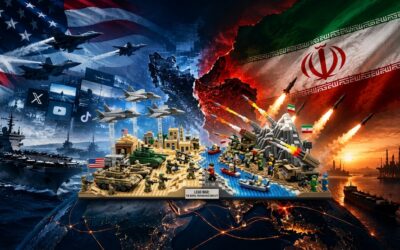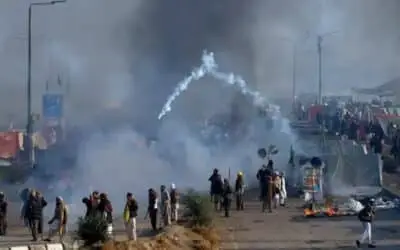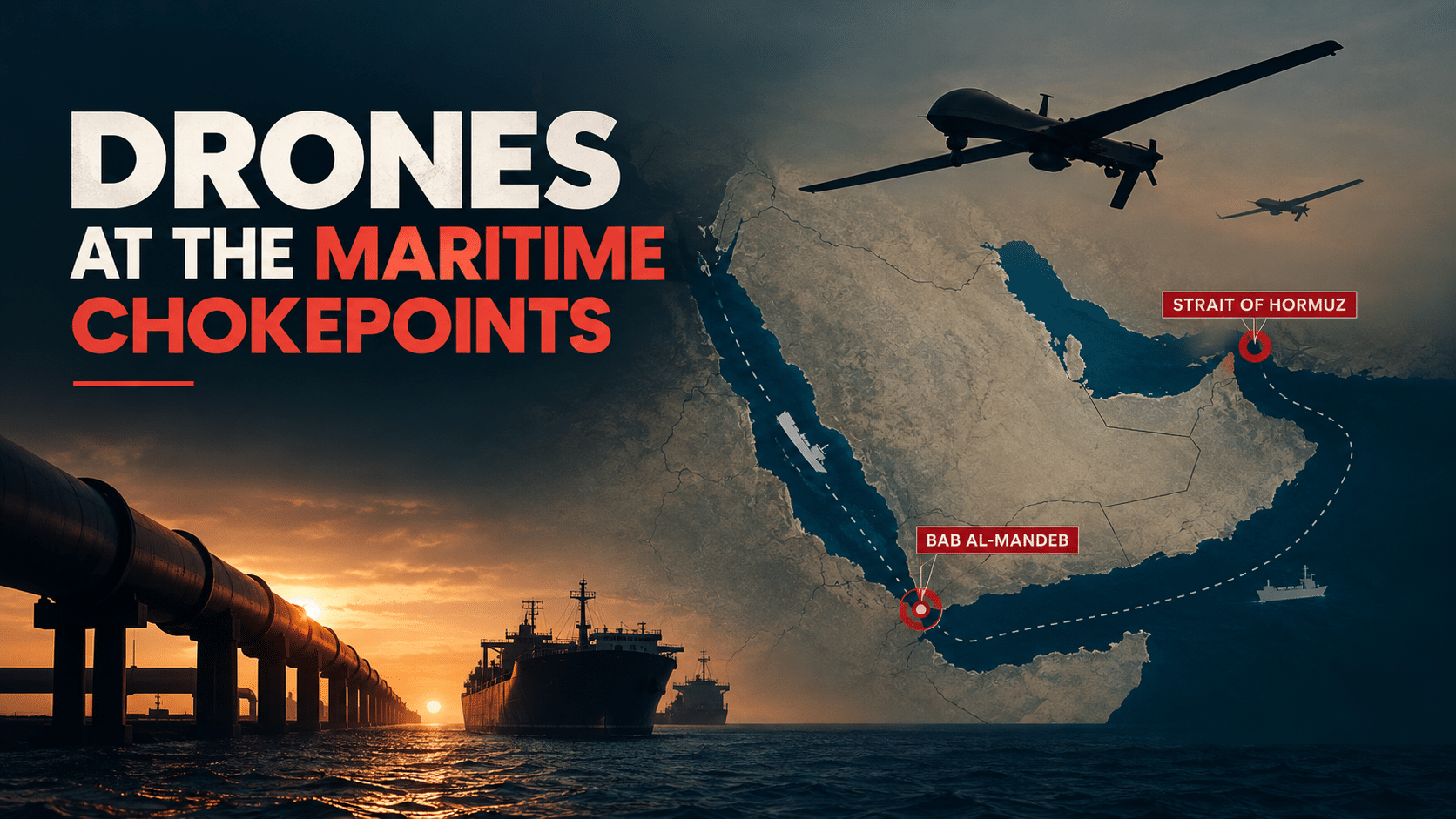





The Russia-Ukraine War brought a significant shift in drone warfare. This war taught the world how to fight with drones; since then, drones have been used in the Middle Eastern and South Asian Conflicts. Applying lessons from the war between Ukraine and Russia in the Middle East is painting a grim picture for global economies. Drone attacks launched from Iraqi territory have forced Saudi Arabia to shut down its East-West pipelines—the only alternative to the Strait of Hormuz. Simultaneously, Houthis have launched a drone and missile campaign to seize control of Bab al-Mandeb Strait, the narrow passage enabling trade between Europe and Asia. Two maritime chokepoints, numerous wars, one weapon system depict a singular reality: the age of cheap, deniable, difficult-to-intercept drone warfare has now reached the maritime chokepoints.
From Trenches to Tankers
Drone warfare has existed for a long time United States used drones in Afghanistan, but they were mainly used for reconnaissance or to strike a couple of missiles. However, drone warfare has now evolved, and so have the methods of operating them—we are witnessing kamikaze drones, drone swarm operations, and whatnot. Drone warfare was refined in Ukraine, where the warring parties utilized low-cost, mass-produced unmanned systems and turned it into a defining feature of modern warfare.
Ukrainian forces built an ecosystem of hobbyist engineers to churn out first-person-view drones—tens of thousands each month—and used them for frontline strikes, reconnaissance missions, and long-range raids on Russian airbases deep inside Siberia. Russia also institutionalized its own drone doctrine. The reconnaissance feeds were synced with artillery targeting, significantly reducing response and strike times.
The fact that a missile worth millions of dollars was used to shoot down low-cost drones made it pragmatic. During drone-swarm operations, some of the drones still managed to strike their targets and cause significant damage despite the efforts to shoot them down. The economic asymmetry has been learned and is now being used in the Strait of Hormuz, Bab al-Mandeb, and arguably the entire Middle East. Unsophisticated, low-cost drones are now achieving what in the past would have required naval blockades and aerial strikes.
Two Chokepoints, One Playbook
Saudi Arabia built the East-West Pipeline to move crude oil from Abqaiq to the Red Sea port of Yanbu, bypassing the Strait of Hormuz. The East-West Pipeline’s importance becomes evident today, when the Strait of Hormuz is blocked and alternative routes are urgently needed to sustain global energy demand. The drones, launched from Maysan province of Iraq, struck the pipeline near Riyadh and Medina; as a result, Saudi Arabia had to shut it down as a precaution.
Riyadh’s response was restrained; instead of retaliating, they honored the request from Iraqi officials to deal with the militias operating from their territory themselves. However, the right to retaliate explicitly remains reserved if the attacks from Iraq persist.
#Statement | The Foreign Ministry expresses the Kingdom of Saudi Arabia’s strongest condemnation of targetting the East-West Pipeline in the Riyadh and Madinah regions by several drones launched from Iraq, which resulted in injuries and some damage that is currently being… pic.twitter.com/QFqSiMWQWr
— Foreign Ministry 🇸🇦 (@KSAmofaEN) September 11, 2026
What makes drone warfare complex is that it cannot be cleanly traced back to the state actor even when the damage is undeniable and tangible.
Iraq, considering the gravity of the situation, distanced itself from the strike, condemned the attack, and even dismissed a regional commander. Nevertheless, ambiguity persists around who is responsible for the attacks—since drones do not have markers indicating the militia, proxy, or non-state actor to whom they belong.
Further South, the situation has only escalated. Houthis have been operating with the same strategy and greater ambitions. Houthis declared a maritime blockade against Saudi Arabia, and they have been using drones and missiles to target tankers in the Red Sea.
Currently, the Houthis have seized the Yemeni Red Sea coastline and the islands that command the Bab al-Mandeb Strait. Thus, giving the Houthis a chokehold over one of the most important shipping lanes. Houthi forces even stated that the passage has been closed only to Saudi Arabia. They have now effectively turned a vital maritime chokepoint, a global trade route, into a tool of coercion against a rival state.
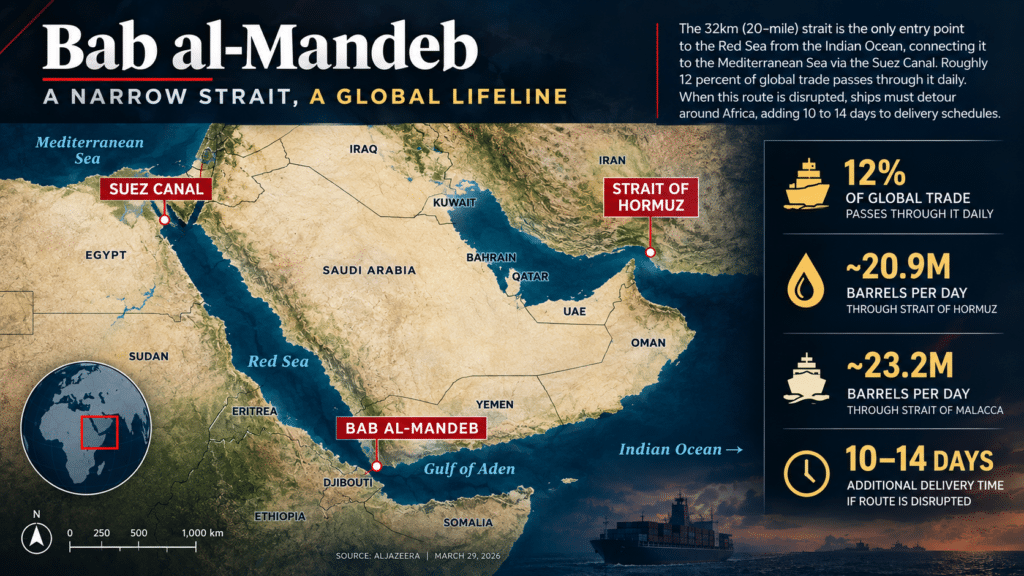
Maritime Chokepoint Bab al-Mandeb Strait
Why Militaries are Struggling to Keep Up?
The experience of NATO forces explains how cumbersome it has been for conventional militaries to keep up with the dramatic shift in warfare with the introduction of drones. Security alliances have so far focused on improving intelligence and surveillance integration, traditional defense procurement, and acquiring and deploying advanced platforms. However, their preparations cannot match the pace or the cost at which these drones are built and deployed.
Efforts to establish joint drone innovation hubs, counter-drone systems, jammers, and AI-assisted detection are underway; however, they still seem to lag behind the improvisational speed demonstrated by Ukrainian engineers and, now, Houthi and militia operators in the Middle East.
You May Also Want to Read: Maritime Chokepoints and Energy Vulnerability
Stakes for Global Oil and Trade
The economic consequences of the shifting war dynamics and increasing hostilities in the Middle East are evident. Oil prices have surged to $100 per barrel, and diesel prices have crossed $6 per gallon. Gulf states have condemned the pipeline attack, terming it a dangerous escalation. Countries with stakes in the Gulf, including Pakistan, have condemned the attack in strong words and issued statements of solidarity with Saudi Arabia.
🔈 PR No. 2️⃣4️⃣2️⃣/2️⃣0️⃣2️⃣6️⃣
Pakistan Strongly Condemns Drone Attacks on Pipeline in the Kingdom of Saudi Arabia
🔗⬇️ pic.twitter.com/giDwEV7O9r
— Ministry of Foreign Affairs – Pakistan (@ForeignOfficePk) September 12, 2026
Pakistan and Turkiye recently signed a Defense Pact with Saudi Arabia titled the Makkah Joint Defense Agreement; a collective response against the aggressors is on the cards if the war spills over. However, the officials have cautioned that the Pact is not ready for that level of operational commitment.
New Warfare, New Targets
The underlying relation between Ukraine’s battlefield innovations, smoke over Saudi deserts, and Houthi flags flying over Bab al-Mandeb is a single strategic insight: drones allow weaker non-state actors to impose heavy losses on stronger states persistently at the lowest possible cost, with massive room for deniability.
Low-cost drones striking targets can tilt the balance of power in this asymmetrical warfare toward the weaker side. Whether the target is a Ukrainian city, Russian airbase, Saudi pipelines, commercial vessels transiting the Strait of Hormuz, Bab al-Mandeb, or the Red Sea, the calculus remains the same; only the actors change.
As drone technology continues to spread and become affordable, the vulnerability of economic arteries, pipelines, ports, and shipping straits has increased. These strategic locations are no longer defended by distance, scale, or naval might. They can now be protected only by mechanisms devised exclusively to stop and take down drones.
Frequently Asked Questions (FAQs)
1. What are UAVs?
UAVs stand for Unmanned Aerial Vehicles, commonly referred to as drones. They are aircrafts being operated without a human pilot on board, rather remotely by an operator or an autonomously running software.
2. Who are the Houthis?
The Houthis are an armed-religious movement that originated in the Northern Yemen. Analysts note they function as a key component of Iran’s Regional Axis of Resistance. The Houthis control large parts of Yemen including the capital, Sanaa.
3. How did the Russia-Ukraine War change drone warfare?
Russia-Ukraine war brought significant shifts to the drone warfare. High-cost military assets were targeted by low-cost, mass-produced drones. Both sides deployed hundreds and thousands of first-person-view (FPV) and kamikaze drones for frontline reconnaissance, direct strikes, and long-range raids.
4. Why are Maritime Chokepoints Vulnerable to Drones?
A significant portion of global trade transits through maritime chokepoints like Bab al-Mandeb and Strait of Hormuz. Plethora of cheap drones with extended rages are being deployed by non-state actors to strike commercial vessels without the need for a strong navy. Thus, causing petro-inflation, surging oil prices, and fragmented supply chains worldwide.