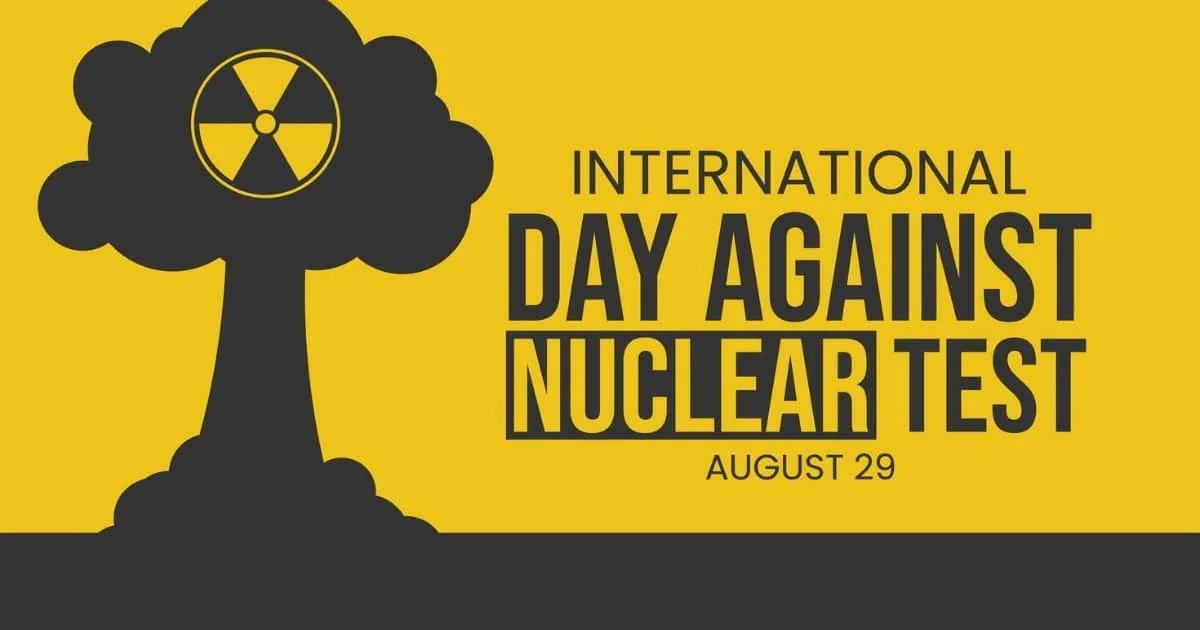




To remind the world about the risks of nuclear weapons and the necessity to avoid the testing of nuclear weapons, the International Day against Nuclear Tests is celebrated each year on August 29. This day was made by the UN in 2009 at the initiative of a country whose population suffered a lot due to decades of nuclear tests at the Semipalatinsk test site, Kazakhstan. The day is supposed to create awareness, commemorate the victims of nuclear testing, and make efforts to ensure that someday the world can live without nuclear weapons threatening its people and its environment.
The Nuclear Testing Historical Context
The history of nuclear testing is traced back to the year 1945, when the United States conducted the first nuclear explosion ever, known as the Trinity Test, in New Mexico. Several weeks later, the nuclear age began with the dropping of atomic bombs on Hiroshima and Nagasaki in Japan, and other nations were soon to start their own testing programs.
In 1949, the Soviet Union conducted its initial atomic test, which was named in the West Joe-1, in Kazakhstan in the Semipalatinsk test center. This had broken the U.S. monopoly on nuclear weapons and ignited the Cold War into a fierce arms race. Other nations such as the United Kingdom, France, and China were not behind and, shortly after, also engaged in the practice, conducting hundreds of tests to develop their own nuclear armories.
These tests were of massive human cost. The environment, too, had suffered a lot. Nuclear tests poisoned soil, water, and air and left radioactive waste that is dangerous decades or centuries later. There are still dangerous test sites, and individuals are unable to go back to their residences due to the extreme amount of radiation.
By the 1960s, the extent of testing and its devastating effect was evident. Not only were the mushroom clouds observed in deserts and over oceans and remote lands, but they also served as warnings of an international threat that could befall the entire humanity. This increased awareness later made world leaders and activists start to insist on the restriction of nuclear tests to set the platform for further international agreements.
Establishment of the International Day (2009)
The concept of the International Day against Nuclear Tests was the brainchild of Kazakhstan, the nation that had experienced all the disastrous impacts of the nuclear experiments. The Soviet Union had over 450 nuclear tests in the Semipalatinsk site located in Kazakhstan, which took place between 1949 and 1989. These tests caused great scarring to the land, and the people’s villages around the site were exposed to a high level of cancer, radiation sickness, and genetic diseases that were transferred to their new generations. It is due to this tragic past that Kazakhstan emerged as a major force in the campaign against nuclear testing.
A historic move was made in Kazakhstan in 1991 when the Semipalatinsk test site was permanently shut down. This daring move made the world realize that it was possible to get out of the sphere of nuclear weapons and get down to peace and security. On this move, Kazakhstan subsequently campaigned to establish an international day that would increase awareness of the consequences of nuclear experiments.
In 2009, a resolution was passed in the United Nations General Assembly to create the International Day against Nuclear Tests, with August 29 being the date. This was not just an empty gesture because it was not only on that day that the Soviet Union tested its first atomic bomb in the year 1949, but it was also on this day that Kazakhstan officially closed down the Semipalatinsk site in 1991. The day is now used worldwide to remember the damage due to nuclear tests and the great necessity to stop them in the future.

International Nuclear Test Ban
When the destructive consequences of nuclear testing were becoming more obvious, the world started to act to regulate and ultimately prevent it. The key initial move was the Partial Test Ban Treaty (PTBT), which was signed in 1963 by the United States, the Soviet Union, and the United Kingdom. This treaty prohibited tests in the air, space, and underwater, although underground testing was permitted. Although small, it was a big beginning since it mitigated radioactive fallout that was making it across the borders.
During the next decades, the pressure towards the more powerful and more extreme ban increased. This was followed by the Comprehensive Nuclear-Test-Ban Treaty (CTBT) in 1996, which demanded that all nuclear explosions, in all settings and with any intention, should come to a halt. CTBT also established an international monitoring system to help in the detection of nuclear tests at any place in the world. Nonetheless, the treaty is yet to come into force since some of the major countries, such as the United States, China, India, Pakistan, and North Korea, have not ratified the treaty.
Nevertheless, the world is trying to do something. A lot of nations also celebrate the International Day against Nuclear Tests by organizing seminars, peace marches, and educational campaigns to create awareness. The non-governmental organizations and activists also contribute largely as they remind the world about the human suffering due to previous tests and call upon the leadership to make a safer future.
The Relevance of August 29
Although the number of nuclear tests has declined over the last years, August 29 reminds the world that it is not out of danger of nuclear weapons, proving that the threat has not completely vanished. The other nuclear powers maintain their test facilities prepared, and the international politics of various parts cause concern that in case the world agreements crumble, tests beyond will resume.
That is why the International Day against Nuclear Tests still matters. Every year, conferences, seminars, and awareness campaigns are organized all over the globe to remind the world of the pain inflicted in the past by the tests and the need to do more with the international community. Test site survivors, also known as the downwinders, tell the story to make sure that the human cost is never lost. The day is used by scientists and peace groups to help bring to light the dangers to health, the environment, and international security.
August 29 is also symbolic as it links the past and hope. It is also on this day that the world is reminded of the first Soviet atomic test in 1949, and Kazakhstan, as a bold nation, made the bold move of shutting down its test site in 1991. It demonstrates that people and nations can prefer peace and safety even though nuclear weapons cause fear and devastation.
You May Like To Read: