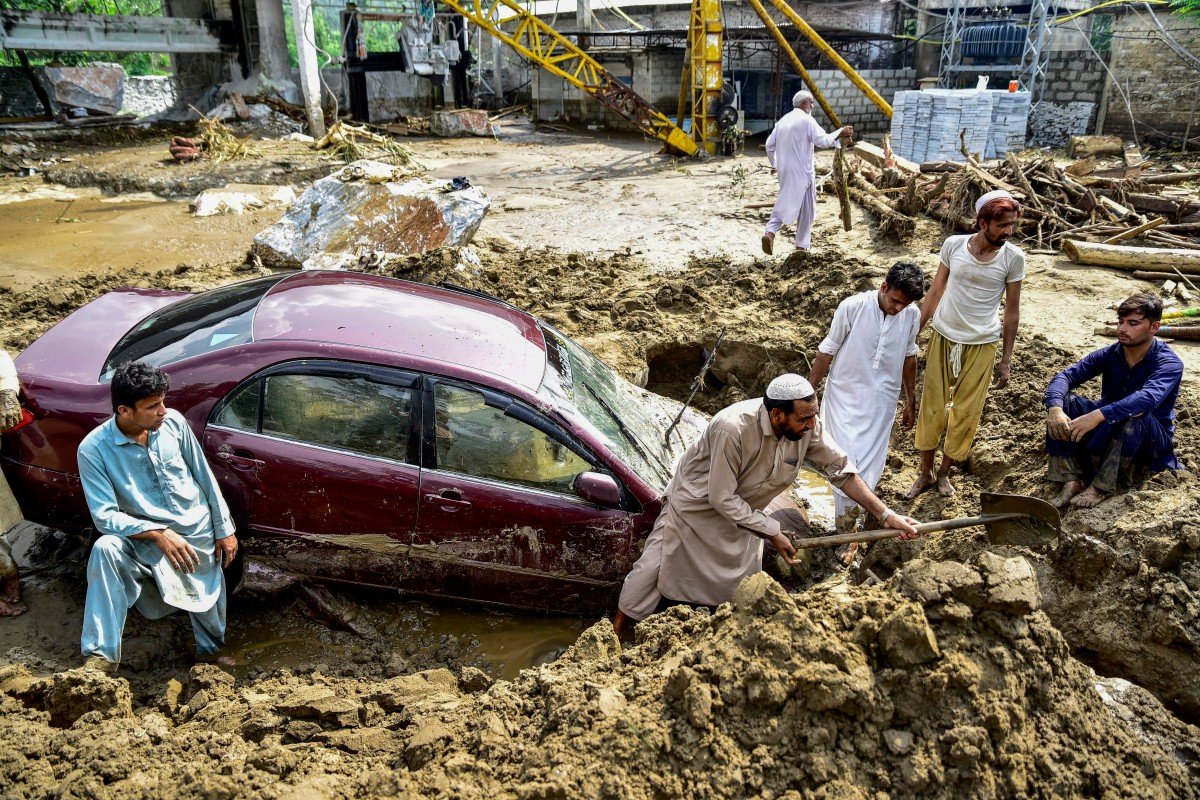





A comprehensive evaluation released by the International Federation of Red Cross and Red Crescent Societies (IFRC) has exposed the staggering human and structural toll of Pakistan’s 2025 monsoon season.
Drawing on consolidated data from the National Disaster Management Authority (NDMA) and provincial bodies, the report confirms that 6.9 million people were affected nationwide. The disaster claimed 1,037 lives and injured nearly 1,000 more, with women, children, and marginalized communities bearing the brunt of the casualties. The findings reinforce Pakistan’s position as one of the world’s most acute epicenters of climate vulnerability.
Nearly 7 million people are affected by monsoon floods in Pakistan last year, with more than 1,000 killed, the IFRC says. https://t.co/fUZAhSZWBm
— Arab News Pakistan (@arabnewspk) June 1, 2026
Regional Breakdown of the Disaster
The 2025 monsoons did not strike uniformly, instead heavily battering agricultural heartlands and fragile northern terrains:
-
Punjab: The hardest-hit province, accounting for 4.7 million of those affected.
-
Khyber Pakhtunkhwa (KP): Saw 1.6 million residents impacted by flash floods and landslides.
-
Gilgit-Baltistan and Sindh: Logged 356,000 and 185,000 affected individuals, respectively.
At the peak of the crisis, more than 2.5 million people were temporarily displaced, requiring a massive logistical evacuation effort that rescued over 3 million citizens before displacement numbers began subsiding in late 2025.
The Secondary Crisis: Water Security and Disease
The IFRC report highlights a prolonged public health emergency that outlasted the floodwaters themselves:
-
Contaminated Supply: Approximately 54% of households in affected districts completely lost access to safe drinking water.
-
Surging Illness: Contaminated water consumption was directly linked to 34% of documented medical illnesses in flood zones.
-
Sanitation Failure: Out of all affected districts, 36% of households reported an absolute inability to access functioning toilet or sanitation facilities, exacerbating the spread of waterborne pathogens.
CRITICAL ANALYSIS
The IFRC’s 2025 data reveals an alarming reality: Pakistan has entered a state of permanent climate regression. The country is no longer experiencing “once-in-a-century” anomalies; it is trapped in a cyclical loop of destruction and partial reconstruction that drains its fiscal reserves and fractures its social fabric.
The Shorter Return Period
Comparing the 2025 disaster to the catastrophic 2022 floods—which inundated a third of the country, affected 33 million people, and cost $14.9 billion—demonstrates a dangerous trend. While the 2025 floods were smaller in absolute scale, the fact that nearly 7 million people were disrupted just three years after a historic cataclysm proves that the “return period” between extreme weather events has shrunk.
Communities lack the time to build resilience, meaning that even a standard monsoon season now yields disaster-level casualties and millions of displacements because the underlying infrastructure was never fully healed from 2022.
The Clean Water Bottleneck
Furthermore, the statistic that 54% of households lacked safe water underscores a systemic failure in rural planning. Flood response in Pakistan remains fundamentally reactive—focusing on short-term evacuations rather than the proactive hardening of water treatment, elevated tube wells, and sanitation grids. By allowing more than a third of all post-flood illnesses to stem directly from dirty water, international and local aid architectures are failing to address the most predictable element of a post-disaster theater.
The Geopolitical Loss and Damage Standoff
From a geopolitical standpoint, the 2025 numbers weaponize Pakistan’s argument on the global stage. The country contributes less than 1% of global greenhouse gas emissions, yet it is paying a continuous premium in human lives and infrastructure.
While Islamabad has consistently demanded the operationalization of the UN’s Loss and Damage Fund, the financial flow from developed nations remains sluggish, mired in bureaucratic inertia. Without direct, unconditional climate reparations to fund climate-adaptive agriculture and resilient civil engineering, Pakistan’s annual budget will continue to function as an emergency disaster-relief fund, stifling economic development and guaranteeing a rerun of these exact statistics in 2026 and beyond.
The Takeaway: The IFRC report should not be read as a summary of a past crisis, but as a forecast of the next one. Until global climate financing shifts from loan-based relief to structural loss-and-damage restitution, Pakistan remains the ground zero of global climate injustice.