


Khyber Pakhtunkhwa, once hailed for its governance reforms, now finds itself amid a deepening quagmire of financial irregularities. A relentless succession of corruption scandals has cast a dark shadow over development projects and public trust, revealing systemic vulnerabilities that allow billions to be siphoned from the national exchequer. From multi-billion-rupee urban development schemes to mega-projects in remote districts, the province appears to be infested in corruption.
The Rs 32-Billion KPCIP Scandal: A Disputed Urban Dream
The latest controversy to surface involves an alleged Rs 32 billion corruption scandal within the Khyber Pakhtunkhwa Cities Improvement Project (KPCIP). This ambitious initiative, jointly funded by the Asian Development Bank (ADB), the Asian Infrastructure Investment Bank (AIIB), and the KP government, aimed to uplift urban infrastructure and municipal services in key cities including Peshawar, Abbottabad, Kohat, Mardan, and Mingora.
This project aims to improve urban services and strengthen local institutions in select cities of Khyber Pakhtunkhwa (KP) province, Pakistan. The project has five main components:
- Component A (Water Supply and Sanitation): Improving access to clean water and sanitation through infrastructure upgrades.
- Component B (Solid Waste Management): Improving solid waste collection and disposal with new equipment and facilities.
- Component C (Green Urban Infrastructure): Creating green spaces and parks to promote healthy living and support women-led small businesses.
- Component D (Institutional Strengthening and Capacity Building): Providing training and resources to improve the performance of relevant organizations.
- Component E (Women’s Participation in Urban Development): Empowering women to participate more fully in urban development and access economic opportunities.
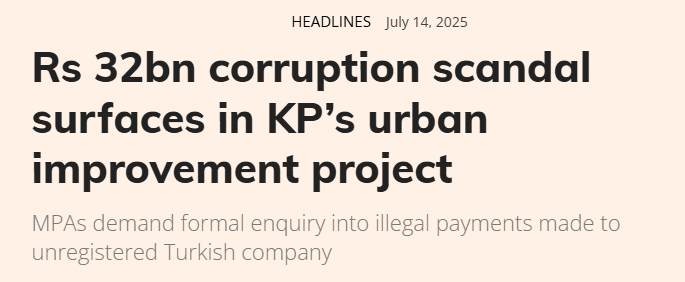
Alarming details have emerged regarding the contract award for the project. According to official documents, the lucrative contract was granted to an unregistered Turkish company operating through a joint venture. This firm reportedly lacked registration with the Federal Board of Revenue, the KP Revenue Authority, or the Pakistan Engineering Council. Despite minimal tangible progress on the ground, a staggering Rs 32 billion was allegedly disbursed to the company.
Alarmingly, these payments were released based on falsified progress reports, lax monitoring, and suspected collusion among officials, project staff, and consultants. Adding insult to injury, the foreign firm is accused of evading taxes, resulting in substantial financial losses to the national treasury.
Members of the Provincial Assembly have since petitioned the Chairman of the Public Accounts Committee (PAC), demanding a formal inquiry into these illicit payments and urging accountability for all officers who sanctioned payments based on allegedly fraudulent documentation. The case is expected to be referred to the National Accountability Bureau (NAB) and the Federal Board of Revenue (FBR) for further investigation, signaling a serious breach of financial oversight and contractual integrity.
Source: Profit
The Rs 40-Billion Kohistan Mega-Corruption: A Tale of Missing Billions
Even as the KPCIP scandal unfolds, the province continues to grapple with the fallout from the colossal Rs 40 billion Kohistan mega-corruption case. This scandal has exposed mammoth levels of financial misconduct, with the Accountant General (AG) Khyber Pakhtunkhwa pointing out dozens of dubious individuals and suspicious bank accounts linked to the irregularities.
The AG Office’s official correspondence, recommended disciplinary action against ten officials of the Finance Department and listed 52 questionable bank accounts. Records for as many as 1,293 cheques, already with NAB, are reportedly missing from official databases, highlighting a fundamental breakdown in financial record-keeping.
Initial findings estimate the corruption in Upper Kohistan alone to be around Rs 29 billion. NAB has since escalated its inquiry to a formal investigation, revealing remarkable progress in asset recovery.
The NAB has reportedly seized assets worth Rs 25 billion, including over Rs 1 billion in cash and foreign currency, more than three kilograms of gold, 73 frozen bank accounts holding over Rs 5 billion, 77 luxury vehicles, and 109 properties across various cities, collectively valued at approximately Rs 17 billion.
Billions of Rupees, Luxury Cars, and Gold Confiscated in Kohistan Corruption Probe#SamaaTV #KohistanScandal #Corruption #AntiCorruption #LuxuryCars #GoldSeized #PakistanNews #Accountability #Justice pic.twitter.com/0niw5OTKzJ
— SAMAA TV (@SAMAATV) July 17, 2025
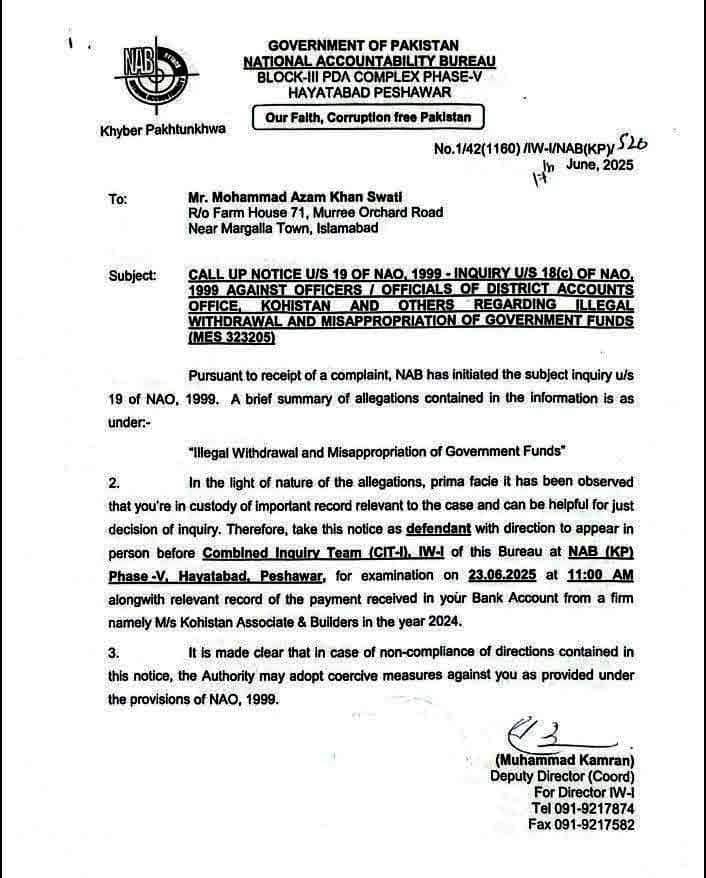
The investigation revealed a cunning nexus involving government officials, greedy contractors, and complicit bank authorities, operating with shocking boldness to siphon billions from the national treasury. Noteworthy is the arrest of contractor Muhammad Ayub, who allegedly received Rs 3 billion and used embezzled funds to acquire a property connected to a former senator, namely Azam Swati, who has been reportedly called up for further investigations by NAB.
Source: Nation
Erosion of Public Trust: A Crisis of Governance
These cascading scandals have led to erosion of public trust. A recent Gallup Pakistan survey, conducted between February and March 2025, revealed dissatisfaction with the PTI government’s performance in KP.
Public frustration stems not only from corruption allegations but also from critical gaps in basic public services, including access to clean drinking water, education, and healthcare.
Over half of the surveyed population alleged misuse of development funds, and a staggering 71% supported investigations into corruption, a sentiment echoed even among PTI’s own voters. Nearly half of respondents believed corruption in government departments had worsened, underscoring the deep-seated public concern over financial integrity.
The Imperative for Accountability and Reform
The successive emergence of these multi-billion-rupee corruption scandals in Khyber Pakhtunkhwa points to a dire need for rigorous accountability and transparent investigations to this effect. The sheer scale of the embezzled funds, glaring procedural lapses in procurement and monitoring, demands urgent and unwavering action. Without transparent investigations, swift trials of accused individuals, and reforms to bolster financial oversight, the province risks spiraling deeper into a crisis of governance, with the ultimate cost borne by its citizens and their aspirations for development and progress.