



The recent war-of-words emanating from across the border concerning the Sir Creek maritime boundary dispute is deeply worrying. When a senior official starts tossing around phrases like a “decisive response” that could potentially “change both history and geography,” it’s more than just political grandstanding—it’s a dangerous escalation of rhetoric that directly threatens regional stability.
Such inflammatory talk demands not just a defense posture, but a clear, principled articulation of Pakistan’s position: we stand ready to defend our borders, but our commitment remains to the peaceful and lawful resolution of this long-standing issue.
The Alarming Gambit: Karachi and the Reckless Threat
The most startling and unacceptable part of the recent statement was the highly provocative claim: “the road to Karachi goes through Sir Creek.” This isn’t a technical comment on a boundary dispute; it’s an open military threat against the very heart of Pakistan’s economy and its principal port.
Karachi is not just a city; it’s the lifeline of our nation. To suggest that a legal dispute over a coastal marshland could be used as strategic leverage for an attack on our economic capital is reckless and fundamentally violates all norms of peaceful international conduct. We must view this threat with the utmost seriousness, not because we fear the outcome, but because it exposes a mindset willing to use aggression over dialogue.
Furthermore, the simultaneous allegation that Pakistan is expanding its “military infrastructure” near Sir Creek appears to be a manufactured pretext. When a powerful neighbour threatens to alter your geography, any responsible nation will, and must, enhance its defensive capabilities. Our actions are purely defensive and proportionate, ensuring that Pakistan’s sovereignty remains non-negotiable. Our security forces are on high alert, demonstrating that while our priority is peace, our capacity for a decisive, defensive response is absolute. We will not be bullied into compromising our territorial integrity.
You May Like To Read: Geopolitical Tensions Escalate as US Signals Shift to ‘War to Win’ Amid Hybrid Threats
Why Sir Creek Matters: More Than Just Mudflats
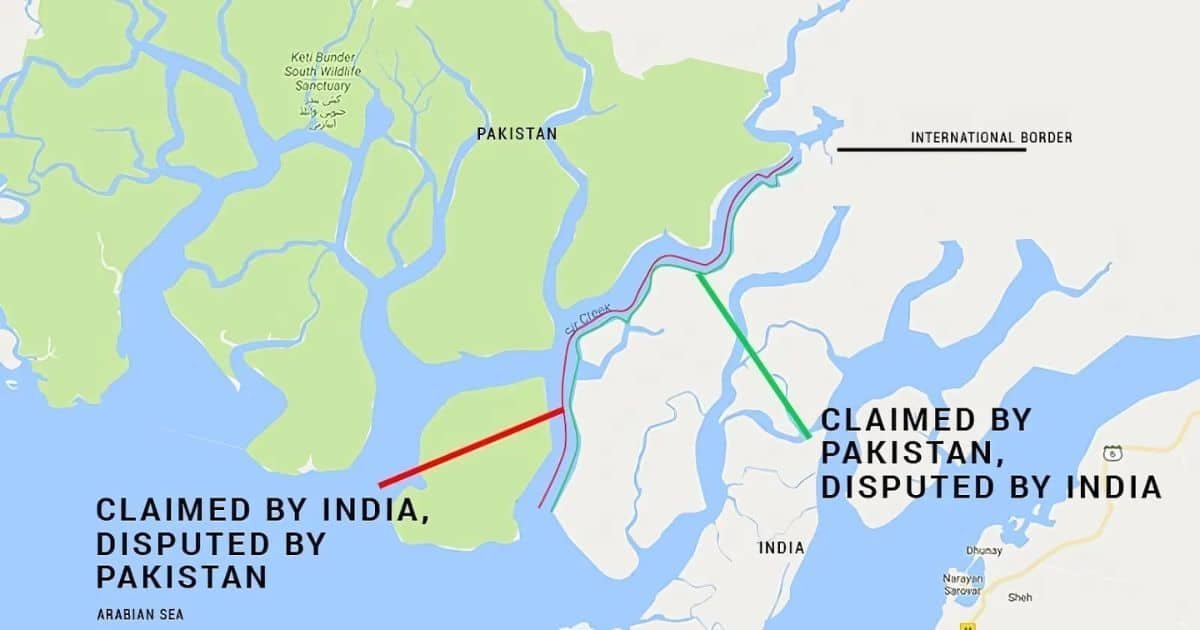
To understand the tension, we have to look past the political theatre and understand the significance of Sir Creek itself. This is not just a muddy, 96-kilometer tidal estuary between Gujarat and Sindh. It is the crucial point where the land boundary transitions into the vast Arabian Sea.
The way this boundary is drawn—the way we divide this small, contested creek—determines the size and shape of our respective Exclusive Economic Zones (EEZs).
The True Stakes
- Economic Resources: The EEZ is often rich in hydrocarbons (oil and gas) and deep-sea mineral deposits. A few square miles of creek can translate into thousands of square miles of valuable maritime territory.
- Fishing Rights: Thousands of fishing families depend on these waters for their livelihood. An unfavorable boundary demarcation impacts the economic security of our coastal communities.
- Maritime Security: Control over this area is essential for protecting our coastline and critical shipping lanes that pass through the Arabian Sea, including those linked to Karachi.
For Pakistan, conceding to India’s demands would mean sacrificing significant economic and security interests. This is why the dispute, despite its seemingly small geographical footprint, has remained unresolved for decades.
Pakistan’s Principled Stance: The Thalweg Doctrine
The core difference between Pakistan and India’s approach lies in international law. This isn’t a political disagreement; it’s a legal argument about how boundaries should be drawn in tidal waterways.
Pakistan’s position is clear, pragmatic, and supported by global convention: the boundary in Sir Creek must be determined using the Thalweg Doctrine.
The Thalweg Doctrine (from the German for “valley line”) is a universally accepted principle stating that the boundary should follow the middle of the main channel of navigation. Since Sir Creek is a navigable waterway that shifts and flows, the boundary should track the deepest, most navigable channel.
India, however, chooses to cite a 1914 British resolution and argues that the boundary should be fixed on the eastern bank of the creek (the Pakistani side). This position is widely seen as legally unsound in the context of international maritime boundaries and is clearly an attempt to maximize India’s claim over the rich EEZ resources at Pakistan’s expense.
We are not asking for an arbitrary advantage; we are simply asking that the internationally recognized and fair Thalweg Doctrine be applied. This would be a win-win for stable, lawful borders, and it is the only way to genuinely depoliticize this issue.
You May Like To Read: Informal Justice Systems: A Barrier to Rule of Law in Pakistan’s Rural Areas
Moving Forward: Dialogue is the Only Road to Stability
While these threats are unsettling, they cannot deter Pakistan from prioritizing peace. Our security forces are prepared for any eventuality, but our diplomacy remains open.
The cycle of escalating rhetoric must end. The stability of the entire region, which relies on the safety of international shipping lanes and resource exploration, is too important to be jeopardized by aggressive posturing over a boundary dispute.
Pakistan has participated in countless rounds of talks over Sir Creek and remains ready to sit down, under the umbrella of international law, to finally resolve this technical issue. We urge the global community and regional powers to recognize the dangers inherent in threatening a major port like Karachi and to pressure for a return to principled, technical dialogue. The way to resolve Sir Creek is through maps and treaties, not through military ultimatums.
Our nation’s resolve is firm: we stand with our brave security forces, prepared to defend our sovereignty, while continuing to hold the door open for an equitable and peaceful solution based on the rule of law.
You May Like To Read: Israel’s Aggressive Role in the Middle East Power Struggle