Whenever development is mentioned, an image of modern day Times’ Square comes to our mind. We misconstrue ostentatious infrastructure for growth and that is one of the biggest fallacies the Pakistani mind has.
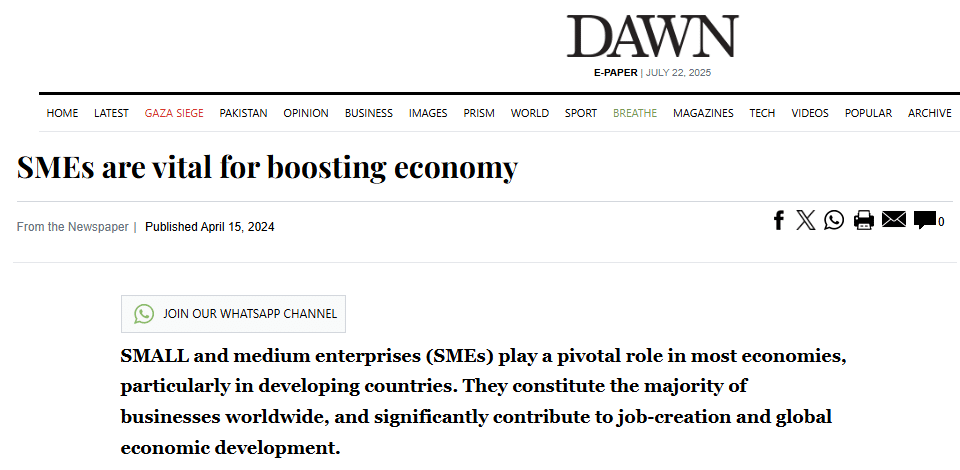
Contrary to popular belief, small and medium Enterprises (SMEs) are the backbone of a country’s economy, no less Pakistan, contributing significantly to employment, innovation, and economic diversification. With over 5.2 million SMEs operating across the country, they account for approximately 90% of private sector businesses and provide employment to around 30% of the total workforce.
Source: Dawn
A Decade of Struggle for Pakistan’s SME’s
Since 2010, Pakistan’s small and medium enterprises (SMEs) have struggled under weak institutional support, fragmented policy frameworks, and poor access to financing. The SME sector, which contributes over 30% to GDP and accounts for 78% of non-agricultural employment, remains largely informal and undercapitalized. After the 18th Amendment, SME policymaking became an ambiguous federal-provincial subject, leading to coordination failures and the absence of a unified national strategy. Despite multiple policy announcements—including the National SME Policy 2007 and its successor in 2021—implementation remained inconsistent. Credit provision has been especially problematic: SME lending as a share of total private sector credit fell from 7.4% in 2008 to just 5.4% in 2023, reflecting both risk-averse banking practices and a regulatory environment that failed to prioritize inclusive finance.
This policy neglect and structural weakness became more pronounced during crises. SMEs were hit hardest during the 2018 balance of payments crunch, COVID-19 lockdowns, and recent inflationary and energy shocks. Many lacked formal registration, access to digital tools, or collateral to qualify for emergency or subsidized financing. Programs such as the SBP’s Temporary Economic Refinance Facility (TERF) disproportionately benefited larger, already formalized firms (IMF, 2021). The failure to create targeted mechanisms for SMEs deepened inequality within the business ecosystem and stunted productivity growth. As a result, Pakistan’s SME sector—despite its scale and potential—continues to lag behind regional peers such as Bangladesh and Vietnam in terms of value addition, export participation, and technological upgrading.
Government Support and Policy Initiatives
The Pakistani government has introduced several initiatives aimed at supporting the growth of SMEs. One of the most significant steps was the creation of the Small and Medium Enterprise Development Authority (SMEDA) in 1998. SMEDA provides a range of services, including policy advice, access to finance, and capacity-building programs. The agency helps SMEs by offering technical assistance, advisory services, and facilitating access to funding.
In recent years, the government has increased its focus on improving access to finance for SMEs, recognizing that many small businesses are unable to secure the capital they need to expand. Initiatives such as microfinance programs and partnerships with fintech companies are being explored to provide SMEs with the necessary funds to grow. However, access to formal financing remains a challenge, with only 17% of SMEs receiving financing from banks (agrieconomist.com).
To overcome this issue, the government has been working on creating financial products tailored to the needs of SMEs. For example, the State Bank of Pakistan (SBP) has introduced Refinancing Schemes for SMEs, which offer lower interest rates and longer repayment terms. These schemes are designed to reduce the financial burden on small businesses and facilitate their growth. The introduction of digital lending platforms is another important step toward improving financial access for SMEs, particularly those in remote areas.
Economic Contribution and Employment Generation
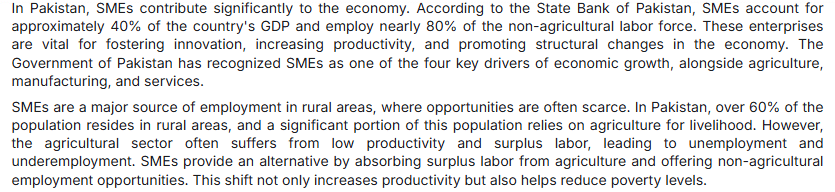
SMEs play a crucial role in Pakistan’s economic development. They contribute nearly 40% to the country’s GDP and are instrumental in reducing rural-to-urban migration by creating employment opportunities in rural areas. By fostering entrepreneurship and innovation, SMEs drive economic diversification and resilience.
Source: Agrieconomist
The government’s focus on promoting SMEs aligns with its broader economic strategies, such as the URAAN Pakistan initiative launched in December 2024. This five-year economic transformation plan aims to modernize Pakistan’s economy through reforms and investments in critical sectors, including SME development.
Challenges Faced by SMEs
Despite their importance, SMEs in Pakistan face several challenges that hinder their growth. Limited access to finance, inadequate infrastructure, and complex regulatory frameworks are among the primary obstacles. Additionally, many SMEs rely on outdated technology and lack skilled labor, reducing their competitiveness in the global market.
To overcome these challenges, the government has been working to simplify regulatory processes and improve infrastructure. Programs aimed at enhancing technical skills and promoting the adoption of modern technologies are also being implemented to increase the efficiency and competitiveness of SMEs.
The Role of Digital Transformation
In recent years, digital transformation has become a key priority for the government to help SMEs overcome these challenges. By embracing technology and digital tools, SMEs can improve their operational efficiency, reduce costs, and expand their reach to new markets. The government has launched various initiatives to support the digitization of SMEs, including training programs for entrepreneurs and providing access to affordable digital tools.
The rise of e-commerce platforms and online marketplaces has opened up new opportunities for SMEs to access global markets. The Pakistan Software Export Board (PSEB) has played a crucial role in helping SMEs leverage technology to reach customers both locally and internationally. These initiatives are expected to help SMEs tap into the global digital economy, expanding their customer base and increasing revenue.
Future Outlook and Recommendations
The future of SMEs in Pakistan looks promising, provided that the government continues to focus on removing the barriers to growth. Expanding access to finance, improving infrastructure, and fostering innovation are key to unlocking the full potential of SMEs. Public-private partnerships are essential in addressing these challenges and creating an environment where SMEs can thrive.
The government’s ongoing efforts to simplify regulatory processes and improve access to finance are steps in the right direction. However, more needs to be done to support SMEs in adopting modern technologies and improving their workforce’s skills. By focusing on these areas, Pakistan can create a vibrant and competitive SME sector that will drive economic growth and create jobs.