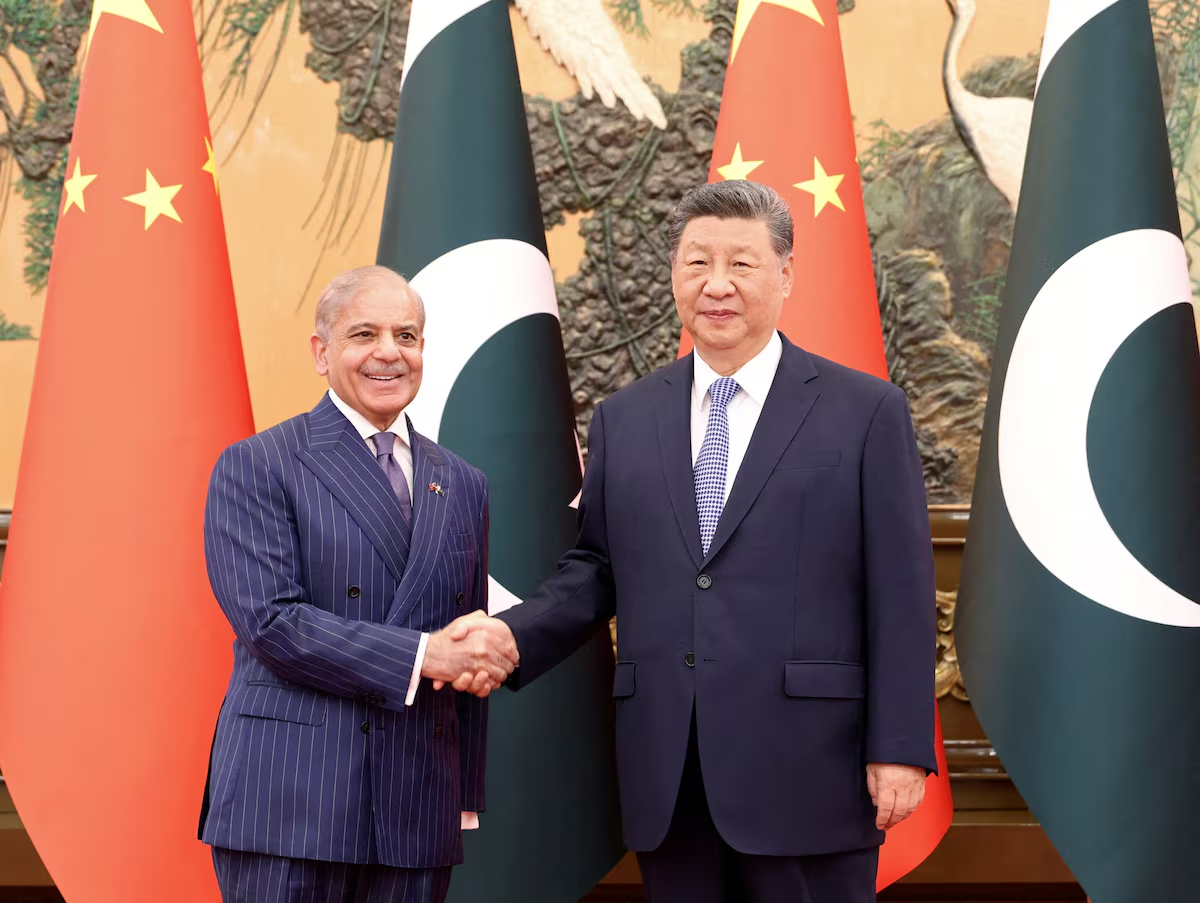





In a landmark four-day official visit, Pakistan’s Prime Minister Shehbaz Sharif met with Chinese President Xi Jinping in Beijing, reaffirming the “all-weather” strategic cooperative partnership between the two nations. The visit, which included high-level talks and the signing of numerous agreements, underscored a shared commitment to regional peace, stability, and mutual development.
President Xi Jinping hailed the “unbreakable tradition of friendship” between China and Pakistan, emphasizing China’s consistent prioritization of relations with Pakistan in its neighborhood diplomacy. He expressed China’s readiness to accelerate the building of an even closer China-Pakistan community with a shared future, aiming for greater results in their “all-weather” cooperation and contributing to regional peace and stability.
Prime Minister Shehbaz Sharif reciprocated these sentiments, describing China and Pakistan as “iron brother” countries with a relationship “next to none.” He praised President Xi’s leadership, recognizing China as a global economic and military power dedicated to peace and multilateralism. The Prime Minister lauded President Xi’s visionary initiatives, including the Belt and Road Initiative (BRI) and the China-Pakistan Economic Corridor (CPEC), which he highlighted as transformative for Pakistan’s development.
China’s President Xi Jinping has hailed Beijing’s “unbreakable” friendship with Pakistan as he met visiting Prime Minister Shehbaz Sharif seeking to deepen their “all-weather” partnership. Results of this meeting will start coming in few hours. pic.twitter.com/kfmt2yWG7p
— Hamid Mir حامد میر (@HamidMirPAK) May 25, 2026
Critical Analysis of the Visit
This visit marks a significant strengthening of the already robust ties between Pakistan and China. The emphasis on an “unbreakable” and “all-weather” friendship reflects a deep-seated strategic alignment that extends beyond economic cooperation to encompass regional security and diplomatic coordination.
A key highlight of the discussions was the acknowledgment of Pakistan’s constructive role in mediating peace in the Middle East. President Xi specifically commended Chief of Defence Forces and Chief of the Army Staff Field Marshal Asim Munir’s efforts in facilitating dialogue between the United States and Iran. This underscores Pakistan’s growing diplomatic influence and its potential to act as a crucial regional stabilizer, further enhancing its strategic value to China.
Beijing: 25 May 2026.
Prime Minister Muhammad Shehbaz Sharif Meets President Xi Jinping in Beijing.
Prime Minister Muhammad Shehbaz Sharif held a most warm and cordial meeting with H.E. President Xi Jinping in Beijing today. The meeting took place in the backdrop of the 75th… pic.twitter.com/NVwICMoabZ
— Prime Minister’s Office (@PakPMO) May 25, 2026
The signing of 15 memoranda of understanding, protocols, and cooperation agreements across diverse sectors such as trade, investment, agriculture, science and technology, climate change, education, and media, signifies a comprehensive approach to deepening bilateral cooperation. The alignment of China’s 15th Five-Year Plan with Pakistan’s ‘Uraan Pakistan’ initiative is particularly noteworthy, indicating a concerted effort to integrate Pakistan’s development priorities within China’s broader strategic framework.
The focus on the next phase of CPEC, with an emphasis on industrialization, connectivity, and digital transformation, suggests a shift towards higher-value economic activities, moving beyond infrastructure development to foster sustainable growth and job creation in Pakistan. The selection of Pakistani astronauts for China’s space station program further illustrates the expanding scope of this strategic partnership into advanced technological and scientific domains.
While the visit was framed around positive affirmations of friendship and cooperation, underlying geopolitical currents were evident. The shared commitment to regional peace and stability, particularly in the context of the Middle East, suggests a coordinated approach to addressing evolving international challenges. Pakistan’s reiteration of firm support for China on its core interests, including the One China Principle, reinforces the strong diplomatic solidarity between the two nations.
Overall, Prime Minister Shehbaz Sharif’s visit to China has not only celebrated 75 years of diplomatic relations but also laid a robust foundation for a new phase of strategic, practical, and future-oriented cooperation, signaling a deeper integration of their national interests and a stronger united front in a complex global landscape.
Key Outcomes
- Reinforcement of “All-Weather” Strategic Cooperative Partnership: Both leaders reiterated their commitment to strengthening the enduring friendship and strategic alliance.
- Expansion of Economic Cooperation: Signing of 15 agreements covering trade, investment, agriculture, and technology, with a focus on the next phase of CPEC.
- Diplomatic Coordination on Regional Peace: Acknowledgment of Pakistan’s mediation efforts in the Middle East, highlighting a shared commitment to regional stability.
- Enhanced Strategic Alignment: Integration of Pakistan’s development priorities with China’s long-term plans, particularly in industrialization, connectivity, and digital transformation.
- Collaboration in Advanced Technologies: Inclusion of Pakistani astronauts in China’s space program, demonstrating a growing partnership in strategic domains.
This visit serves as a powerful testament to the deepening bond between Pakistan and China, promising continued collaboration and mutual support in the years to come.