


Global Context and Strategic Timing
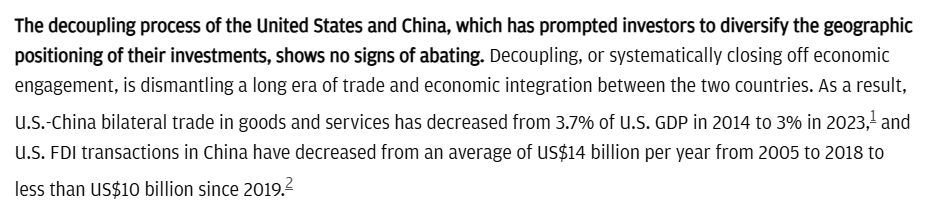
Global supply chains have entered a phase of strategic reconfiguration. Driven by geopolitical tensions, pandemic-era disruptions, rising tariffs and a focus on sustainability, companies are actively de-risking their reliance on China and exploring near‑shoring models. These shifts present both opportunities and challenges for Pakistan’s manufacturing base, especially in textiles, leather, and surgical instruments.
Source: JP Morgan
Opportunities for Pakistan’s Manufacturers
Textile & Apparel
Pakistan is Asia’s fifth largest cotton producer, and holds 5% of global spinning capacity. Its textile sector employs 25 million people, accounts for roughly half the country’s exports, and contributes about 8.5% of GDP. Recent near‑shoring trends, companies moving sourcing away from China, open doors for smaller and mid‑tier producers in Pakistan to fill gaps in global value chains.
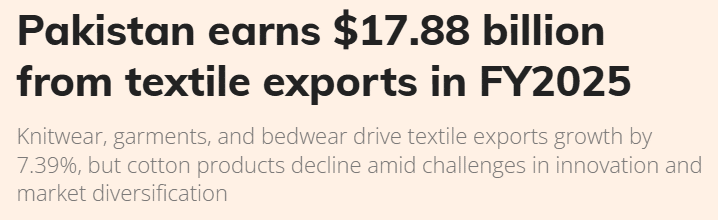
Government initiatives are yielding traction; Pakistani textile exports jumped 5.6% to $1.05 billion in FY 2023–24. And while textile exports dipped from $20 billion to $17 billion in 2025 due to rising costs, energy constraints, and soft cotton prices, this drop represents a cyclical low, importers continue seeking resilient supply.
Source: Profit
Surgical Instruments
Sialkot is internationally recognized as a global leader, producing up to 70% of the world’s surgical instruments. Competitively priced labor helped exports grow at a 7.3% CAGR between 2016–2018, supported by government incentives. Yet, emerging EU Medical Device Regulations and global 3D‑printing disruption threaten this advantage. Despite the risks, opportunities abound: as buyers look beyond China and India, Pakistan could attract new OEM contracts, if firms rapidly align with EU MDR, upgrade quality controls, and invest in tech to match international compliance.
Leather & Small-Scale Industries
Beyond textiles and instruments, Pakistan’s leather and small-scale cottage sectors; ranging from carved woodwork to electric fans, are gaining attention, especially for niche, high-value exports. Quality certification and vertical integration can help these producers rise in global sourcing strategies.The export value of leather goods shows steady growth, with exports to key markets such as the US, Germany, UK, and Canada. For example, leather footwear exports rose by 15.48% to $126.4 million in July–Feb FY25.
Structural Bottlenecks Obstructing Pakistan’s Industrial Growth
Pakistan’s manufacturing sector faces several entrenched challenges that hinder its ability to capitalize on global supply chain shifts. Chief among these are rising operational costs and persistent energy shortages, with power shortfalls exceeding 5,000 MW, forcing mills to cancel orders and driving up production costs, which in turn erode export competitiveness.
Compliance with international standards, such as WRAP for apparel and MDR for medical devices, remains uneven; although the Pakistan Accord is encouraging better factory safety practices, progress still lags behind regional peers like Bangladesh and Vietnam. Additionally, exporters are under growing pressure from regional competitors, with India enjoying preferential tariff access and Bangladesh expanding its global market share.
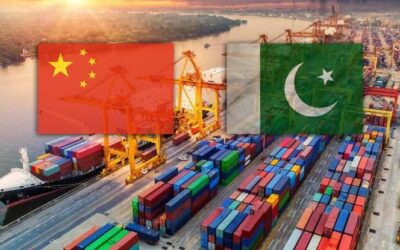
The looming threat of a 29% U.S. tariff could further slash Pakistani exports of textiles, surgical instruments, and rice by up to 25%, demanding urgent policy intervention, cost optimization, and export diversification. Despite substantial investments under CPEC, totaling over $62 billion, Pakistan’s infrastructure still suffers from critical deficiencies in cold-chain logistics, customs processing, and road connectivity, all of which are vital for timely and competitive integration into global supply chains.
Strategic Pathways Forward
Public–Private Synergies
Pakistan’s Ministries, in conversation with U.S. officials, are working on tariff relief and new trade frameworks, especially to reduce the 29% U.S. tariff burden. Coordinated efforts between government, manufacturers, and international buyers are key to securing favorable trade deals and easing regulatory friction.
Energy & Infrastructure Reforms
Urgent investments are needed to stabilize Pakistan’s power grid. Renewable energy, strict blackouts prevention, and power-efficient manufacturing should be prioritized. Equally, modernizing customs procedures and seaport logistics, leveraging CPEC corridors will lower delivery times and increase export competitiveness.
Compliance & Quality Upgrades
Textile firms should expedite accreditation under the Pakistan Accord to gain buyer trust. Surgical instrument makers must invest in EU‑compliant MDR systems and digitalized QA/QC systems. Compliance not only reduces trade barriers, it enhances brand value.
Diversification & Digitalization
Pakistan must diversify beyond textiles and surgical instruments: agro-processing, auto parts, and electronics (currently minimal) offer future growth areas. At the same time, digital tools track-and-trace, ERP systems, predictive logistics, are necessary to handle complexity and meet near‑shored buyers’ expectations.
Human Capital Development
Modern supply chains need advanced skills. Technical training in CPEC SEZs and vocational institutes, especially in factories in special economic zones, will foster a workforce capable of meeting new standards and technology adoption.
Conclusion
Pakistan stands at a crossroads: near‑shoring and supply‑chain realignment are redefining global sourcing. For Pakistani manufacturers, this transition offers an opening, especially in textiles, surgical instruments, leather goods and beyond but success hinges on resolving cost constraints, compliance standards, trade barriers, and infrastructure inefficiencies. With aligned policies, targeted investment in quality, and smart use of CPEC-powered logistics, Pakistan can significantly enhance its role in re‑emerging global supply chains. If swift action is taken now, Pakistan’s industrial base could transform from a regional player into an agile, trusted supplier in global markets.