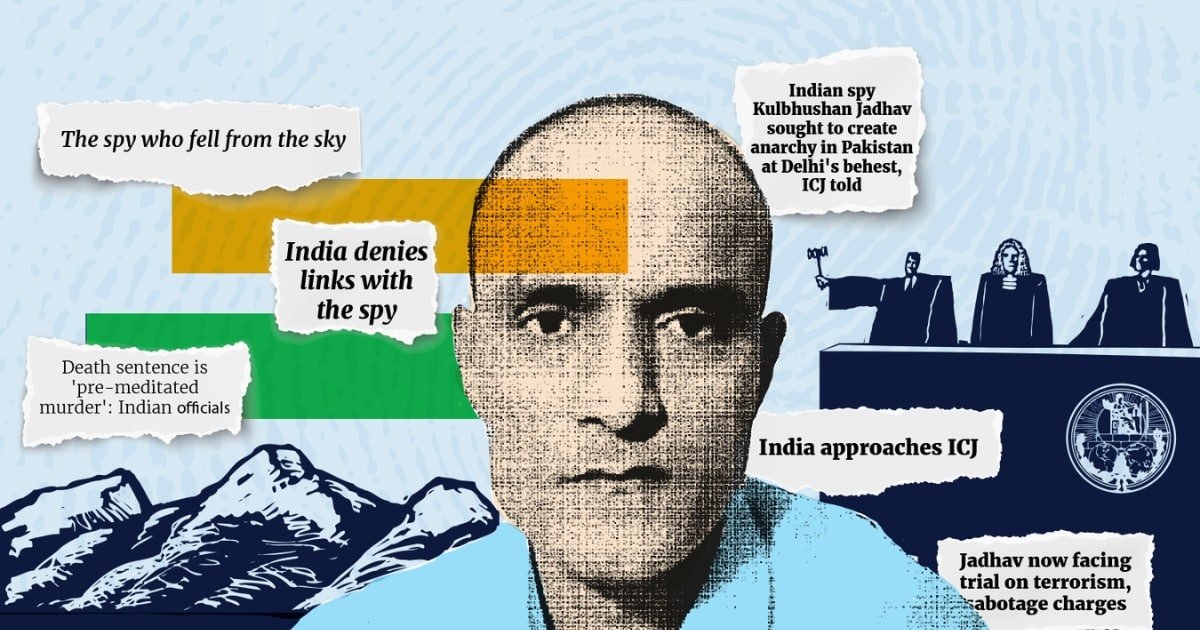





The arrest of Kulbhushan Jadhav in March 2016 marked one of the most high-profile espionage cases in South Asia in decades. Jadhav, a former Indian Navy officer, was captured in Balochistan and accused of working as a covert operative for India’s external intelligence agency, the Research and Analysis Wing (RAW). Pakistan alleged that his activities were directly tied to sabotage operations and funding of separatist violence in Balochistan, framing the case as irrefutable proof of Indian state-sponsored terrorism.
Although the International Court of Justice (ICJ) in 2019 stopped short of acquitting Jadhav and instead ordered Pakistan to provide consular access while upholding his conviction, the case remains deeply etched in Pakistan’s strategic narrative. Nearly a decade later, Jadhav’s name continues to surface in official statements, media discourse, and diplomatic exchanges as shorthand for India’s alleged proxy warfare. The persistence of the “Jadhav echo” underscores how espionage cases, beyond their immediate legal and intelligence dimensions, become enduring tools of strategic communication and national security framing.
You May Like To Read: Over 70 Killed in Devastating Bus Collision in Western Afghanistan Amid Refugee Repatriations

Espionage, Terrorism, and International Law
One of the reasons the Jadhav case retains traction is its hybrid legal character. Espionage has historically been treated as a state-on-state offense, falling in the grey zone of international law where captured operatives are often denied protections afforded to prisoners of war. Terrorism, however, is treated as an international crime with broader implications.
Pakistan has been consistently portraying Jadhav not merely as a spy but as a “terrorist mastermind.” By doing so, Islamabad places his case outside the traditional espionage framework and into the realm of terrorism, which carries far greater stigma and political utility. This framing also allows Pakistan to highlight India’s alleged involvement in destabilizing Balochistan, shifting the debate from intelligence rivalry to state-sponsored subversion.
The ICJ ruling illustrated this tension. While the court mandated consular access for Jadhav under the Vienna Convention, it stopped short of questioning Pakistan’s terrorism allegations, allowing Islamabad to maintain its narrative that the case involved more than espionage.
From Kulbhushan Yadav to Jafer Express, BLA terrorism to attacks in Balochistan,India’s twin goals are clear: destabilise Pakistan & hurt China’s interests in the region.
Ever wonder who echoes RAW’s agenda?
But Remember: Pakistan’s armed forces are our true strength. pic.twitter.com/r7oezimIwv— Amir Saeed Noon 🇵🇰 (@AmirNoon) July 10, 2025
A Foundational Pillar of the Proxy Warfare Narrative
Jadhav’s capture was not Pakistan’s first claim of nabbing Indian operatives, but it has become the most symbolically potent. Unlike earlier cases, Islamabad publicized Jadhav’s confession videos, paraded dossiers at the United Nations, and tied his alleged network to wider insurgent and terrorist activities in Balochistan and Karachi.
This has served multiple functions. Domestically, it reinforced the narrative that unrest in Balochistan is externally orchestrated rather than an outcome of local grievances. This framing provides political cover for counter-insurgency operations while rallying public support around the armed forces. Internationally, it gave Pakistan a concrete example to counter Indian allegations of cross-border militancy in Kashmir. The Jadhav case has thus become part of a “strategic archive” that Pakistani officials repeatedly invoke whenever India raises terrorism concerns in bilateral or multilateral forums.

Strategic Communication and Public Diplomacy
The way espionage cases are narrated is as important as their intelligence value. Pakistan’s handling of the Jadhav affair has been marked by calculated media exposure, including televised confessions, official press briefings, and public dossiers. These efforts are designed not only for domestic consumption but also for the international audience.
By consistently foregrounding Jadhav’s identity as a serving Indian naval officer, Pakistan has amplified the sense of Indian culpability. This resonates with a public already primed by decades of suspicion toward India’s role in fomenting unrest. Moreover, the timing of public references to the case often coincides with spikes in border tensions or diplomatic standoffs, suggesting its utility as a flexible communication tool.
Espionage cases elsewhere have followed similar trajectories. The Cold War was rife with spy swaps and propaganda campaigns that served more as political theatre than pure intelligence management. The U.S.–Russia relationship today still sees espionage cases used as leverage in broader strategic contests. Pakistan’s use of Jadhav’s case fits into this global pattern of transforming captured operatives into instruments of diplomatic signaling.
Implications for Bilateral Relations
The persistence of the Jadhav narrative has reinforced the entrenched mistrust between Pakistan and India. Every mention of the case underscores the asymmetry in how the two states perceive their conflicts: for India, Pakistan is a source of cross-border militancy; for Pakistan, India is an orchestrator of internal insurgency.
This duality complicates attempts at dialogue. When backchannel talks are explored, such espionage cases hang heavy in the background, limiting room for compromise. At the same time, the enduring spotlight on Jadhav ensures that even if the case is not at the center of negotiations, it serves as a symbolic reminder of the depth of hostility.
Beyond Jadhav: The Broader Landscape
While Kulbhushan Jadhav remains the most prominent example, Pakistan has on multiple occasions claimed to have intercepted other Indian operatives and disrupted RAW-linked networks. Each new claim is layered onto the foundation established by Jadhav’s capture, reinforcing the perception of a systematic campaign.
The durability of this narrative lies not only in its factual claims but also in its symbolic power. For Pakistan, cases like Jadhav’s offer a tangible embodiment of a broader argument: that India’s hand in Balochistan is real, organized, and hostile. As long as insurgency persists in the province, such narratives will continue to hold strategic currency.
Conclusion
The Jadhav case demonstrates how espionage affairs, once exposed, often transcend their intelligence origins to become enduring pillars of statecraft and narrative warfare. For Pakistan, Jadhav is more than a captured spy; he is a symbol around which the narrative of Indian proxy warfare in Balochistan has been built and sustained.
In an era where states increasingly rely on strategic communication to shape international perceptions, the Jadhav echo illustrates the lasting power of espionage cases in framing national security discourses. Whether it brings resolution or merely entrenches hostility, the legacy of Kulbhushan Jadhav will remain central to Pakistan’s articulation of its security challenges vis-à-vis India.
You May Like To Read: The Price of Help: How Foreign Aid Creates Dependency in Pakistan