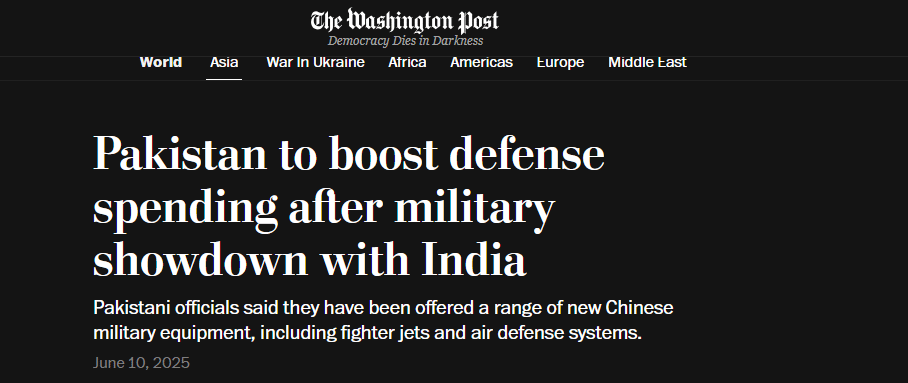
Pakistan’s military is undergoing an ambitious and comprehensive transformation of its land forces. Fuelled by a nearly 20% increase in the defence budget, which now stands at approximately Rs 2.55 trillion ($9 billion) for FY 2025–26, these investments are tailored to bolster the army’s conventional deterrence, rapid mobility, and technological edge—essential amid regional threats and evolving warfare dynamics.
Source: Washington Post
Armour Modernisation: From Legacy to Lethal
To counterbalance India’s armoured advancements—such as its acquisition of T‑90MS tanks—Pakistan has revitalised its own armour capabilities:
- Al‑Khalid and Al‑Zarrar main battle tanks continue to be upgraded with advanced powertrains, sighting systems, and reactive armour, replacing outdated T‑80UD and Type‑85 platforms.
- Procurement of Chinese VT‑4 tanks and indigenous production of the “Haider” MBT demonstrate a move towards modern firepower parity.
- Field exercises now routinely involve combined arms manoeuvres, improving interoperability between armour, infantry, artillery, aviation, and air defence—crucial for high-intensity warfare.
Artillery & Rocket Systems: Expanding Range and Precision
Modernisation efforts have prioritised long-range firepower:
- SH‑15 155 mm self-propelled howitzers, acquired from China, offer 50 km reach and precision-guided munitions—the first of their calibre in the army’s inventory.
- PCL‑181 wheeled 155 mm howitzers are being integrated for rapid deployment across frontline commands.
- Fatah MLRS systems—including guided 140 km (Fatah‑I) and 400 km (Fatah‑II) variants—add deep-strike capabilities, deployed during the 2025 India–Pakistan conflict.
- Older systems (M109, PLZ‑45, A‑100E) continue undergoing upgradation and network integration to support coordinated fire missions.
Air Defence & C4ISR: Towards a Networked Battlefield
Source: Pakistan Institute of Development Economics
Modernisation extends beyond firepower and include:
- HQ‑9B long-range air defence systems and emerging HQ‑16 SHORAD platforms enhance protection against modern aerial threats
- Battlefield Management Systems (BMS) and secure C4I networks allow real-time situational awareness and faster sensor-to-shooter cycles—a key objective of network-centric warfare (NCW).
Infantry and Mobility: Enhancing Field Effectiveness
The army is investing in mechanised and infantry enhancements:
- Introduction of infantry fighting vehicles (e.g., Saad/Viper platforms) equipped with remote weapon systems and anti-tank capabilities is underway.
Source: Defense News
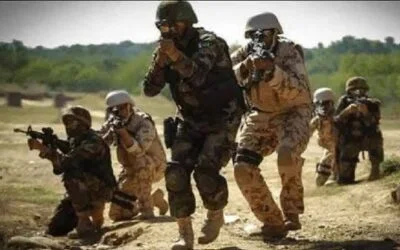
- Infantry is being upgraded with modern small arms, personal protection gear, night-vision tools, and anti-tank weaponry, reflecting a move toward balanced, flexible manoeuvre forces.
Indigenous Capabilities: Heavy Industries Taxila (HIT)
Pakistan’s defence-industrial base continues to grow:
- Heavy Industries Taxila (HIT) has overhauled thousands of tracked vehicles, including T‑59, T‑80UD, and Type‑85 tanks, and now builds advanced systems like SH‑15 and VT‑4 under license.
- Partnerships with NESCOM and POF drive development of precision munitions (Fatah, PCL‑181) and emerging cyber/robotic systems.
Fiscal Commitment: Sustained & Strategic Investment
Pakistan has signalled a long-term shift in defence funding:
- Defence spending now comprises nearly 2% of GDP, maintaining its highest level in recent history.
- Investments are strategically balanced between conventional arsenal development and networked, tech-driven warfare infrastructure—enhancing resilience amid financial constraints.
Geostrategic Imperatives & Regional Dynamics
- The driving force behind this modernisation is India’s own military enhancement—Pakistan’s moves are calibrated for deterrence parity.
- Chinese platforms dominate procurement, offering cost-effective interoperability and technology transfer—minimising Pakistan’s reliance on Western systems.
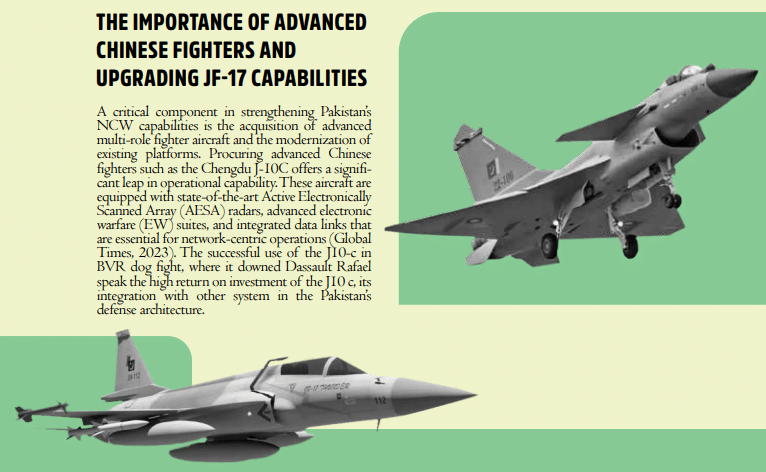
- Pakistan’s recent procurement of Chinese defence assets, including J‑10C fighters and submarine projects, complements land-focused upgrades within a broader defence strategy.
From Legacy to Lethality
Pakistan’s land forces are evolving into a more agile, integrated, and technologically sophisticated force. Through a combination of legacy platform upgrades, advanced artillery, air defence networks, mechanised infantry, and Indigenous manufacturing, the army is steadily closing the conventional gap with regional adversaries.
As Islamabad balances fiscal discipline with security imperatives, the success of these modernisation efforts will depend on sustained budget commitment, operational training, and cohesive integration across army branches. If implemented effectively, Pakistan’s land forces will remain a formidable deterrent—adaptive to 21st-century threats, while retaining conventional credibility.