Rawalpindi, Pakistan | July 30, 2025 — Chief of Army Staff (COAS) General Syed Asim Munir has firmly declared the Pakistan Army’s unwavering commitment to uprooting terrorism from the nation’s soil. His resolute message, delivered during a visit to the Corps Headquarters in Peshawar, underscored the complex security challenges confronting Pakistan, particularly those stemming from alleged foreign-backed destabilization efforts. General Munir explicitly pointed towards India’s intensified proxy warfare against Pakistan, attributing the use of destructive elements, ominously labeled as “Fitna-al-Khawarij” and “Fitna-al-Hindustan,” to hostile agendas.

Source: ISPR
Unwavering Resolve on the Front Lines
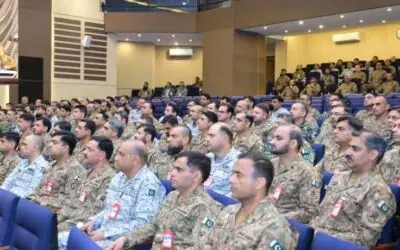
General Munir’s visit to Peshawar, a region that has borne the brunt of terrorist activities, was aimed at engaging directly with officers and soldiers. He commended their resolve and dedication in the relentless fight against terrorism, acknowledging the immense sacrifices made by the armed forces. His remarks serve as a powerful morale booster for troops operating in challenging terrains, particularly those bordering Afghanistan, where militant groups continue their persistent efforts to undermine peace and stability. The ongoing struggle against militancy in Pakistan is a long-standing one, with the nation having endured significant human and economic costs over decades.
You May Like To Read: Operation Azm-e-Istekham: A New Counter-Terrorism Strategy
Unmasking Foreign-Sponsored Proxy Warfare
The COAS articulated a clear understanding of the multifaceted threats facing the country. He stressed that Pakistan’s security forces are fully cognizant of the nefarious designs of foreign-sponsored elements that seek to destabilize the nation. This accusation of external involvement, particularly from India, highlights a critical dimension of Pakistan’s security doctrine. According to Pakistan’s military leadership, India is actively engaged in orchestrating proxy warfare, utilizing various factions to fuel internal strife and unrest.
“Fitna-al-Khawarij”: Battling Ideological Extremism
The term “Fitna-al-Khawarij” used by the COAS carries significant weight within Pakistan’s security discourse. This designation positions the FAK not merely as terrorists but as apostates who have deviated from mainstream Islamic tenets, aiming to delegitimize their narrative and operations within a religiously conservative society. This strategic rebranding seeks to erode the TTP’s perceived Islamic legitimacy among the public and foster unity against their violent ideology. Recent evidence has even surfaced regarding a nexus between the Afghan government and Fitna-al-Khawarij, further complicating regional security dynamics.
“Fitna-al-Hindustan”: Countering Separatist Destabilization
Concurrently, “Fitna-al-Hindustan” is a designation recently applied by the Pakistani government to all terrorist organizations operating in Balochistan that are believed to be acting at the behest of India. This term underscores Pakistan’s assertion that India is actively supporting separatist and militant groups in Balochistan to undermine the province’s stability and development. These groups engage in acts of sabotage, targeting security forces and civilian infrastructure, in what Pakistan views as a clear act of hybrid warfare. The COAS’s statements firmly condemn India’s alleged overt sponsorship of these terror proxies, asserting that such misguided attempts to undermine the patriotism of the Baloch people are bound to fail, echoing their perceived defeat in past conflicts.
You May Like To Read: Honoring Major Zeeyyad Salim Shaheed
A Unified National Response
General Munir’s assertion that “the Pakistan Army, with the full support of the nation, is determined to uproot this menace of terrorism” reaffirms the military’s strong commitment. This statement not only reassures the public but also sends a clear message to adversaries that any attempts to sow discord or destabilize Pakistan will be met with a decisive and united response. The comprehensive strategy involves not only kinetic operations to eliminate militant hideouts and infrastructure but also socio-economic development initiatives, particularly in regions like Balochistan, to address root causes and promote national cohesion.
The military leadership’s firm resolve, coupled with the nation’s unwavering support for its armed forces, is critical in navigating the complex security landscape. As Pakistan continues its fight against terrorism and foreign-backed destabilization, the emphasis remains on a holistic approach that includes intelligence-based operations, border management, and a robust counter-narrative to combat extremist ideologies. The sacrifices of countless soldiers and citizens in this prolonged struggle underscore the gravity of the challenge, but the leadership’s clear vision aims to ensure that Pakistan emerges stronger and more secure. The visit to Peshawar served as a poignant reminder of these sacrifices and the enduring spirit of the nation and its defenders.