




Pakistan’s healthcare sector faces a precarious balancing act as the nation grapples with budget allocations that reveal a complex and often contradictory picture. While some areas of health spending have seen significant proposed increases, particularly in development initiatives for the fiscal year 2024-25, more recent data for FY2025-26 indicates a concerning federal-level cut, further highlighting the country’s persistent struggle to allocate sufficient resources to public health.
Federal Allocations: A Mixed Outlook
For the fiscal year 2024-25, the Ministry of National Health Services proposed a total budget of approximately Rs91.4 billion. This included a recurring (non-development) budget of Rs28.3 billion, an amount that fell short of the ministry’s initial requests. However, the most prominently reported aspect was the substantial increase in the Public Sector Development Programme (PSDP) for health. The federal government had announced a significant hike of 131 percent in the health development budget for FY2024-25, earmarking Rs63.1 billion for new and ongoing projects, up from Rs27.3 billion in the previous fiscal year. This was framed as a positive step towards improving health infrastructure and expanding essential services.

Source: Dawn
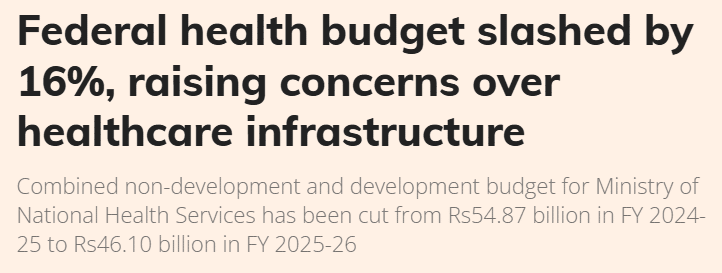
However, the narrative has shifted for the upcoming fiscal year. According to more recent budget documents and analyses, the combined non-development and development budget for the Ministry of National Health Services, Regulations, and Coordination (NHSR&C) for FY2025-26 has been slashed by nearly 16 percent.
Source: Profit
The total allocation for the federal ministry has reportedly decreased from Rs54.87 billion in the outgoing fiscal year (FY2024-25) to Rs46.10 billion for the new one. While the non-development expenditure, primarily covering salaries and administrative costs, saw a moderate increase to Rs31.75 billion, the crucial development budget (PSDP) has faced a drastic 47 percent cut, down to Rs14.34 billion.
You May Like To Read: Pakistani Airlines are Back to UK Routes
This reduction in development funding raises serious concerns, as it is expected to limit the government’s capacity to initiate or complete vital infrastructure projects, expand existing hospitals, enhance disease surveillance systems, and support the training of medical professionals. Projects earmarked for the FY2025-26 PSDP include allocations for the Jinnah Medical Complex and Research Centre, the Prime Minister’s National Programme for the Elimination of Hepatitis C, and the establishment of a cancer hospital in Islamabad, among others. While these specific projects are crucial, the overall cut to the development portfolio signals a potential slowdown in the much-needed expansion of healthcare facilities.
A Deeper Look: Health Spending as a Percentage of GDP
Perhaps the most alarming aspect of Pakistan’s health financing is its consistently low allocation as a percentage of its Gross Domestic Product (GDP). Despite various promises and the urgent need for robust healthcare, health and education allocations remain under 1 percent of GDP. This figure is strikingly low when compared to international and even regional standards. For instance, the Economic Survey 2024-25 revealed that Pakistan’s health expenditure is less than one percent of GDP, a stark contrast to the South Asian average of 3.1 percent. In terms of per capita spending, Pakistan’s $68.11 (2022) pales in comparison to neighbors like India ($106.83), Sri Lanka ($245.91), and Iran ($475.01).
This chronic underinvestment in public health forces a significant burden onto citizens, with over 50 percent of healthcare spending being out-of-pocket. Such high out-of-pocket expenses can push vulnerable populations further into poverty, creating a vicious cycle of ill-health and financial distress. Experts and medical associations, such as the Pakistan Islamic Medical Association (PIMA), have voiced deep concerns, emphasizing that this inadequate budgeting compromises the country’s capacity to effectively respond to health challenges.
Lopsided Priorities and Dual Burdens
Further complicating the landscape are the lopsided priorities within the existing health budget. A significant portion of spending, estimated to be around 80 percent, is directed towards high-cost tertiary care services (specialized hospitals and complex treatments like transplants and cancer therapies), which are utilized by only a small fraction (around 15 percent) of the population.
In contrast, only a meager 15 percent is allocated to primary healthcare services, which are crucial for preventive care and serve the vast majority of the population. This imbalance means that while some high-tech medical interventions are funded, basic preventive care, essential for addressing the dual burden of communicable and non-communicable diseases, remains critically underfunded.
Pakistan continues to battle both traditional infectious diseases like tuberculosis, hepatitis, and HIV/AIDS, alongside a rising tide of non-communicable diseases such as diabetes, cancer, and heart disease. The reduced development allocations, particularly at the federal level for FY2025-26, threaten to undermine the resilience of the health system in the face of these ongoing and emerging health crises.
Glimmers of Progress and Future Pathways
Despite the overarching budgetary concerns, there have been some positive developments reported. The Economic Survey 2024-25 indicates modest improvements in several health indicators, including an increase in life expectancy to 67.6 years in 2023 and a significant rise in immunization coverage (DPT vaccination reaching 86 percent of children).
You May Like To Read: Flash Floods in Gilgit-Baltistan
The number of registered doctors and dentists has also seen an increase. Furthermore, the government has launched specific initiatives like the National Action Plan for Health Security (NAPHS), the Prime Minister’s National Programme for the Elimination of Hepatitis C, and expanded services for malaria, TB, and HIV/AIDS.
At the provincial level, some governments have announced increases in their health budgets for the coming fiscal years, with Punjab earmarking a substantial Rs630.5 billion, Sindh increasing its budget by almost 7 percent, and Khyber Pakhtunkhwa by 19 percent. However, the challenge remains to ensure these funds are utilized efficiently, prioritize primary healthcare, and address governance issues and corruption that often plague the sector.
The persistent low investment in health, particularly as a proportion of GDP, underscores the urgent need for comprehensive reforms. Experts advocate for re-evaluating spending priorities, increasing overall budget allocations to meet international benchmarks, and exploring alternative funding mechanisms, such as introducing health-protective taxes on ultra-processed products, to create a more sustainable and equitable healthcare system for all Pakistanis. The public health crisis demands a holistic and robust financial commitment to ensure the well-being of the nation.