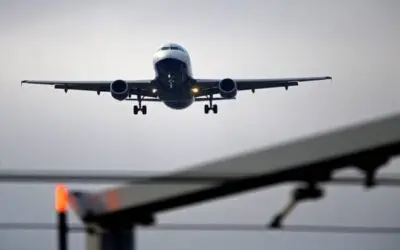



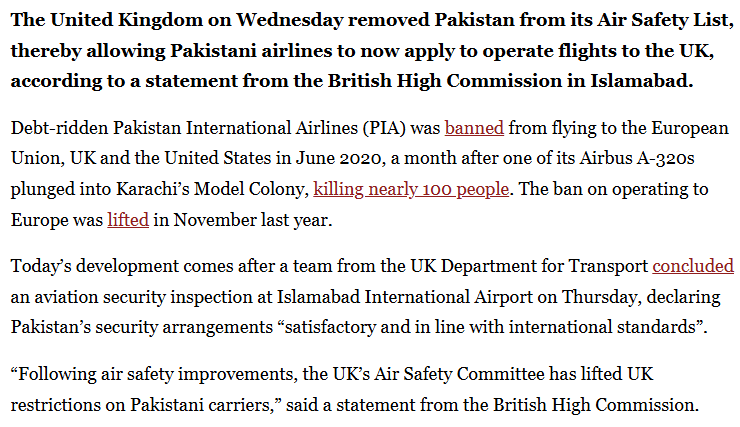
Pakistani airlines can once again fly to the United Kingdom after a five-year hiatus, as the UK government removed Pakistan from its air safety list in July 2025. This significant move reinstates direct flights between the two nations, relieving millions of Pakistanis residing in the UK and opening up avenues for tourism, business, and family visitation. This follows Pakistan’s carrying out robust reforms in the area of aviation safety, which has been accepted by international organizations such as the UK Civil Aviation Authority and the International Civil Aviation Organization.
The Ban and Its Aftermath
The UK had earlier banned direct flights of Pakistani carriers in 2020 following a tragic crash of a PIA flight PK-8303 that killed 97 people and revealed severe shortcomings in the country’s aviation sector, such as a scandal with fake pilot licenses. This prompted the European Union Aviation Safety Agency (EASA) and the UK Civil Aviation Authority (CAA) to ban Pakistan International Airlines (PIA) and other airlines from flying in their airspace due to serious safety concerns. The prohibition severely affected not only the airline sector, but also the Pakistani communities in the UK who depended on direct flights to travel to their family, conduct business, and meet emergencies.
Economically, the suspension was a significant setback to Pakistan’s national carrier, and PIA is estimated to have lost about 40 billion rupees in five years. There was also a reputational loss in the international aviation community because the licensing scandal brought into question the integrity of the Pakistani aviation regulatory agencies. The regaining of credibility was a national concern, more so in a country that heavily relies on air travel for foreign workers, business relationships, and diplomatic relations.
Reform and Recovery
The years after the ban saw Pakistan make significant reforms in order to bring it to international standards in aviation safety. The revalidation of the pilot licenses was probably one of the most important steps. Pakistan Civil Aviation Authority (PCAA) collaborated with international aviation authorities to make thorough examinations, rectify internal procedures, and put in place harsher regulations concerning the training and certification of pilots.
One of the highlights in the reform process was the fact that Pakistan was able to pass the audit conducted by the International Civil Aviation Organization (ICAO), which recognized that there had been a change of safety oversight, licensing, and airworthiness compliance. Such reforms paved the way to subsequent acceptance by the UK Civil Aviation Authority, whose technical staff conducted their respective independent examination before the ban on air safety was lifted.
Moreover, in 2023, Pakistan created the Bureau of Air Safety Investigation (BASI), an independent organization based on the best practices in the international community, whose task is to investigate aviation incidents without any political influence. It was a grave undertaking towards openness and professional investigation of accidents. The establishment of BASI filled the much-needed gap in the aviation safety system of Pakistan and turned out to be a milestone in the international image.
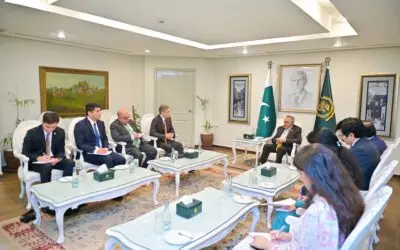
The reforms were not only technical but diplomatic as well. Pakistan officials, including the High Commission in London, were in endless conversation with the British authorities to clarify the progress and demand re-evaluation. Jane Marriott, the UK High Commissioner to Pakistan, confirmed that Pakistan had fulfilled the strict technical requirements needed to be removed from the air safety list, and this was a testimony to the hard work and determination of the country to reform.
Source: Dawn
The capacity of the country to rebuild trust following a high-profile scandal is a significant step in terms of accountability and rebuilding the institutions, which is an important step in this phase of reforms.
Reconnecting the Skies
Pakistan International Airlines (PIA) is now gearing up to resume its direct flight services to the UK, with three flights per week between Islamabad and Manchester starting in the coming months, now that the UK ban has been lifted.
The route is considered the initial step to restoring wider international connectivity, and already, schemes are underway to extend services to London and ultimately to New York.
The reopening of the UK routes may mark a financial turnaround for PIA. It is estimated that the five-year suspension resulted in an estimated revenue loss of 400 million for the airline, and the airline is now keen to reclaim its piece of the lucrative transcontinental travel market.
PIA considers these routes as assets that can be used to attract business and diaspora passengers since the airline has better safety compliance, and there is a potential future privatization.
It is also expected that the resurgence of Pakistani carriers in the UK skies will strengthen trade and economic relations between the UK and Pakistan. The UK is still among the biggest trading partners of Pakistan, whose bilateral trade has been in excess of 4.7 billion annually.
Direct flights will not only move people and goods more easily but also boost investor confidence, which is a very crucial factor as Pakistan is looking into foreign investment in its aviation and infrastructure sectors. The reopened lines, consequently, are not only air bridges, but also economic lifelines, bridging Pakistan to international markets and societies that it had been out of touch with for years.
Conclusion
The lifting of the air safety ban by the UK is not only a move to open up the flight routes, but it is also a sign of how Pakistan is moving out of crisis to credible in the eyes of the international regulators. Pakistan has reestablished air connections as well as confidence in its aviation regulation through its long-term reformation, technical enhancements, and diplomacy. With the planes flying again between Pakistan and the UK, they not only bring passengers; they bring back confidence, economic prosperity, and a renewed effort to adhere to international standards.