




Public pension funds are designed to offer post-retirement security. In Pakistan, they have acquired a fiscal load that is expanding with repulsive rates. Hundreds of billions are spent annually by the country on pensions, and there is no special fund to finance these payments. This is referred to as unfunded liability, the government has promised to make payment throughout their life and yet it has not saved. It sustains itself momentarily, but eventually expenses increase at a rate that surpasses income. That is exactly where Pakistan stands today.
The Size of the Problem
The government in the federal budget 2025-26 allocated PKR 1.014 trillion towards pensions, nearly the same as the development budget. A decade back, pensions used less than PKR 200 billion. They take up a significantly larger proportion of national expenditure today. This growth is due to:
- An expanding number of retirees.
- Increases in salaries and linked pensions.
- The absence of pension reforms.
If this trend continues, pensions could cross PKR 2 trillion by 2030, leaving little for infrastructure, health, and education.
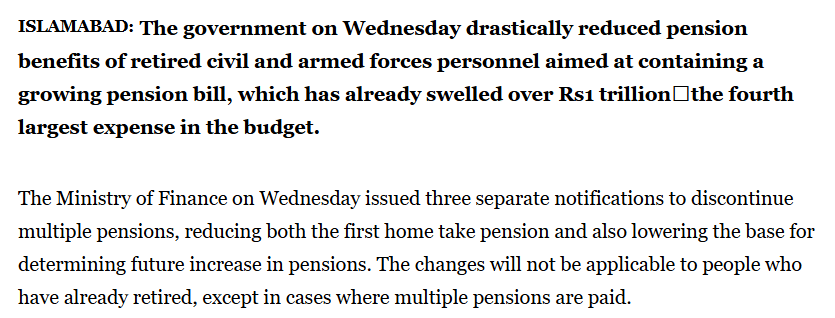
Source: Tribune
Why It’s Unsustainable
Pakistan follows a pay-as-you-go pension model. This implies that pensions of retired workers are paid at the expense of current taxpayers. No investment pool is generating returns.
This is risky with an increasing population and a small tax base. The Federal Board of Revenue (FBR) generates approximately PKR 12.33 trillion as tax revenue. A huge proportion of this is already tied up in salaries, pensions, and debt repayments. This leaves almost nothing for public services or development projects.
You May Like To Read: Policy for Privatization, Restructuring, and Efficiency
Who Gets These Pensions?
Most public pensions go to:
- Civil servants
- Armed forces personnel
- Teachers and health workers in the public sector
Private sector workers rarely receive pensions unless they are part of schemes like EOBI (Employees’ Old-Age Benefits Institution), which offers much smaller payments.
The problem is not that pensions exist it’s that they cover a small group but cost the entire taxpayer base.
The Political Challenge
The risk of pension reform is political. Government employees and unions resist strongly any efforts to conduct change in the system.
No political party will give a chance to offend this group; particularly before the elections. Consequently, governments sit on the fence when it comes to reforms, despite the forewarnings of experts over the years.
Global Examples of Reform
Many countries have faced this crisis and acted:
- Bangladesh introduced a contributory system where both employer and employee pay into a pension fund.
- Malaysia’s EPF (Employees’ Provident Fund) invests contributions in profitable ventures, ensuring long-term sustainability.
- Chile moved to a funded pension model decades ago, though with its own challenges.
These systems share a key principle: pensions are partly self-financed through contributions, not entirely dependent on future taxpayers.
Possible Solutions for Pakistan
- Shift to a Contributory Pension Model: New government recruits should contribute a portion of their salaries to a pension fund. The government matches it.
- Create a National Pension Fund: Invest contributions in secure, high-return projects to build a long-term asset base.
- Gradual Reform: Protect existing retirees but introduce new rules for future employees.
- Better EOBI Coverage: Expand EOBI to cover more private sector workers and improve payouts.
- Link Retirement Age to Life Expectanc: With people living longer, retirement ages can be adjusted to reduce the years of payout.
You May Like To Read: The Political Discourse Deteriorates | Personal Attacks Replace Policy Debates
The Cost of Doing Nothing
If reforms are delayed, pension costs will keep eating into the budget. This will mean:
- Less money for schools, hospitals, and roads.
- Higher borrowing, increasing debt.
- More pressure on future generations to pay for today’s promises.
Economists warn that Pakistan’s fiscal stability depends on tackling pension liabilities soon.
The Way Forward
Reform will require:
- Political courage
- Public awareness about the real costs
- A fair system that balances security for retirees with sustainability for taxpayers
Pensions should protect old age, not bankrupt the state. A funded, contributory, and transparent pension model can secure both retirees and the economy.
Conclusion: The Time to Act is Now
Pakistan’s pension system is at a turning point. Continuing with the current model is not an option. Each year of delay adds billions to the burden. By learning from global examples and designing a locally suitable reform plan, Pakistan can turn this fiscal time bomb into a secure retirement system for all. The sooner we start, the less painful the transition will be.