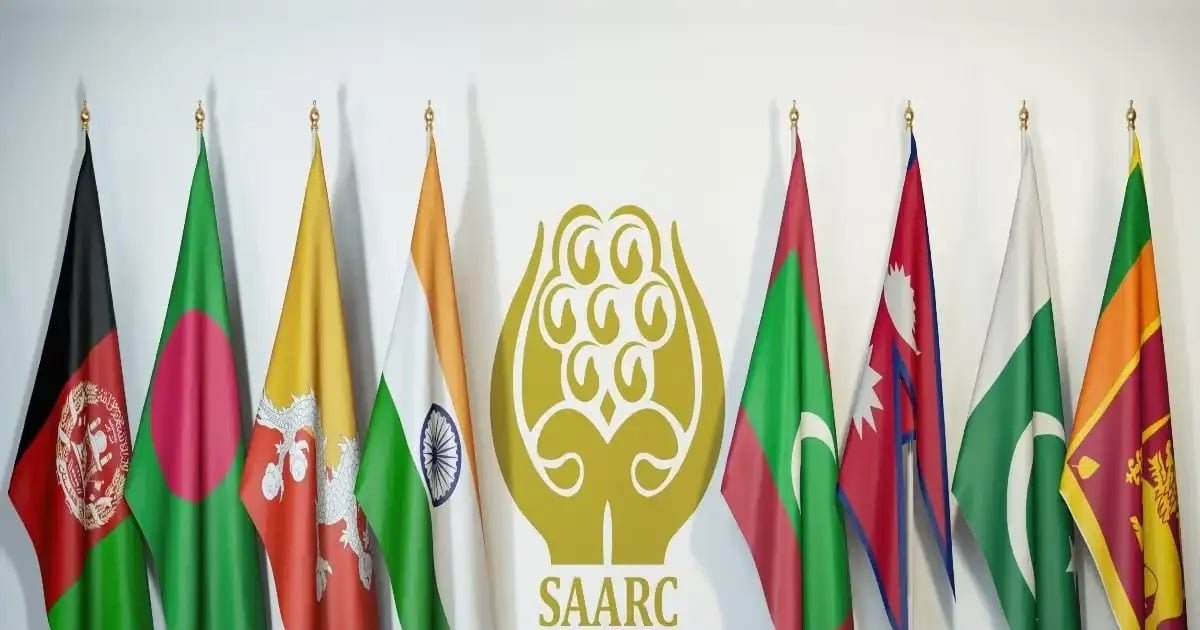





A forum that lost momentum
The South Asian Association for Regional Cooperation (SAARC) was conceived as a mechanism to bring together the nations of South Asia under a shared framework of cooperation, economically, politically and socially. But decades after its founding, SAARC remains essentially inactive. The last official summit was held in 2014; its declared mechanisms for trade liberalization and regional integration, like South Asian Free Trade Area (SAFTA), have done little to overcome structural and political obstacles. Recent expert commentary suggests that SAARC today is “struggling under the weight of political deadlock and mutual mistrust.”
The consequence is that South Asia, despite being home to over a quarter of the world’s population, remains among the least economically integrated regions globally. Intra-regional trade remains minimal, far below what analysts regard as the bloc’s potential.
You May Like to Read: SAARC vs. BIMSTEC: Why South Asia Struggles with Regionalism While Other Blocs Move Forward
The India–Pakistan rivalry: the main drag
A central reason for SAARC’s paralysis has long been the rivalry between India and Pakistan. Political hostility, border tensions and security-related distrust, especially between those two states, regularly derail the consensus required for regional cooperation under SAARC’s charter.
That pattern has continued in 2025. In December, Pakistan’s Foreign Minister Ishaq Dar proposed forming a new regional architecture, a “new South Asian bloc” effectively acknowledging that SAARC, in its current form, remains crippled.
As his spokesman put it, South Asia can no longer remain “trapped in zero-sum mindsets, political fragmentation and dysfunctional regional architecture.”
You May Like to Read: The Foreign Policy Dilemma of Pakistan and India: Asymmetry and the Lack of Leverage
Trade data: stark evidence of stagnation
The economic data paints a stark picture. According to multiple recent assessments, intra-South Asian trade remains a tiny fraction of what it could be. Despite repeated trade-liberalization agreements, estimates suggest that around 86 percent of potential trade opportunities for Pakistan remain unexploited.
Bilateral trade between India and Pakistan offers a particularly grim illustration. Official trade between the two countries fell from roughly US $2.41 billion in 2018 to about US $1.2 billion in 2024. Even more stark: Pakistani exports to India reportedly plunged from around US $547.5 million in 2019 to just US $480,000 in 2024.
These numbers suggest that for many in Pakistan’s export sector, especially small and medium traders, manufacturers and farmers, the promise of regional supply chains and cross-border commerce has largely vanished.
On a broader level, South Asia’s trade-to-GDP ratio has fallen, sliding from 47.3 percent in 2022 to about 42.9 percent by 2024, signaling growing economic inwardness.
Structural barriers beyond politics
While political hostility is the most visible obstacle, structural and operational barriers also contribute heavily to the stagnation. Reports note that intra-SAARC trade costs remain exorbitantly high: internal trade cost within South Asia is estimated at roughly 114 percent of the shipment value, even more expensive than trading with the United States (109 percent), despite the far greater distance.
By contrast, intra-regional trade costs in more integrated blocs like ASEAN are far lower (roughly 76 percent), enabling smoother supply chains and efficient regional commerce.
Such high trade costs, driven by inefficient customs procedures, poor cross-border infrastructure, delays at border crossings, and fragmentation in regulatory and standards frameworks, cripple the competitiveness of regional trade. This structural inertia means that even if political relations improve, the logistics burden may continue to hinder trade integration.
Pakistan’s own economic vulnerabilities
For its part, Pakistan is not immune to economic contradictions. According to the latest data from the World Bank, Pakistan’s exports as a share of GDP have been shrinking. Once averaging around 16 percent in the 1990s, that share fell to about 10.4 percent by 2024, a sign that the country is not fully leveraging its export potential.
This decline comes even as external competitiveness is eroded by high domestic energy costs, cumbersome regulatory environments, and weak logistics infrastructure.
Taken together, these constraints make it difficult for Pakistan to view cross-border trade liberalization as a low-risk, high-reward strategy, especially when political strains with its neighbours often translate into abrupt disruptions (border closures, transit denials or informal trade curbs).
You May Like to Read: Pakistan’s Position in Evolving Global Trade Governance
Islamabad’s recalculated strategy
Against this backdrop, Islamabad in late 2025 appears to be rethinking its approach. With SAARC moribund for almost a decade, Pakistan is advocating a “variable-geometry” regional cooperation model, effectively a smaller, more manageable bloc potentially built around nations with friendlier ties. Foreign Minister Ishaq Dar has suggested expanding a trilateral mechanism (involving Pakistan, Bangladesh and China) to include other states, to pursue collaborative economic and connectivity projects outside the SAARC framework.
Still, many economists and regional analysts warn that replacing SAARC with a new grouping could deepen regional fragmentation rather than heal it. The argument goes that SAARC, despite its many limitations, remains the only homegrown, inclusive structure for South Asia. New blocs may lack the institutional history, trust-building pedigree, or legitimacy required to deliver collective gains.
Indeed, some observers argue the problem has never been structural alone: SAARC frameworks such as SAFTA, the SAARC Development Fund (SDF) or the regional visa-exemption schemes were not meant to be utopian-scale integration efforts, but modest, incremental steps. The real failure lies less in design than in political will.
You May Like to Read: Gulf Economies Diversifying Beyond Oil: What It Means for Pakistan’s Migrant Labor and Investments
What a restart would require: and why Pakistan must lead
Reviving meaningful South Asian economic integration would require not grand gestures but pragmatic, small-scale, confidence-building actions. For Pakistan, that could mean focusing first on trade facilitation where ties are least contentious, with Bangladesh, Sri Lanka or Maldives, and improving domestic export competitiveness simultaneously.
Given its export challenges, Pakistan should invest in strengthening logistics, reducing internal trade-costs, streamlining customs procedures, and improving regulatory transparency, both for exports and for transit trade. This would make regional trade more attractive even if political conditions remain fragile.
At the same time, Pakistan, along with other willing members, must demonstrate that regional cooperation does not have to wait for full political reconciliation. Regular private-sector trade delegations, mutual recognition of product standards, incremental tariff liberalization and reactivation of dormant regional institutions could slowly rebuild trust.
For South Asia as a whole, a return to cooperation would not only unlock long-neglected trade potential but also offer strategic resilience. As global economic headwinds intensify, regional value-chain integration could help buffer supply shocks, stabilize prices and offer viable alternatives to distant, volatile markets. The latest regional outlook by the World Bank, projecting growth for South Asia at 6.6 percent in 2025 but pointing to trade reforms as a key growth lever, underscores how much is at stake.
You May Like to Read: ASEAN’s Quiet Power: Lessons for Pakistan and South Asia on Regional Cooperation
Conclusion: a more realistic path forward
SAARC’s stagnation is not merely a diplomatic failure; it is a tangible economic loss for Pakistan and all South Asian countries. The data shows missed opportunities, in trade, investment, and regional value-chain formation, that accumulate over years of inertia. But the story is not yet irreversible. What is needed is a sober appraisal of what works, paired with modest, realistic, incremental steps.
For Pakistan, that means investing at home in export competitiveness, logistics, and trade facilitation, while simultaneously taking the lead on regional initiatives where consensus is possible. If Islamabad can adopt such a pragmatic, effect-oriented approach, and if other willing neighbours join in, there remains a real possibility that South Asian cooperation may yet rise from the ashes of political freeze and deliver economic benefit to millions.
In the end, revitalizing South Asia’s trade and integration doesn’t need bold declarations; it needs consistency, clear policies, and a willingness to build trust through action.