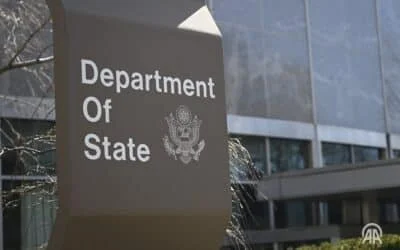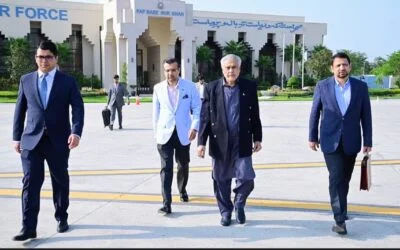



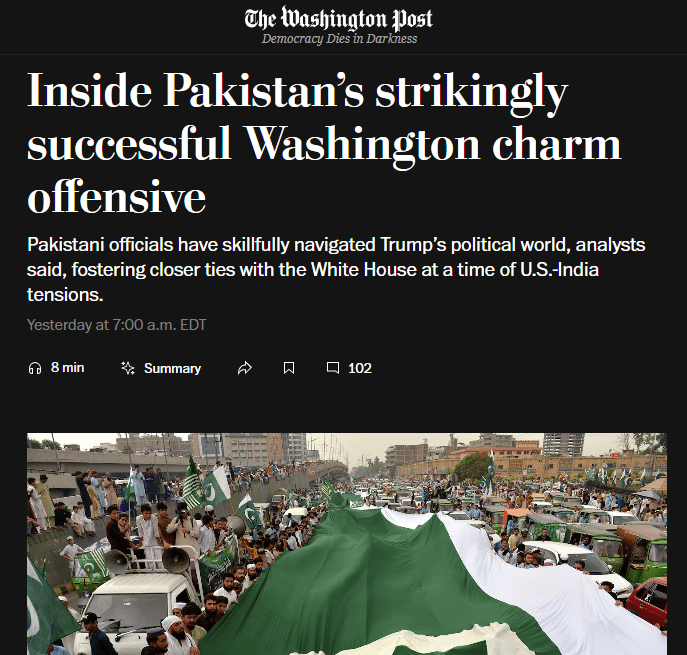
On the day Donald Trump delivered his second inaugural address, anxious whispers circulated among Pakistani officials: could this herald a return to the president’s anti-Pakistan rhetoric? During his first term, Trump had publicly accused Pakistan of deceit and harboring terrorists, while lauding India instead. Yet, in a stunning reversal, Pakistan now finds itself in a rare position of favor in the Trump White House—propelled not by ideology, but deft diplomacy and strategic outreach.
You May Like To Read: The Kulbhushan Jadhav Echo: Enduring Relevance of Espionage Cases in Indian Proxy Warfare
Source: Washington Post
From Surprise to Strategy
Over six months into Trump’s second term, a striking diplomatic transformation has unfolded: while U.S.–India relations have deteriorated amid escalating trade friction and a personal spat between Trump and Prime Minister Narendra Modi, Pakistan has quietly engineered warmer ties with Washington.
Pakistan’s military leadership, particularly Field Marshal Asim Munir, Chief of Army Staff (COAS), has played a central role in orchestrating this turn. Describing his recent U.S. visits as “a sign of a new dimension,” COAS Asim Munir has become the face of Islamabad’s charm offensive.
A Deal-Centric Diplomacy
At the heart of this evolving relationship lies a suite of gains visible to all:
- Tariff concessions: Pakistan secured U.S. import duties at a strikingly low 19 percent, significantly undercutting the 50 percent tariff slapped on India for its Russian oil purchases, as well as the initially threatened 29 percent tariff on Pakistan.
- Economic and energy collaboration: Trump has promoted plans to explore Pakistan’s “massive” oil reserves. Islamabad, in turn, has proposed joint ventures in cryptocurrencies and rare-earth minerals—sectors that have gained traction in Washington’s strategic calculus.
- Counterterrorism cooperation: The U.S. officially designated the Majeeb Brigade an offshot of Fitna-al-Hindustan (FAH) as a foreign terrorist organization—a diplomatic win for Pakistan—while praising its role in capturing a senior ISIS-K operative responsible for the 2021 Kabul airport bombing.
- Landmark trade agreement: In late July, Islamabad and Washington inked a pivotal trade deal. It promises reciprocal tariff reductions across key sectors—textiles, leather, IT, agriculture—and ambitious energy cooperation including oil exploration in Balochistan, Sindh, Punjab, and Khyber Pakhtunkhwa.
The White House Connection
A decisive moment came in June when Trump hosted a private White House lunch for COAS Asim Munir—an extraordinary gesture for a foreign military officer. During their two-hour meeting, discussions spanned trade, crypto, minerals, and regional conflicts, signaling deeper U.S. interest in Pakistan’s geoeconomic potential. Pakistan’s lobbying tactics were equally sophisticated. Interior Minister Mohsin Naqvi traveled to Washington during Trump’s inauguration week to meet with key congressional figures, while Pakistani officials engaged lobbyists closely tied to Trump’s political circle.
Trump drops the line: “I love Pakistan!” 🇵🇰
Says Gen. Asim Munir played a key role in stopping a war with India. 🛑🔥 pic.twitter.com/qpAYLasZGk— Mansoor Ahmed Qureshi (@MansurQr) June 18, 2025
Ceasefire and Diplomatic Theater
Further accelerating momentum was Trump’s claim of brokering a ceasefire between India and Pakistan in May—a claim Islamabad readily embraced, even going so far as to nominate Trump for the Nobel Peace Prize. India, by contrast, rejected any third-party mediation, asserting the truce was achieved solely through military-level dialogue. Washington’s narrative, however, framed Trump as savior—enriching Islamabad’s diplomatic positioning.
A Fragile Triumph
Despite these advances, many analysts warn that this rapprochement may be transactional and fragile:
- Strategic calculus: India remains geopolitically more vital to Washington as a democratic counterweight to China. Islamabad’s rise, while opportunistic, may not endure if regional dynamics shift.
- Economic and security vulnerabilities: Pakistan’s economy and internal security—especially in volatile provinces—could derail lofty promises around oil and tech investments.
- Trump’s unpredictability: Given his transactional instincts, Trump’s favor could swiftly pivot based on shifting political winds and perceived benefits.
Ripple Effects and Regional Reactions
The recalibration has not gone unnoticed:
- India alarmed: Delhi has seen the outreach as a diplomatic provocation. Reportedly, policymakers are recalibrating ties with China—despite their tensions—as a hedge against growing U.S.–Pakistan warmth.
- Narrative warfare: Murky messaging around “Operation Sindoor” and competing claims of victory have colored national narratives across both neighbours—elevating military figures and weaponizing public sentiment.
A Calculated Pivot with Uncertain Longevity
In recent months, Pakistan has achieved a remarkable reset with Washington—leveraging charm, strategic offerings, and deep diplomatic engagement. Tariff reductions, joint ventures in energy and crypto, high-level access in Washington, and counterterrorism cooperation all point to a pragmatic, results-driven approach that has outmaneuvered India’s more values-driven diplomacy.
But beneath the veneer of success lies an array of unknowns: the resilience of Pakistan’s economy, the volatility of U.S. policy under Trump, India’s recalibrations, and regional security flashpoints. For Islamabad, the challenge now is translating access into sustainable partnerships—and ensuring that this charm offensive doesn’t prove fleeting.
You May Like To Read: Gulf Economies’ Diversification (Vision 2030): What it Means for Pakistani Labour Exports