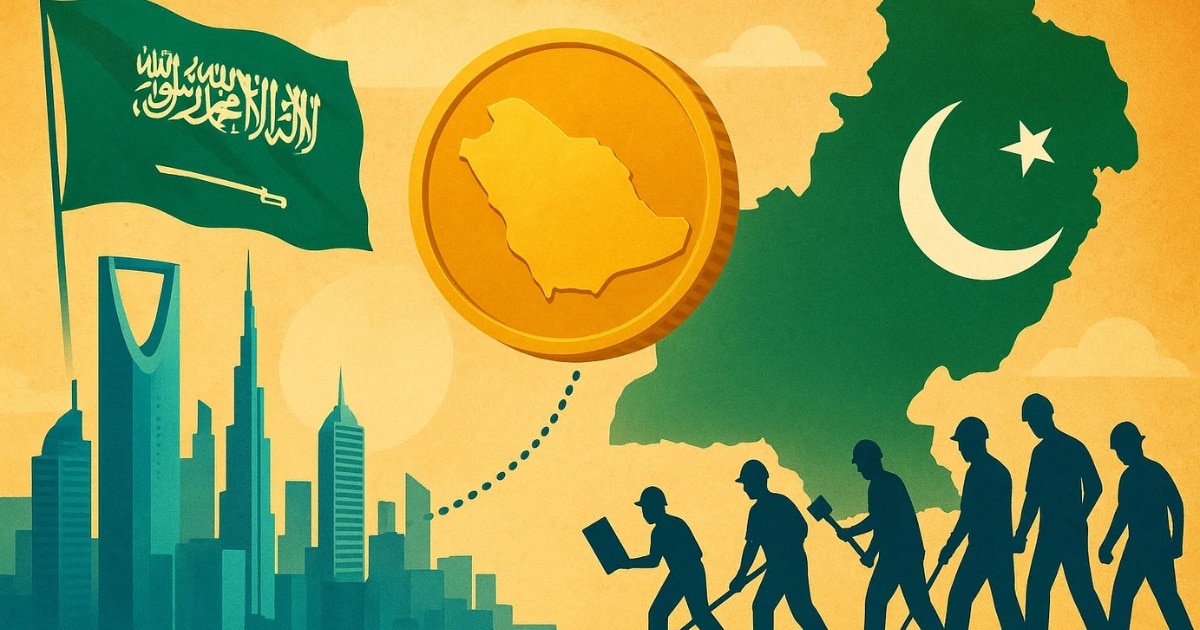





As Gulf economies double down on diversification under their Vision 2030 roadmaps, Pakistan’s overseas workforce faces a sharper, more skills-driven contest for opportunity. The headlines in 2025 are mixed. Record remittances flowing into Pakistan, tighter localisation rules in host countries, evolving visa and skills verification regimes, and a continuing, if recalibrated, pipeline of mega-projects that still need manpower. Understanding these shifts is essential for policy and planning in Islamabad.
Pakistan’s remittances hit an all-time high of $38.3 billion in FY25, providing vital support to the external account. July 2025 alone brought $3.21 billion, with Saudi Arabia and the United Arab Emirates leading inflows. This underscores how crucial Gulf markets remain for Pakistani households and the national balance of payments, even as host economies change the rules of the game.
Chaired today’s Cabinet meeting at Qasr Al Watan, Abu Dhabi. Approved our National Investment Strategy for the next 6 years, aiming to increase annual FDI inflows from AED 112B in 2023 to AED 240B by 2031, and grow FDI stock from AED 800B to AED 2.2T, focusing on industry,… pic.twitter.com/WVefEiUzeq
— HH Sheikh Mohammed (@HHShkMohd) March 10, 2025
A New Jobs Map in the Gulf
Saudi Arabia’s Vision 2030 is moving from aspiration to delivery, and adjustment. While flagship projects like NEOM, Diriyah and the Red Sea continue to anchor demand in construction, tourism, transport and utilities, the state investor PIF has acknowledged an $8 billion write-down across giga-projects, reflecting cost pressures and scope changes. Yet the broader agenda is intact and now intertwined with guaranteed global events. Expo 2030 in Riyadh and the 2034 FIFA World Cup, both of which will sustain hiring across construction, hospitality, venues, transport and city services. For Pakistan, this means opportunities will persist but will be more phased, standards-driven and time-bound around milestones.
The UAE’s model is also shifting. Diversification is speeding up in finance, logistics, clean energy and advanced services, while Emiratisation quotas tighten year by year. In 2025, authorities reinforced compliance deadlines and expanded requirements, pushing firms to add Emirati hires, especially in skilled roles. This does not end foreign hiring; it changes its composition, fewer low-skill openings, more emphasis on certified skills and niche expertise.
You May Like to Read: The ‘New Energy Policy’
Localisation and Skills: The New Gatekeepers
Pakistani workers today meet higher regulatory bars. Saudi Arabia’s Professional/Skills Verification Program requires tradespeople to pass theory and practical assessments before visas or renewals, part of a push to upgrade workforce quality and support Saudisation. Pakistan became an early partner via NAVTTC and Takamol, signalling a pathway for compliant, tested talent to move faster. For migrants, the message is clear: documented skills, verifiable credentials and safety compliance are no longer optional.
At the same time, localisation targets in the UAE are being actively enforced with penalties for non-compliance and incentives for firms that hit benchmarks through the Nafis program. The upshot for Pakistani job-seekers is that hiring in general administration and entry-level services will narrow, while demand rises in specialised construction trades, MEP, project controls, HSE, facility management, ICT, hospitality operations, and green energy maintenance, provided candidates hold the right certifications.
You May Like to Read: Digital Economy and IT Exports
Where the Demand Is, And How It’s Changing
Despite cost resets, Saudi’s build-out for Expo and the World Cup keeps the construction and infrastructure engine running, complemented by tourism assets, metro and road mobility, stadiums and fan infrastructure. Consulting and industry analyses point to sustained needs across civil works, rail and mobility, accommodation and venue operations in the lead-up to 2030 and 2034. Employers increasingly favour project-based and freelance models, with value placed on digital tools, BIM, QA/QC, and HSE culture.
Outbound flows from Pakistan reflect these dynamics. Official data show thousands of proceeding abroad annually, with Saudi Arabia regaining share in 2025, while the UAE’s intake fluctuates under tighter screening and localisation pressures. That said, the Emirates continue to hire, just with greater emphasis on qualifications and sector fit.
What Pakistan Must Do Next
First, double down on skills that map to Gulf priorities. Islamabad’s partnership with Saudi Arabia on skills verification is a good start, but scale matters. NAVTTC and provincial TVET bodies should align curricula with host-country test banks, expand modern apprenticeship pathways, and fast-track trade testing in high-demand occupations, electrical, HVAC, welding, scaffolding, rigging, crane operations, safety supervision, and facility maintenance. Embedding Arabic-language safety modules and customer-service training would raise pass rates and job retention.
Second, formalise credentials and digital records. Gulf HR systems now cross-check qualifications; digitised certificates, work histories and HSE clearances reduce visa friction. Pakistani agencies and recruiters must pivot from volume to verifiable quality, clamping down on misclassification and paper-only “experience.”
Third, protect workers and Pakistan’s reputation. Enforcement of ethical recruitment, contract transparency and grievance redressal keeps corridors open. Gulf regulators are sensitive to welfare compliance, visibility on accommodation standards, wage protection and onsite safety helps both workers and employers and sustains demand for Pakistani talent.
Finally, anticipate sector pivots. As Emiratisation absorbs more office roles, Pakistan should tilt toward specialist construction, operations, logistics, hospitality and green-energy maintenance, plus ICT and cybersecurity where localisation remains gradual and global skills are scarce. Riyadh’s transport ambitions and venue pipeline, together with Saudi Arabia’s broader services push, point to steady, but more competitive, demand for certified technicians, supervisors and mid-management professionals.
You May Like to Read: The Economic Survey Paradox
Concluding
Vision 2030 across the Gulf is not closing doors to Pakistan; it is changing the locks. The corridors remain open, the projects are still large, and the remittance impact is visible at home. But success now hinges on tested skills, clean documentation, language and safety culture, and recruiters who deliver quality over quantity. If Pakistan scales these reforms quickly, building on the skills-verification track and aligning TVET with host-country standards, our workers can thrive in a higher-bar, higher-wage Gulf economy and keep remittances resilient through the decade.