




Pakistan’s Interior Minister, Mohsin Naqvi, has reaffirmed the federal government’s resolve to eliminate terrorists associated with Fitna‑ul‑Hindustan (FAH) operating in Balochistan. The assurance came during a high‑level law and order meeting in Quetta, chaired by Naqvi and attended by Balochistan Chief Minister Mir Sarfraz Bugti, senior law enforcement officials, and representatives of intelligence and frontier corps units.
Context and Designation
Last month, the Ministry of Interior issued a formal notification designating all terrorist groups active in Balochistan as “Fitna al‑Hindustan”, citing alleged sponsorship from India. The move was intended to highlight what the government described as the ideological and operational nature of these groups and their external backing. Prime Minister Shehbaz Sharif has similarly accused India of launching indirect aggression via proxy outfits in the province.
Operational Successes and State Messaging
In recent months, Pakistani security forces have conducted multiple intelligence‑based operations resulting in the neutralisation of terrorists linked to the Fitna‑ul‑Hindustan network:
- In early June, at least seven terrorists were killed across separate operations in Balochistan, prompting Naqvi to declare that their complete elimination was “the top priority” of the federal government.
- On July 22, in Kalat district, four terrorists were neutralised during a sanitisation operation following a prior intelligence‑based raid—authorities recovered weapons, explosives and destroyed hideouts. Naqvi affirmed there would be “no safe shelter” for these elements in Pakistan.
- In a separate incident on July 18, militants linked to Fitna‑al‑Hindustan attacked a police convoy between Kalat and Quetta. Two officers—Acting DSP Inspector Abdul Razzaq and Constable Raza Muhammad—were martyred, and others were injured. Naqvi strongly condemned the attack and reaffirmed the government’s commitment to eradicating those responsible, describing them as “acting on foreign directives”.
High-Level Coordination and Federal Support
During the Quetta meeting, Naqvi pledged unwavering federal support to the provincial administration. The gathering emphasised intensified counter‑terrorism efforts, coordinated actions across state institutions, and enhanced intelligence sharing among security agencies. CM Bugti reiterated that all institutions were working in concert “to ensure lasting peace in Balochistan.”
You May Like To Read: Afghan Taliban and FAK: Two Sides of the Same Coin?
Symbolism of State Resolve
The rhetoric of complete eradication underscores a broader state messaging strategy: to delegitimise these groups as externally orchestrated actors, not indigenous movements. Security agencies, including the ISPR, have portrayed these militants as Indian proxies. In May’s Machh bombing, for example, Pakistan blamed Fitna‑ul‑Hindustan for killing 14 soldiers in twin attacks. Subsequent sanitisation operations were framed as direct responses to “Indian proxy terrorism”.
Similarly, Operation Azm‑e‑Istehkam, launched in June 2024, has been the umbrella counter‑insurgency effort encompassing military, law enforcement, and intelligence operations against a wide range of extremists in Balochistan and Khyber Pakhtunkhwa.
Assessment: Security Gains Amid Rising Pressure
Mohsin Naqvi’s emphatic vow to eradicate Fitna‑ul‑Hindustan terrorists marks a continuation and intensification of recent policy. Operational gains—such as neutralising multiple militants—lend credibility to the federal assertion of results. At the same time, repeated attacks on security forces and civilians—including children and unarmed passengers—underline the persistence of the threat and its human cost.
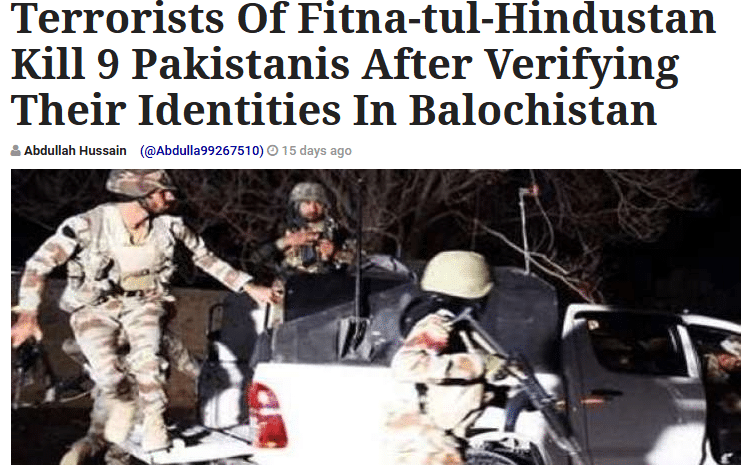
Source: Pakistan Point
The political framing aims to consolidate national consensus: the entire leadership—President, Prime Minister, provincial chief minister, and military authorities—is unified in denouncing these groups as state-sponsored chaos agents and enforcing a zero‑tolerance policy that extends beyond sporadic raids into a sustained campaign of denial of sanctuary and infrastructure dismantling.
Forward Outlook and Challenges
Despite tangible progress in neutralisation efforts, the complex insurgency ecosystem in Balochistan continues to challenge authorities. Pro‑independence factions, low‑intensity guerrilla tactics, and the rugged terrain allow militants to embed within sympathetic communities, complicating intelligence gathering and ground operations. Furthermore, allegations of human rights abuses, collateral damage, or overreach during operations may erode public trust if not carefully managed.
Addressing root causes such as socio-economic underdevelopment, local grievances, and political marginalisation remains essential to complement kinetic efforts. The government’s strategic mix—naming, military action, security coordination—is at a critical juncture: continued disruption of militant infrastructure must be paired with visible investment in local development and inclusive governance to avoid perpetuating the cycle of violence.
You May Like To Read: ISIS-K’s Expanding Reach: Threatening Pakistan and the Region
Interior Minister Mohsin Naqvi’s pledge to completely eradicate Fitna‑ul‑Hindustan terrorists from Balochistan reflects both recent operational successes and a clear political narrative framing the insurgency as foreign‑inspired. While security gains have been notable, lasting peace will depend not only on intelligence‑led operations but also on addressing the underlying socio-political dynamics in the region. The state’s challenge now is to sustain its pressure on militants while building credibility and legitimacy among Baloch communities.