


Introduction: A shift in national priorities
For decades, Pakistan has viewed its foreign and domestic policy through the prism of security, border protection, defense, strategic alliances. That approach has real merits, reflecting the region’s volatility and the need for a strong defence posture. But in 2025, a different kind of urgency is becoming clearer. Economic fragility, balance-of-payments stress, slow job creation and volatile global markets are making it necessary to consider a reorientation: harnessing Pakistan’s geography, ports and people to become a regional trade and logistics hub. This doesn’t mean sidelining security, but embedding economic connectivity as a pillar of national resilience.
You May Like to Read: Strategic Autonomy Under Economic Constraints: Can Pakistan Escape External Financial Dependence?
Recent trade performance: modest growth but persistent imbalances
The latest data from the Pakistan Bureau of Statistics (PBS) show that Pakistan’s exports are seeing some improvement. In July 2025, exports amounted to Rs. 762,746 million, up about 18.8% from July 2024. In US dollar terms, exports in July 2025 reached $2.686 billion, up 16.4% year-on-year.
In fiscal year 2024–25, total exports reportedly rose to $31.75 billion, compared to $30.76 billion in the previous year.
Still, imports remain large (particularly energy, machinery, raw materials, etc.), and trade deficits persist. That means Pakistan cannot rely simply on modest export growth, it needs structural changes to convert geography and potential into sustainable trade flows and value-added export sectors.
You May Like to Read: Pakistan Initiates Landmark Plan to Develop Three New Deep-Sea Ports
Infrastructure opportunities: ports, connectivity and regional reach
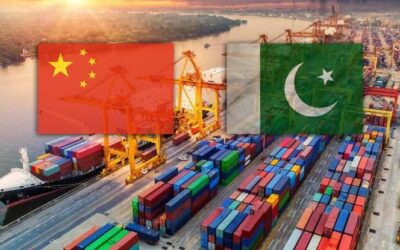
What gives Pakistan a real shot at becoming a regional trade hub is geography, and the effort now underway to turn that into real logistics infrastructure. The 2025–2029 Maritime Affairs Action Plan underscores an ambition to transform Gwadar Port into a regional transit and logistics hub, integrating with the New Gwadar International Airport to enable multimodal transport. Expansion of the port, completion of Free Zone Stage II and acceleration of expressway projects (e.g. the East Bay Expressway Phase II) are part of this strategy.
In parallel, coordination among major ports, Karachi Port, Port Qasim and Gwadar, plus planned upgrades to rail and road links, aim to create a logistics network that could serve Central Asia, the Middle East, Africa, and South Asia.
This kind of strategic infrastructure, deep-sea ports, free zones, airport-port connectivity, and onward corridors, offers Pakistan a genuine competitive advantage, if execution remains on track.
You May Like to Read: Pakistan, and China Launch Five-Year Maritime Action Plan to Operationalize Gwadar-Africa Shipping Corridor
Digital and institutional reforms: modernizing trade facilitation
Infrastructure matters, but so does how efficiently goods move through the system. In 2025, Pakistan launched a suite of reforms aimed at improving port operations and customs processes. The PCS (Port Community System) is being rolled out to streamline information flow among stakeholders; the customs agency is upgrading its Web-Based One Customs (WeBOC) platform; and ports are deploying modern terminal-operating systems, vessel-traffic management, and risk-based inspection systems.
These reforms aim to speed cargo handling, cut down delays, reduce corruption and improve transparency, a transformation from paper-heavy, slow bureaucracy to data-driven, streamlined logistics. For a country hoping to attract transshipment business and regional trade flows, such institutional modernization is not optional: it is the linchpin.
Further, the federal government has reduced port-handling and vessel charges at Karachi Port by 50%, partly as a climate-conscious maritime reform and partly to lower the cost burden on trade logistics. Such financial incentives, combined with digital reforms, can make Pakistani ports more competitive relative to regional alternatives.
You May Like to Read: AI and Trade: Will Automation Collapse the Labour-Export Economies of the Global South?
Blue economy, export diversification, and value addition
The 2025 maritime vision for Gwadar and coastal areas does not only target container traffic or re-exports. Significant emphasis is being placed on developing the “blue economy” notably fisheries, aquaculture, and exports of value-added seafood and dates. The government believes that Gwadar could generate over $850 million annually in exports if the fisheries and dates sectors are properly modernized, processed, and connected to global markets.
On the broader exports front, textiles, garments, bed-wear and other traditional sectors remain critical. In July 2025, knitwear, readymade garments, bedwear, cotton cloth, rice, towels and made-up articles were among the top exported items. Yet for sustainable growth, Pakistan must not only export raw textiles but move up the value chain, more processed garments, design-driven products, compliance with international standards, and leverage logistics improvements to deliver competitively.
Developing the blue economy and upgrading traditional export sectors simultaneously will offer diversification, a hedge against global demand fluctuations, and open new markets for Pakistan beyond textiles alone.
Challenges and the need for governance, regulatory clarity
Transforming into a trade state won’t happen automatically. Infrastructure and digital systems are necessary but not sufficient: seamless port operations, transparent customs, rule-based regulation, and consistent long-term policies are essential. Frequent policy shifts, regulatory uncertainty, slow implementation, or governance lapses can frustrate investors and traders alike.
Moreover, connectivity alone does not guarantee trade. Regional geopolitics matters. Pakistan’s ability to serve as a transit corridor, say for Central Asia or Afghanistan, will depend on stable diplomatic ties, consistent transit agreements, and mutual trust. Trade corridors must be institutionalised as part of national strategy, not just aspirational rhetoric.
Finally, value addition and export diversification call for investments in skills, processing infrastructure, export-grade compliance, quality controls, and marketing, not just ports. Without committed support in these areas, Pakistan risks remaining a raw-material or low-value exporter, even if trade flows increase.
Why now: urgency and opportunity
2025 is not an arbitrary moment for this reorientation. Global trade patterns are shifting: supply-chain disruptions, rising shipping costs, and geopolitical realignments mean many importers and exporters are seeking alternative routes and new hubs. For Pakistan, having deep-sea ports on the Arabian Sea, proximity to the Gulf, and potential access to Central Asia offers real leverage. The policy decisions now being taken, investing in ports, integrating airports and seaports, digital customs, suggest official recognition that Pakistan must reposition itself economically.
At home, exporters seem to respond: official figures show export growth and expansion of the export base beyond traditional categories. For the government, expanding port capacity, reducing costs, and improving ease-of-trade are becoming priorities.
The blue economy adds another dimension, food exports, seafood, date processing, that could benefit coastal Balochistan and offer jobs, export revenue, and regional economic uplift.
A balanced geoeconomic strategy: security and trade in tandem
This shift from a predominantly security-driven posture to one that blends economic connectivity does not weaken national security, it redefines it. A country that is economically integrated, with thriving commerce, regional trade links, and stable transit corridors, arguably builds resilience: more jobs, more investment, more capacity to absorb external shocks.
In that sense, transforming infrastructure, streamlining trade facilitation, growing exports, and attracting investment should be treated as strategic national priorities, not just economic policy.
You May Like to Read: The Economic Architecture of a Multipolar World Order
Conclusion: From potential to performance
Pakistan has in 2025 opened a window of opportunity. Geography, infrastructure plans, digital reforms, a growing export base and political vision all converge to suggest that reimagining Pakistan as a regional trade hub is now plausible, if not probable. The foundations of a “trade state” are already being laid: port expansions, integrated airports, free zones, customs digitization, blue economy push, export growth, and incentives for logistics efficiency.
What remains critical is follow-through: consistent implementation, policy stability, regulatory transparency, investment in value-addition and human capital, and diplomatic efforts to embed Pakistan in regional trade corridors. If these steps are taken with discipline, 2025 could mark the beginning of a new chapter, one in which Pakistan’s strategic depth becomes economic depth, and where trade becomes not an after-thought but a national strategy.