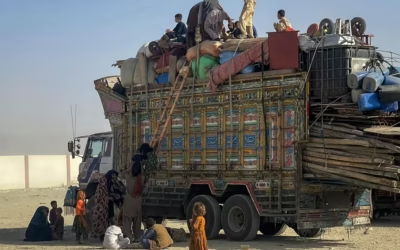



Urban crime in Pakistan’s major cities has become a pressing concern, with street robberies, burglaries, and violent crimes dominating news cycles. Traditional policing methods have largely failed to curb this surge, leading to growing interest in community policing –a model that emphasizes collaboration between law enforcement and citizens to prevent crime rather than merely react to it.
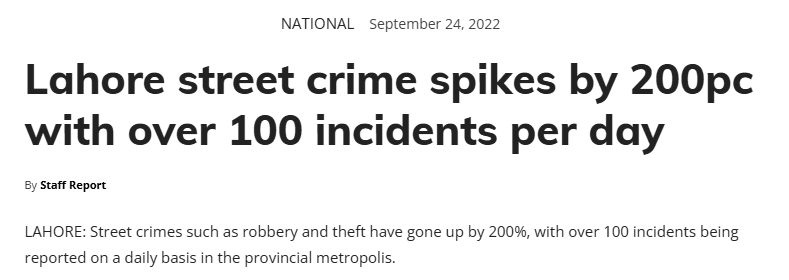
Source: Pakistan Today
Understanding Community Policing
Community policing represents a fundamental shift from conventional law enforcement strategies. Instead of relying solely on arrests and punitive measures, it focuses on building trust, proactive engagement, and collaborative problem-solving. Where officers work closely with residents to identify and address local security concerns, such as poor street lighting, drug trafficking hotspots, or gang activity.
In Pakistan, where public confidence in law enforcement remains low. A 2025 Gallup survey found that only 23% of citizens trust the police –community policing offers a potential pathway to bridge this gap. However, its success depends on overcoming deep-seated institutional and societal challenges.
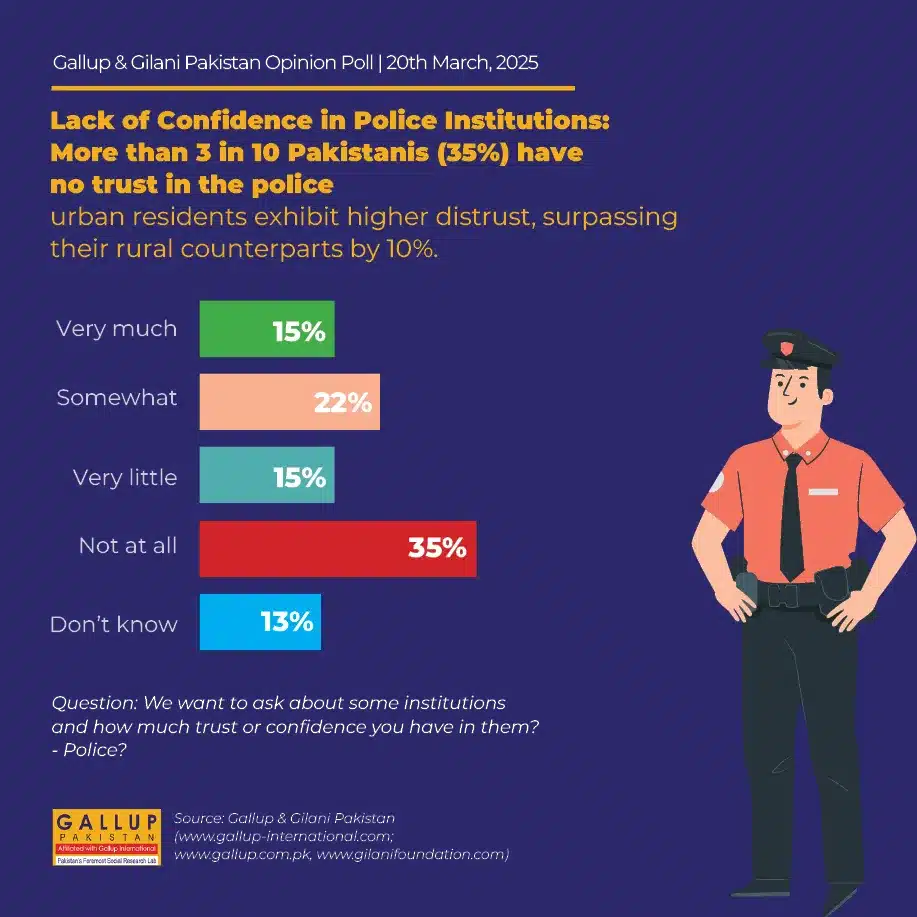
Source: Gallup and Gilani Pakistan
Existing Community Policing Models in Pakistan
Pakistan’s urban security challenges have spurred several community policing initiatives, each adapting to local needs while facing unique constraints.
Karachi’s Citizens-Police Liaison Committee (CPLC)
Established as a public-private partnership, the CPLC has become one of Pakistan’s most recognized community policing efforts. It operates a dedicated hotline for citizens to report crimes, particularly thefts of mobile phones and vehicles.
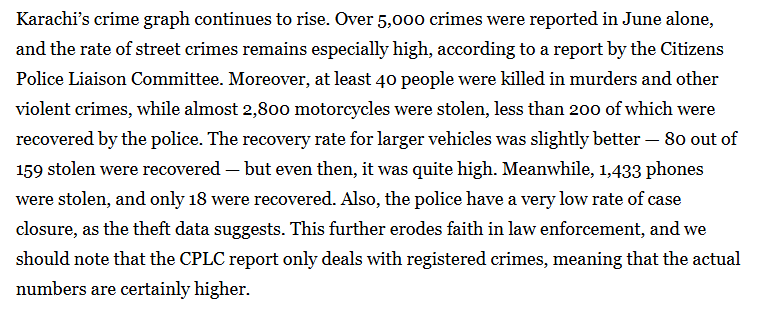
The latest Citizens-Police Liaison Committee (CPLC) report paints a grim picture of urban crime and police effectiveness. Shockingly, 40 lives were lost to violent crimes while criminals made off with nearly 2,800 motorcycles, from which police recovered fewer than 200.
Source: Tribune
The recovery statistics reveal systemic failures. Only 18 of 1,433 stolen phones were retrieved, while 80 of 159 stolen vehicles were recovered, a relatively better rate; these numbers, however, remain alarmingly low.
The CPLC’s scope remains limited. While effective in tracking stolen goods, it does little to address violent crime or systemic policing issues. Additionally, its reliance on technology excludes marginalized communities with limited access to smartphones or the internet.
Lahore Police Khidmat Markaz (Service Centers)
Lahore’s experiment with community policing takes a different approach. The city has established service centers where police officers mediate local disputes such as landlord-tenant conflicts or family feuds, before they escalate into violent crimes.
Yet, this model is not without flaws. It functions more as a dispute-resolution mechanism than a comprehensive crime prevention strategy. Moreover, funding constraints have prevented its expansion to high-crime neighborhoods that need it most.
Challenges Hindering Effective Implementation
The challenges obstructing the effective implantation of community policing are as follow;
Institutional Resistance
A major obstacle is the reluctance within police departments to adopt community-oriented approaches. As many officers, trained in traditional, authoritative policing, view public engagement as secondary to law enforcement. This mindset, coupled with a lack of training in conflict resolution and community relations, stifles reform efforts.
Resource Constraints
Most community policing initiatives in Pakistan operate on shoestring budgets, relying on donor funding or limited government allocations. The absence of a national policy on community policing further exacerbates inconsistencies, with programs varying widely in scope and effectiveness across cities.
Public Distrust
Decades of corruption, inefficiency, and heavy-handed tactics have eroded public confidence in law enforcement. Many citizens remain skeptical of community policing, fearing it may be another superficial reform. Low crime reporting rates driven by distrust further undermine data-driven policing strategies.
Scaling Up: Is Nationwide Adoption Feasible?
For community policing to succeed at scale, Pakistan must address several critical gaps:
- The government must institutionalize community policing through legislation and dedicated funding. Ad-hoc projects, no matter how successful, cannot replace systemic reform.
- Performance metrics should extend beyond crime statistics to include public satisfaction surveys. Policing strategies must be evaluated not just by arrest numbers but by whether citizens feel safer, or not.
- Media and civil society must play a role in reshaping public perceptions. Transparent reporting on successful cases such as the CPLC’s recoveries can help rebuild trust.
A Promising but Unfulfilled Solution
Community policing offers a viable alternative to Pakistan’s failing crime control strategies. Pilot programs, to foster better relations between community and law enforcement agencies particularly police, show that collaborative policing can reduce certain crimes and improve police-community relations.However, without structural reforms, consistent funding, and a shift in policing culture, these efforts risk remaining isolated successes rather than nationwide solutions. The question is not whether community policing can work in Pakistan, but whether authorities are willing to commit to the long-term changes required making it effective.