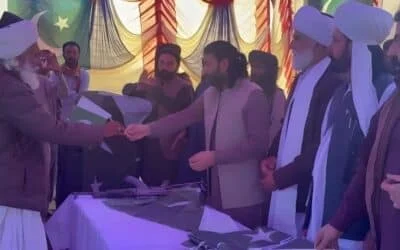
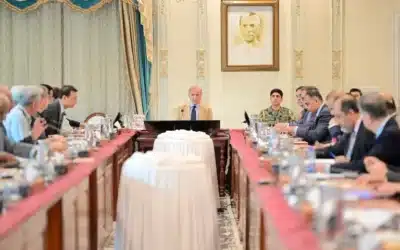
In a significant diplomatic engagement, Russian Deputy Prime Minister Alexei Overchuk declared Pakistan an “important partner” in regional economic and energy development, calling the two nations “natural allies.” The remarks came during a high-level meeting in Moscow between Russian officials and a Pakistani delegation attending INNOPROM, Russia’s largest annual industrial trade fair.
The meeting underscores the growing strategic and economic partnership between Pakistan and Russia, spanning energy, infrastructure, and regional connectivity. With discussions on a new steel mill in Karachi, railway projects, and enhanced trade underway, both nations appear poised to deepen their collaboration in the coming years.
Current Developments: High-Level Engagements and Key Statements
Recent months have seen a flurry of diplomatic activity between Pakistan and Russia, signalling a strong commitment to expanding bilateral ties.
According to the Press Release issued by Pakistan’s Ministry of Foreign Affairs (MoFA), Special Assistant to the Prime Minister (SAPM) on Foreign Affairs, Ambassador Syed Tariq Fatemi, held a meeting with Russian Deputy Prime Minister Alexei Overchuk in Moscow. The discussions focused on strengthening bilateral cooperation in key areas such as trade, energy, and regional connectivity, with both sides reaffirming their commitment to enhancing economic ties. MoFA in the press release iterated;
The SAPM [Ambassador Syed Tariq Fatemi] expressed satisfaction at the ongoing energy cooperation between the two countries, while confident of further expansion of ties in this vital sector.
SAPM Haroon Akhtar conveyed that Pakistan attached high importance to ongoing discussions on the new Steel Mills in Karachi, as the project carried an important legacy of Pakistan’s relations with Russia, which could serve as a “leap forward” symbol of future cooperation and partnership. The SAPM gave an overview of the investment-friendly industrial policy of Pakistan, which had ensured macro-economic stability, achieved under the present Government.
The Russian Deputy Prime Minister Overchuk reiterated Russia’s view of Pakistan as an “important partner” and highlighted ongoing projects like the Pakistan Stream Gas Pipeline (PSGP) and the proposed Uzbekistan-Pakistan-Russia railway link. The meeting underscored the growing strategic alignment between the two nations, with plans for further high-level engagements, including a potential meeting between Prime Minister Shehbaz Sharif and President Vladimir Putin at the upcoming SCO Summit in China.
Russian Deputy PM’s Remarks on Strategic Partnership
During the Moscow meeting, Alexei Overchuk reiterated Russia’s commitment to Pakistan and intentions of increasing cooperation in the energy sector, development of railways, and industrial projects, like the proposed steel mill plant in Karachi. The Press Release by MoFA further stated:
He [DPM Overchuk assisted by key Ministers] also pointed out potential areas, such as hydropower, LPG and modernisation of oil refineries, as suitable for future collaboration. He also stated that Russia was looking forward to working closely with Pakistan in the energy sector, which would be an important element in the agenda for the 10th session of the Pakistan-Russia Inter-Governmental Commission (IGC) on Trade, Economic, Scientific and Technical Cooperation, scheduled in Islamabad this year.
He also emphasised the importance of the Uzbekistan-Pakistan-Russia railway link and the upcoming pilot cargo train service (August 2025), which will enhance trade connectivity.
Historical Context
Pakistan and Russia (formerly the Soviet Union) had a complicated relationship during the Cold War, with Islamabad aligning closely with the U.S. and Moscow backing India. However, the post-9/11 geopolitical shifts and Pakistan’s evolving foreign policy have led to a gradual thaw in relations.
The Shanghai Cooperation Organisation (SCO) has been a key platform for fostering Pakistan-Russia ties. Pakistan became a full SCO member in 2017, opening doors for greater economic and security cooperation with Russia and Central Asian states.
Pakistan’s Delegation at INNOPROM: Focus on Industrial Growth
From the statements and information obtained from press releases issued by the MoFA, it is apparent that Pakistan is keen to attract Russian investment in key sectors. To Pakistan’s advantage, the government’s business-friendly policies under the SIFC (Special Investment Facilitation Council) provide excellent opportunities for joint ventures.
Likewise, the new steel mill project in Karachi, with Russian collaboration, will be a game-changer for Pakistan’s industrial sector. It will not only revive a historic project but also create thousands of jobs.
Key Areas of Cooperation
Energy Partnerships
Russia has emerged as a crucial player in Pakistan’s energy sector. The Pakistan Stream Gas Pipeline (PSGP), previously known as the North-South Gas Pipeline, is a flagship project between the two countries. Initially agreed upon in 2015, the project aims to transport LNG from Karachi to Lahore, enhancing Pakistan’s energy infrastructure.
Russia has also shown interest in Pakistan’s oil and gas exploration sectors. In 2022, Russian energy giant Gazprom expressed willingness to invest in Pakistan’s energy market, including LNG terminals and refinery upgrades.
Trade and Industrial Collaboration
The Pakistani delegation at INNOPROM highlighted investment opportunities in Pakistan’s industrial sector. A major point of discussion was the revival of Pakistan Steel Mills (PSM)—a Soviet-era project that once symbolised industrial progress but collapsed due to mismanagement. 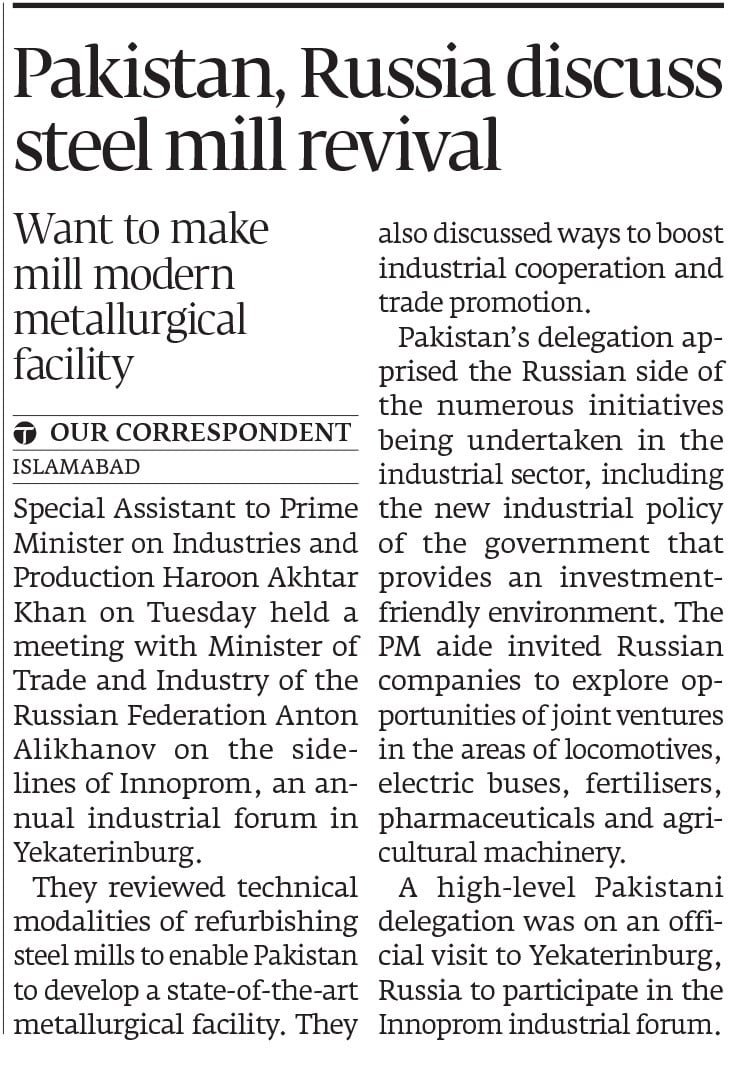
Source: Tribune
Russia has expressed interest in establishing a new steel plant in Karachi, which could mark a significant leap in bilateral industrial cooperation. This project aligns with Pakistan’s efforts to attract foreign investment under the Special Investment Facilitation Council (SIFC), which prioritises key sectors like mining, agriculture, and IT.
Regional Connectivity and Transport
Connectivity remains a cornerstone of Pakistan-Russia relations. Russian Deputy Prime Minister Overchuk emphasised the importance of:
- Uzbekistan-Pakistan-Russia Railway Link: A proposed rail route connecting Central Asia, Pakistan, and Russia to boost trade.
- Pilot Cargo Train (2025): A trial run of a freight train between Pakistan and Russia, expected to enhance logistics and trade efficiency.
Pakistan and Russia are moving ahead with plans to launch a pilot freight train service by August 2025, aiming to enhance regional connectivity and economic cooperation. #PakistanRussia #FreightTrain #RegionalConnectivity #Putin #ShehbazSharif #PakistanSteelMills pic.twitter.com/KaIHlEtClT
— Startup Pakistan (@PakStartup) July 10, 2025
These initiatives align with Russia’s broader Eurasian Economic Union (EAEU) strategy and Pakistan’s vision for the China-Pakistan Economic Corridor (CPEC), creating a transcontinental trade network.
Defence and Security Cooperation
While not explicitly mentioned in recent talks, defence collaboration has been a growing aspect of Pakistan-Russia relations. Almost a decade ago, in August 2015, Pakistan purchased Russian-made Mi-35 attack helicopters, worth 153 million USD. Russia and Pakistan also engaged in joint military exercises, most recently in October 2024, in exercises named Druzbha VII held at Pabbi.
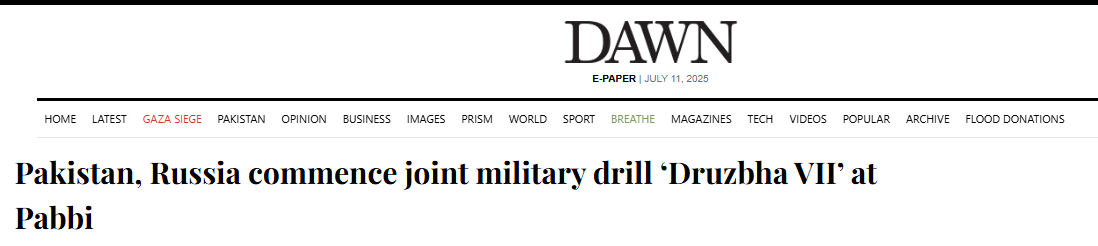
Source: Dawn news
Both countries also share concerns over the regional and international issues pertaining to Afghanistan, the Middle East, and the condition in South Asia. The MoFA in the press release noted;
The two sides also touched upon regional and international issues, such as the situation in South Asia, Afghanistan, and the Middle East, as well as the bilateral cooperation between Pakistan and Russia at all multilateral forums.
Geopolitical Implications
Pakistan’s Balancing Act
Pakistan’s deepening ties with Russia reflect its multi-alignment strategy, balancing relations with the U.S., China, and now Moscow. As Washington’s focus shifts away from South Asia, Islamabad is diversifying its partnerships to secure energy, investment, and geopolitical support.
Russia’s Pivot to Asia
Facing Western sanctions over the Ukraine war, Russia is strengthening ties with Asian nations, including Pakistan. Energy exports, arms sales, and infrastructure projects are part of Moscow’s broader strategy to reduce reliance on European markets. Because the European markets were the largest consumers of Russia’s energy products and services, prior to the sanctioning of Russia amid the Ukraine conflict.
Impact on India-Russia Relations
Traditionally, Russia has been India’s closest ally. However, its growing engagement with Pakistan could test this relationship. While India remains a major arms and crude oil buyer from Russia, Moscow’s outreach to Islamabad may prompt New Delhi to further diversify its defence suppliers (e.g., U.S., France, Israel).
Challenges Ahead
Despite optimistic rhetoric, several hurdles remain:
- Financial Constraints: Pakistan’s economic instability may delay large-scale projects.
- U.S. Sanctions: Closer Pakistan-Russia ties could attract scrutiny from Washington, particularly in the defence and energy sectors.
- Implementation Delays: Past projects like the Pakistan Stream Gas Pipeline have faced bureaucratic and funding delays.
Conclusion
The Moscow meeting highlights a strategic convergence between Pakistan and Russia, driven by mutual economic and geopolitical interests. From energy to railways, both nations are laying the groundwork for long-term cooperation. If successfully implemented, these initiatives could transform Pakistan into a key trade and energy hub linking Russia, Central Asia, and South Asia. For now, the label of “natural allies” seems more than just diplomatic rhetoric—it reflects a shared vision for regional connectivity and economic growth.