
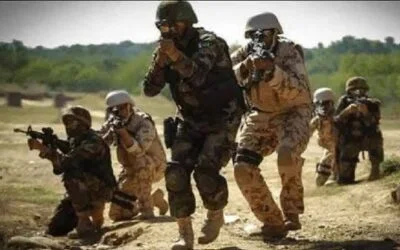


Escalating Crime Patterns in Karachi and the Twin Cities
The early half of 2025 has seen a dramatic increase in street crime across Pakistan’s urban centers, but nowhere more so than Karachi. Data from the Citizens–Police Liaison Committee (CPLC) reveals that between January and March 2025, Karachi reported 16,977 incidents of street crime, including mobile phone snatching, motorcycle theft, and carjacking, resulting in 132 deaths and numerous injuries.

Source: ARY News
Alarmingly, in the first five months, this figure rose to 26,500 incidents, causing 245 fatalities, including 48 lives lost during resistance to robberies.

Source: ARY News
Nearby Rawalpindi and Islamabad are also under pressure. Daily phone snatchings in Rawalpindi and Islamabad now exceed 1,000 cases daily, fueled by smuggling networks that traffic stolen phones to Afghanistan.
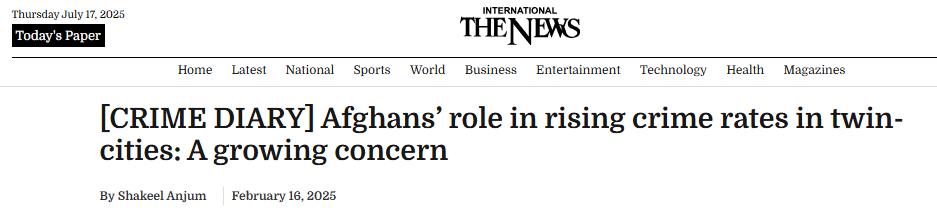
Source: The News
A Reddit account from Rawalpindi reports armed robberies on main roads, with victims stripped of phones and wallets under threat. Karachi’s homicide rate from assaults during robberies adds to the seriousness: at least 46 people killed in street crimes by mid‑May.
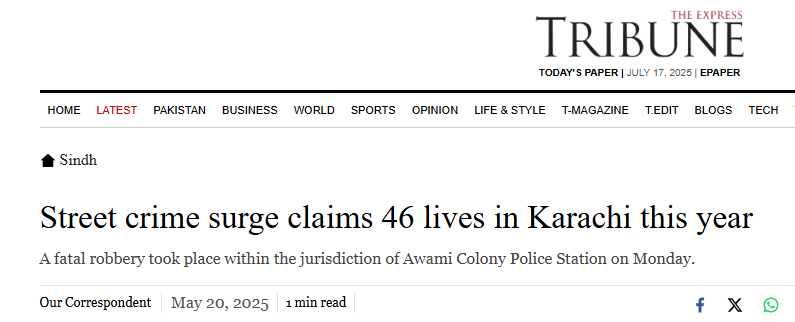
Source: Tribune
Notably, analysts point to economic stress as a fundamental reason behind the surge in Street Crimes. Gary Becker’s rational choice theory, suggests criminals weigh the costs (punishment) against the benefits of their actions; weak deterrence and corruption therefore, contribute to its persistence. The situation is exacerbated by Pakistan Police force’s financial constraints, slow response times, and low conviction rates. Low probability of punishment undermines deterrence, and increases the possibility of recidivism.
Lahore Bucks the Trend
In contrast, Lahore has experienced a sharp reduction in street crime. In January–February 2025, 4,686 total crimes were reported down from nearly 12,739 in 2023. Robberies fell by over 50%, snatchings by 69%, and motorbike thefts by 56%.
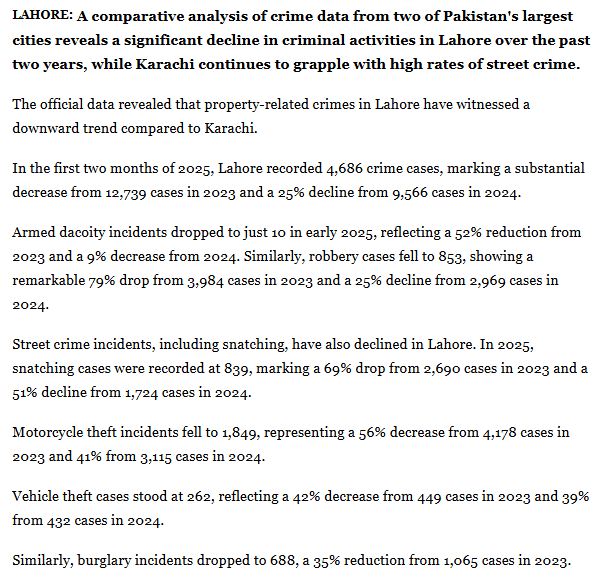
Source: Tribune
These improvements are attributed to the creation of the Crime Control Department (CCD) in February 2025, with 4,250 staff and a budget of PKR 5.56 billion, alongside modern policing technologies.
Urban Desperation: How Economic Stress Fuels the Crime Surge
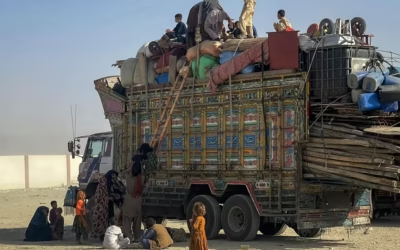
Analysts consistently link the crime surge to economic hardship. Karachi’s soaring unemployment, fueled by prolonged inflation, shuttered businesses, and a surge in climate-induced migration from rural Sindh, has directly contributed to rising incidents of street-level crime. The city’s fragile urban economy is unable to absorb the influx of jobseekers, many of whom fall into informal or criminal networks to survive.
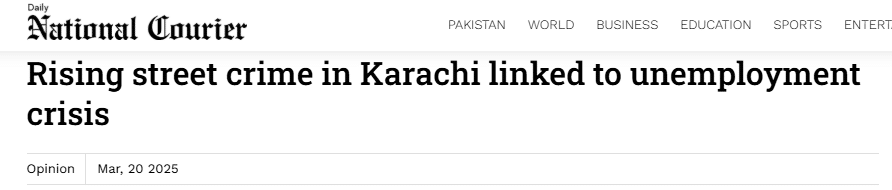
Source: National Courier
The following pattern appears across expert commentary:
Unemployment… economic instability…and a lack of job opportunities… led many to resort to street crimes to survive, noted the National Courier.
Karachi’s descent into lawlessness was primarily due to failures of governance… only long‑term solution is in the hands of legislators, concluded The Express Tribune.
The cost-of-living crisis, driven by spikes in fuel, electricity, and food prices, has stretched household incomes to the breaking point. For many, petty theft and snatching become desperate responses to immediate needs, turning crime into a survival strategy rather than a choice. This desperation is compounded by the absence of structured social safety nets, vocational training, or employment programs in high-risk districts.
Drug abuse is also playing a growing role, particularly among unemployed youth in Karachi’s inner-city neighborhoods and in Rawalpindi’s slums. Addicts, often needing to finance their addiction, turn to quick-hit robberies, frequently under the influence, making encounters more volatile and violent. The lack of accessible mental health care, detox facilities, and community outreach programs has created a cycle of substance abuse and street crime that remains largely unaddressed. The News.

Source: The News
Shortfalls of Urban Policing
Karachi police appear overwhelmed. Their investigative performance is lacking. The CPLC reported that many cases go uninvestigated, and specialized robbery units remain ineffective. A tragic account comes from Landhi and Korangi, where victims who resisted robberies were shot dead, underscoring weak policing and slow emergency response. In contrast, Punjab’s CCD has shown that investment in personnel, modern surveillance, and targeted crime units can yield measurable drops in crime, proving that law enforcement reform can be effective.Caretaker Chief Minister calls out Sindh Police.
Societal and Psychological Fallout
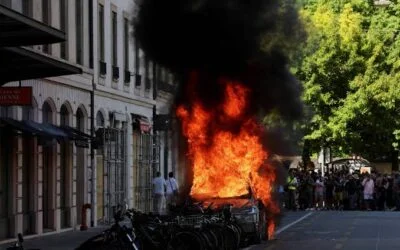
The broader social effects are severe. Residents across Karachi describe a city turned hostile, where they do not feel safe anymore. Social media users, dwellers of Karachi, compared the current unfortunate situation of Karachi to its former glory days, when it was referred to as The City of Lights.
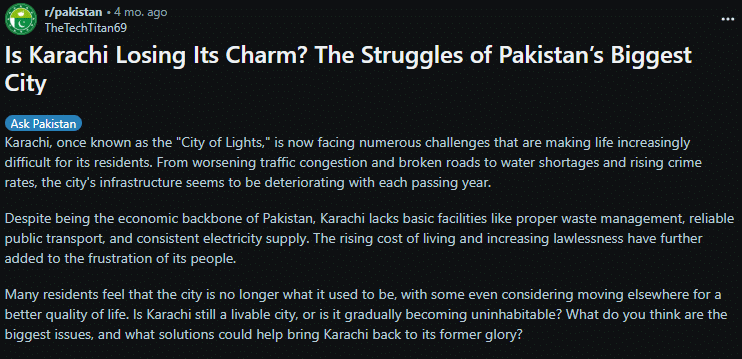
Source: Reddit
This erosion of trust affects economic and social life. People avoid walking outside, especially after dark; families restrict outings; businesses report declining foot traffic, further damaging local economies.
Towards a Sustainable Urban Safety Framework
Addressing the urban crime wave requires more than reactive policing, it demands a balanced strategy that integrates short-term security with long-term socio-economic reform. One effective model worth replicating is Lahore’s CCD initiative, which significantly reduced crime through the deployment of trained personnel, modern surveillance technologies, and specialized crime-fighting units.
Karachi, in particular, would benefit from a similar structured approach, tailored to its unique demographic and geographic challenges. Equally important is economic revitalization in vulnerable urban areas. Job creation, especially through vocational training and microenterprise support, can help reduce the desperation that drives many individuals, particularly youth, toward criminal activity. Community-based interventions must also play a central role. Establishing neighborhood watch programs and police-community liaison committees in high-crime areas can rebuild trust, foster cooperation, and improve crime reporting and response times.
Parallel to this, expanding drug rehabilitation and social support services are critical. Many street crimes are linked to addiction, particularly in low-income settlements where treatment options are scarce. Outreach programs, counseling, and awareness campaigns tailored for at-risk populations can help break the cycle of substance abuse and petty crime. Lastly, judicial and forensic reforms are essential to reinforce law enforcement credibility. Streamlining case processing, improving conviction rates, and upgrading forensic capabilities can restore public confidence in the justice system and ensure that criminals are held accountable in a timely and transparent manner.
Conclusion
In 2025, specifically between May and July 2025, Pakistan’s cities face a stark bifurcation: Lahore showing tangible success in crime reduction via proactive policing and investment, while Karachi battles a worsening crisis of street crime, fueled by economic despair, weak enforcement, and social fragmentation. To reverse the trend in Karachi and Islamabad, a dual strategy of immediate policing overhaul and systemic economic support is critical. Failure to bridge this gap risks deepening lawlessness, economic decay, and public distrust, undermining not only security, but the social contract across Pakistan’s urban heartlands. India and Punjab are models—but national-level political will is needed to ensure urban safety for all.