




The separation of East Pakistan in 1971, which culminated in the creation of Bangladesh, is often mischaracterized as a straightforward military defeat. However, a revisionist analysis reveals that this catastrophic event was fundamentally a failure of political leadership , exacerbated by long-standing internal issues and calculated external geopolitical aggression, which culminated in a strategic military surrender. The partition of Pakistan was the tragic result of a systemic political and constitutional breakdown that rendered the military’s position hopeless long before the war officially began.
The Political Failure: Ego, Ambition, and the Subversion of Democracy
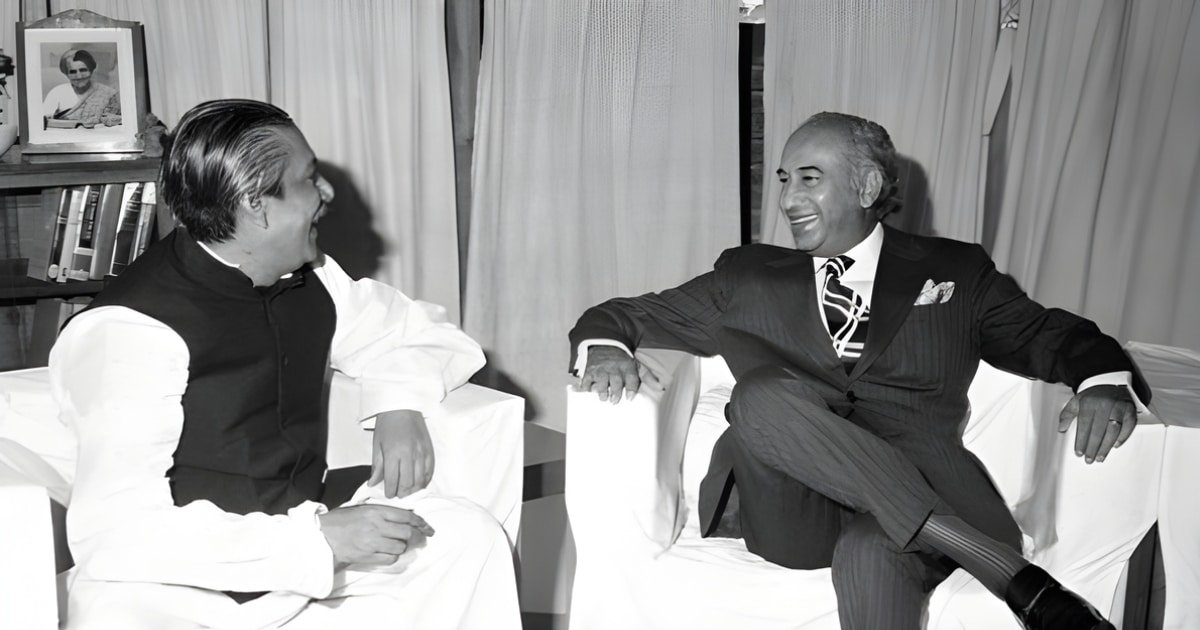
The catastrophic outcome of 1971 represents the failure of the political elite—Zulfiqar Ali Bhutto, Sheikh Mujibur Rahman, and General Yahya Khan—to preserve national unity. The crisis was fundamentally a political outcome, engineered by the malfeasance and self-interest of the national leadership.
The Constitutional Breakdown
The crisis was precipitated by the 1970 general elections, in which Sheikh Mujibur Rahman’s Awami League secured an overwhelming mandate, achieving a majority in the National Assembly. The subsequent refusal by the West Pakistani establishment, controlled by President General Yahya Khan and politically manipulated by Zulfiqar Ali Bhutto, to transfer power effectively nullified the democratic process. This action aggravated the people of East Pakistan, who felt they were being denied the democratic voice they had legally voted for, thereby fueling popular outrage. By ignoring the constitutional process, the political elite prioritized short-term internal power struggles over long-term national cohesion, thereby providing the moral and legal justification for foreign intervention and secession.
The Nexus of Political Egos
The instability was severely aggravated by the personal ambitions and inflexible positions of the key political leaders.
-
Zulfiqar Ali Bhutto’s political maneuvering was highly destructive. There was a belief that Bhutto wanted power specifically in the West, even if it necessitated the separation of the East wing. His delay tactics regarding the National Assembly session fueled popular outrage in the East.
-
Sheikh Mujibur Rahman, though initially keeping the door open for settlement in his 7 March 1971 speech, was committed to the creation of an independent “Bangladesh”. His refusal to back down, influenced by what Ambassador Marker identified as his “garrulous ego” , eliminated any chance of a negotiated settlement for greater autonomy within a united Pakistan.
-
General Yahya Khan, as the head of the military regime, refused to transfer power post-1970 election, triggering the constitutional crisis.
When the ruling military regime and the primary opposition leader acted in concert against the democratic verdict , they collectively alienated 56% of the population who spoke Bengali. This shared culpability in the political and constitutional breakdown confirms that the primary weakness of the federation was internal political malice, making the separation a political, rather than purely military, failure.
Geopolitical Conspiracy: The Indo-Soviet Nexus
The 1971 crisis was not merely the result of a civil war escalating out of control, but the successful execution of a sophisticated, premeditated geopolitical campaign by India, which systematically cultivated the conditions for secession and strategically prepared for invasion.
Pre-Planning and Covert Aggression
The theory of a pre-planned conspiracy is substantiated by the 1968 Agartala Conspiracy Case. The government of Pakistan formally accused Mujib and 34 others of collaborating with India in Agartala, Tripura, to organize an armed revolt aimed at establishing an independent East Pakistan. The formal charges established the critical precedent that separatist elements were actively engaged in foreign-backed plotting years before the 1971 war. This long timeline demonstrates that India did not simply react to Pakistan’s internal crisis in 1971, but systematically cultivated the conditions for secession over several years.
Following the breakdown of constitutional order, India shifted to aggressive covert intervention, actively aiding and organizing the Mukti Bahini. This strategy successfully leveraged the internal dissatisfaction to destabilize the East. India adopted a calculated approach to “militarily split Pakistan and create an independent Bangladesh”.
The Strategic Checkmate of the Cold War
The outcome of the 1971 conflict was sealed by the shifting dynamics of the Cold War, which strategically isolated Pakistan and guaranteed a decisive military advantage for India. This isolation transformed the struggle from a manageable bilateral confrontation into an unwinnable proxy war.
The Indo-Soviet Treaty of Friendship and Cooperation, signed on August 9, 1971, was the decisive strategic shift that guaranteed India’s victory. This was a significant deviation from India’s previous policy of non-alignment. The treaty was crucial because it provided India with the assurance of continuous Soviet military supplies and, more importantly, served to offset any possible intervention by China. As assessed by Henry Kissinger, the treaty effectively removed a vital restraint on India’s war planning. The Soviet Union, now India’s open ally, was prepared to intervene diplomatically and militarily on behalf of India , confirming that the conflict was no longer merely a regional crisis but a significant Cold War entanglement.
In the face of the Indo-Soviet alliance, Pakistan was left “fighting alone“. While China was friendly to Pakistan, the Soviet intervention capability guaranteed that China would be restrained from aiding Pakistan militarily for fear of expanding the war. This geopolitical reality dictated that Pakistan’s allies would not intervene , meaning the outcome was determined in global capitals months before the war began, not on the battlefield.
The Humanitarian Surrender and Political Scapegoating
The final act of capitulation by Lieutenant General A.A.K. Niazi was not simply a concession of battlefield loss but an explicit strategic decision to “save future loss of innocent human lives“. This decision was crucial given the escalating massacres of Urdu-speaking non-Bengali civilians by the Mukti Bahini and Indian-aligned forces , transforming the surrender into an act of necessary sacrifice to prevent wider ethnic cleansing. Niazi’s request to the U.S. Consul General was made “In order to save future loss of innocent human lives which would inevitably result from further hostilities in the major cities like Dacca”.
You May Like To Read: Nobel Laureate Emerges: Machado Defies Travel Ban after Daring Venezuelan Escape
In the subsequent decades, the narrative was meticulously controlled by political leaders in West Pakistan, who successfully utilized the shock of the military defeat to deflect responsibility for their own monumental political and constitutional failures preceding the conflict. Immediately following the surrender, political leaders moved quickly to criticize the military , ensuring that December 16th was cemented as a day of military shame. This deflection established a debilitating cycle of civil-military conflict , undermining the national unity required for defense. The military defeat provided the political parties with a convenient shield to criticize the military while ignoring the fundamental principle that successful defense requires “civil-military unity“. The true lesson of the 1971 debacle is the profound vulnerability created by internal political conflicts arising from the “ego of politicians“.