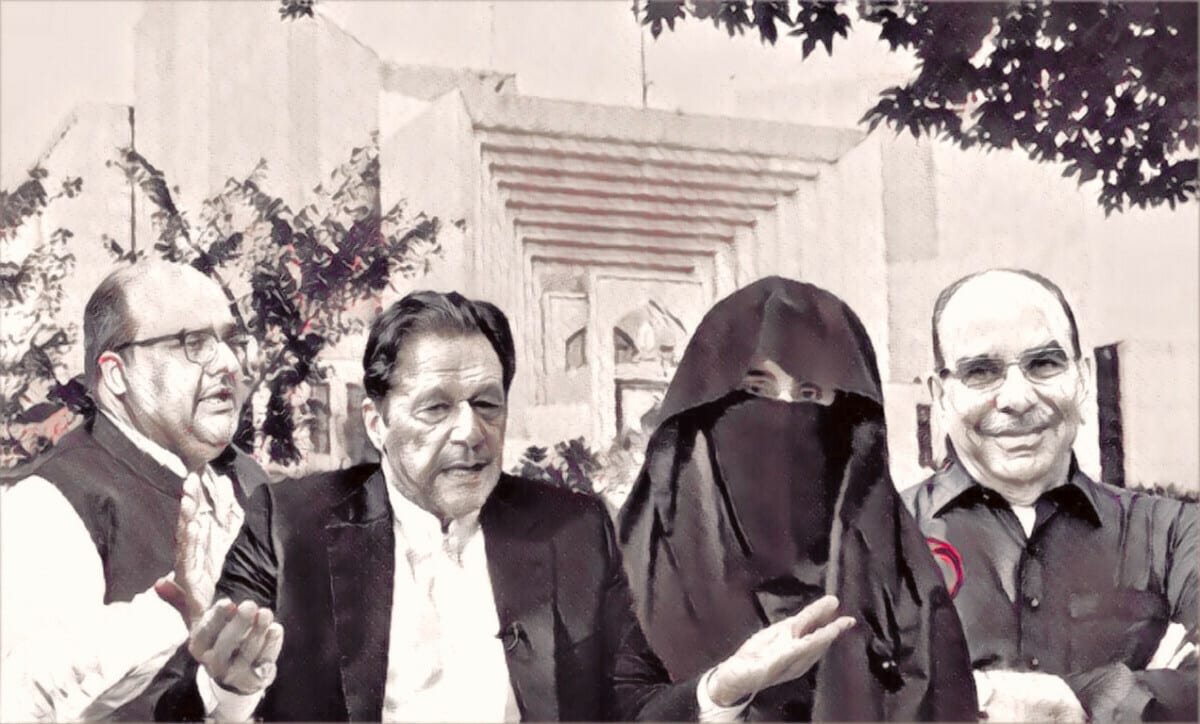





Mirza Shahzad Akbar, once the formidable Special Assistant to the Prime Minister on Accountability, now finds himself at the heart of multiple serious legal battles in Pakistan, facing accusations that range from large-scale corruption to the alleged fabrication of criminal cases.
His transition from a key figure in the previous government’s accountability drive to a “Proclaimed Offender” in several high-profile cases paints a complex picture of legal entanglement. It also raises serious concerns regarding misuse of authority and public office for fabrication of cases, and meeting political ends.
Source: Dawn news
Before we delve deeper into the facts and legal complexities associated with the legal woes of Shahzad Akbar, let’s delve into the most prominent case against him, to shed light on the charges, its progression, and their implications.
Unpacking the Al-Qadir Trust Scandal
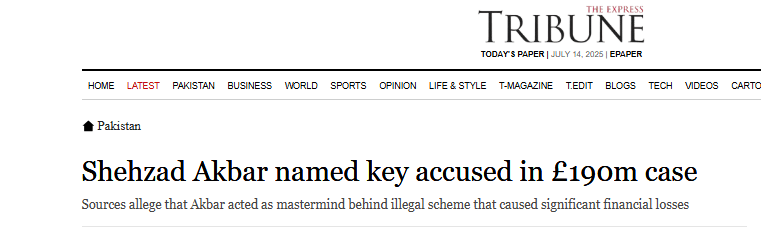
The most significant case against Shahzad Akbar is his alleged involvement in the £190 million settlement case, widely known as the Al-Qadir Trust case. This case centers on, financial embezzlement in funds, of black money or money acquired through illegal means, unearthed and repatriated by British National Crime Agency (NCA) returned to the state and people of Pakistan.
Source: Tribune
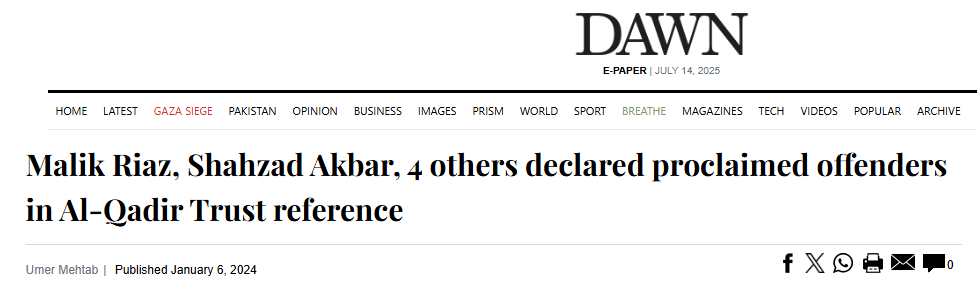
On January 6, 2024, the National Accountability Bureau (NAB) declared Shahzad Akbar a “Proclaimed Offender” in this context, signaling his failure to appear before the court or authorities despite summons.
The case traces back to a settlement between the National Crime Agency (NCA) in the UK and a Pakistani property tycoon, Malik Riaz. The funds, legally belonging to the people of Pakistan, were allegedly repatriated under circumstances that have drawn intense scrutiny from NAB. He has been declared a Proclaimed Offender (PO) by the National Accountability Bureau (NAB) for corrupt practices in relation to his involvement in relation to corrupt funds unearthed and repatriated by British NCA to people of Pakistan.
The National Accountability Bureau (NAB) has accused Imran Khan, former Prime Minister of Pakistan, and his wife Bushra Bibi, along with seven others, of corruption in the Al-Qadir Trust case. The accusation is that Imran Khan and Bushra Bibi illegally acquired billions of rupees and land from Bahria Town Ltd. in exchange for legitimizing 50 billion rupees that the UK had previously identified and returned to Pakistan during Imran Khan’s government.
NAB further alleged that Imran Khan was central to the illegal transfer of funds intended for Pakistan’s government into an account used by Bahria Town, Karachi, to pay for land. The NAB Reference, filed against these individuals also alleges that Shahzad Akbar, who previously worked as a special assistant to the premier and headed the Asset Recovery Unit, was a key figure in the conspiracy of embezzling state funds.
Furthermore, Malik Riaz, a property tycoon, colluded with others to divert funds designated for the state, actively supporting and assisting in the crime. Shahzad Akbar was also involved in illicit financial activities concerning money that should have legitimately gone to the people of Pakistan. This strongly suggests an act akin to embezzlement or misdirection of public funds.
Shahzad Akbar has been formally nominated as an accused in this case, with NAB issuing arrest warrants for him and several other high-profile individuals around December 2, 2023. Other prominent figures nominated as accused by NAB in this case include former Prime Minister Imran Khan, Bushra Bibi, Farah Gogi, Zulfi Bukhari, and Barrister Zia-ul-Mustafa Naseem.
From the information available, Shahzad Akbar’s alleged corrupt practices, in this intricate web of crime, pertain to involvement in handling and misdirection of the repatriated funds of staggering 190 Million Pound Sterling.
The magnitude of the misappropriated funds alone takes the gravity of the case to the sky; whereas, the impact of these corrupt practices, by public officer holders and their nexus of facilitators, on public finances is another debate. The case effectively suggests a betrayal of the public trust regarding funds meant for national benefit.
Convictions in the Al-Qadir Trust Case
The Accountability Court of Islamabad, in the verdict, found the prime accused, former Prime Minister, Imran Khan and his wife Bushra Bibi guilty in the Al-Qadir Trust case. Imran Khan received a 14-year prison sentence and a fine of Rs. 1 million. His wife Bushra Bibi was sentenced to 7 years in prison and fined Rs. 500,000. If they fail to pay the fines, Imran Khan will serve an additional six months, and Bushra Bibi will serve an additional three months. The court has also ordered the Al-Qadir University Project Trust property to be forfeited to the Federal Government. Both of the convicts were taken into custody to serve their sentences.
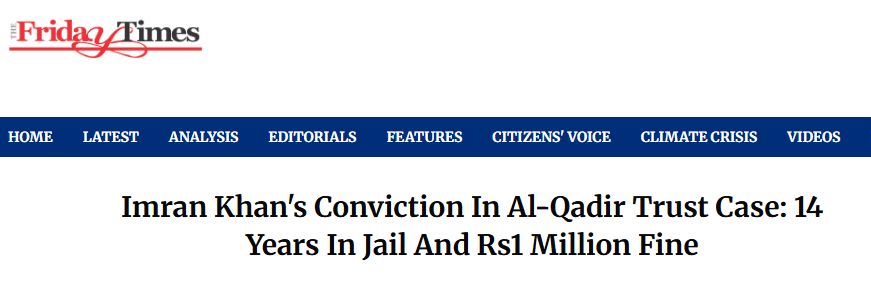
Source: The Friday Time
The Aftermaths
Corrupt practices, particularly those involving public office holders, inflict profound and multifaceted damage upon the very fabric of the state. Beyond the staggering monetary loss to the national exchequer, which directly deprives the already suffering and struggling population from millions of vital services, infrastructure, and development opportunities, such actions deeply erode the public’s fragile trust.
When funds earmarked for the nation’s betterment are allegedly siphoned off for personal gain, it fosters a pervasive sense of betrayal and injustice among citizens. This not only fuels cynicism towards government institutions and the entire political system but also discourages honest participation in the economy. The cumulative effect is a weakened state, vulnerable to instability, and a disillusioned populace left to bear the burden of illicit gains, shattering the promise of a just and prosperous future for all.
The Al-Qadir Trust case is a critical test for Pakistan’s justice system. The ongoing investigation and the “Proclaimed Offender” status of key figures like Shahzad Akbar highlight the authorities’ determination to pursue alleged financial crimes at the highest levels of governance. The outcome of this case, and the eventual accountability of those involved, remains crucial for reclaiming alleged ill-gotten gains and reinforcing the principles of transparency and integrity in public office.