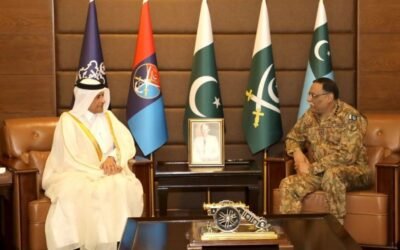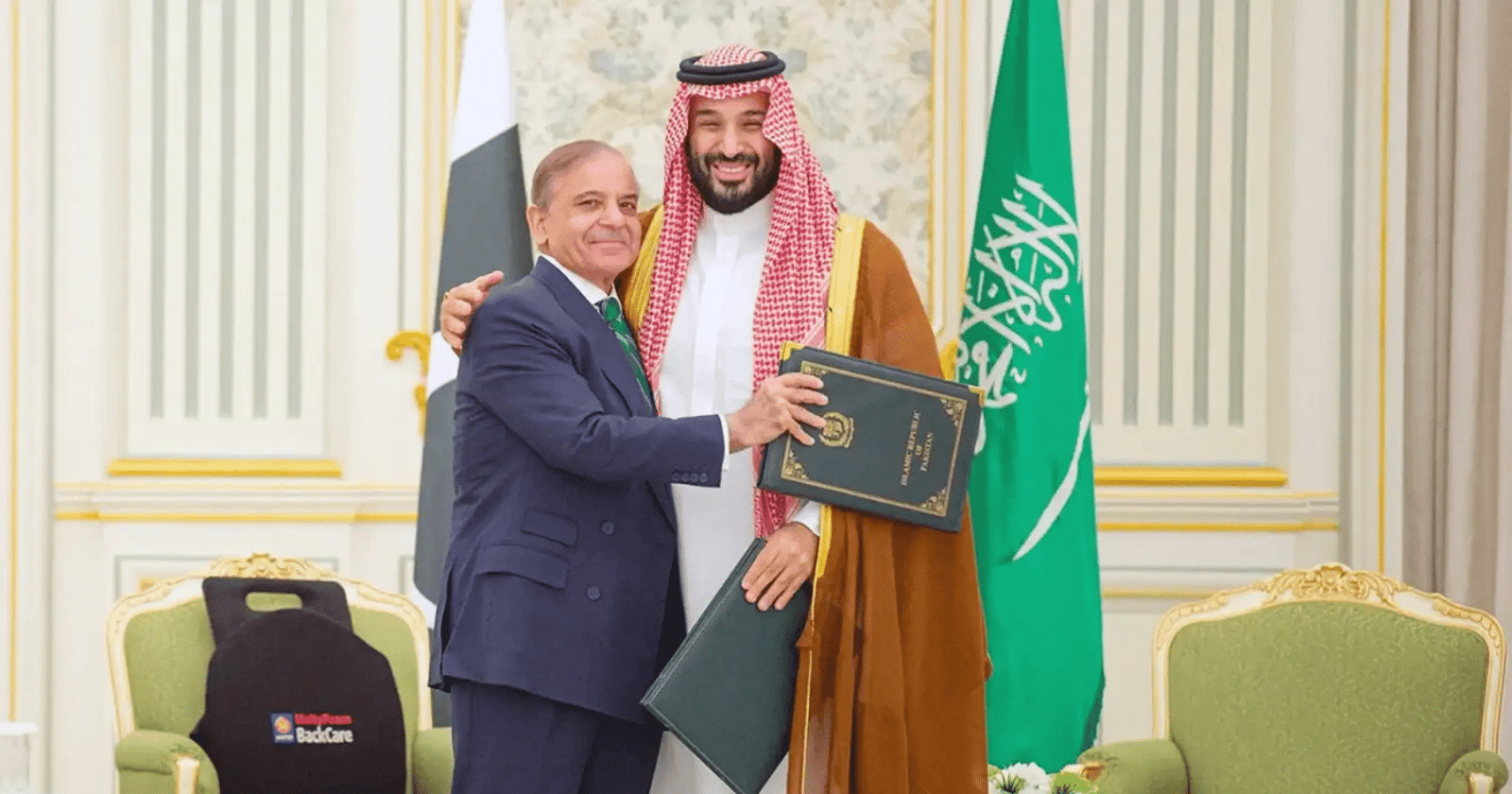


On September 17, 2025, Pakistan and Saudi Arabia signed a “Strategic Mutual Defense Agreement” in Riyadh, declaring that an act of aggression against one would be considered an act against both. The ceremony, attended by Pakistan’s prime minister and military leadership and Saudi Crown Prince Mohammed bin Salman, marked a visible deepening of ties between two long-standing partners whose relationship spans labour, investment and security cooperation. The headline language of the pact, echoing collective-defense formulas, immediately prompted questions about whether this is a narrow bilateral security arrangement or the start of a broader reordering of security in the Muslim world.
You May Like to Read: Pakistan, and Saudi Arabia Sign Historic Strategic Mutual Defence Agreement
What the Pact Says, and What It Does Not
The official Pakistani joint statement described the agreement as aimed at enhancing defense cooperation, joint deterrence and collaboration on military training, exercises and capabilities. The text’s core pledge, mutual treatment of aggression, is strong politically, but leaves implementation details vague. There is no public, detailed operational plan, no timetable for joint deployments, nor explicit clauses on nuclear sharing. Both capitals have framed the pact as defensive and general, rather than an offensive alliance directed at any single country.
The Nuclear Question: Rhetoric versus Reality
Because Pakistan is the only Muslim-majority country with nuclear weapons, the pact instantly raised speculation about whether Riyadh gains a de-facto “nuclear umbrella.” Pakistani politicians have at times offered mixed messaging. Defense Minister’s comments reported in media suggested Pakistan’s deterrent could be extended to Saudi Arabia if required, while official disclaimers insist nuclear weapons are not part of the pact’s public text.
International experts caution that formal nuclear sharing would be legally and politically fraught, involving safeguards, international monitoring and major strategic consequences. and would likely face intense international scrutiny. In short, rhetoric about a nuclear shield matters for signalling, but existing legal and technical barriers make an explicit transfer or formal-sharing arrangement unlikely without major, public steps.
Geopolitical Ripple Effects
The agreement arrives amid shifting Gulf perceptions about traditional security guarantors. Growing doubts in some Gulf capitals about the reliability of external patrons have encouraged regional states to diversify security partnerships. For Pakistan, the deal reasserts its historical role as a security partner to Gulf monarchies and comes at a time when Islamabad is seeking economic and diplomatic support. For Saudi Arabia, the pact is a hedge. It ties Riyadh to a sizable military partner with decades of professional links to the kingdom’s armed forces. The broader regional effect, however, is to add an extra layer of complexity to already fraught relationships, particularly between India, Iran, and Israel, and to prompt recalculations about deterrence and alliance choices across South Asia and the Middle East.
You May Like to Read: Pakistan, and China Launch Five-Year Maritime Action Plan to Operationalize Gwadar-Africa Shipping Corridor
Regional Responses, and Risks
Responses have been cautious and measured. India, which has deepening ties with Saudi Arabia, asked Riyadh to ‘weigh sensitivities,’ reflecting New Delhi’s concern about any development that might alter its security calculus. Other regional capitals and global powers are watching to see whether the agreement becomes an operational security mechanism or remains largely declaratory. The risk, diplomats warn, is twofold: first, that ambiguous commitments produce misperceptions or miscalculations in a crisis; second, that the pact could spur parallel moves by rivals seeking their own guarantees, thereby increasing regional tension rather than stabilizing it.
What this Means for Pakistan
For Islamabad, the pact is a diplomatic and strategic win in several ways. It strengthens ties with a major Gulf patron whose financial and political support Pakistan has long relied upon. It also elevates Pakistan’s role in regional security conversations, reaffirming its military credibility and diplomatic salience. Domestically, the government can present the pact as both a security achievement and a potential lever for economic benefits. But the arrangement also carries costs. Deeper military entanglement with a volatile regional environment could bring Pakistan into external crises, complicate relations with other partners, and generate pressure to clarify posture and thresholds for action.
Can it Redefine Muslim World Security Architecture?
A single bilateral pact, however consequential, is unlikely by itself to redraw the entire security architecture of the Muslim world. Redefinition would require multilateral institutional mechanisms, widely accepted rules of engagement, transparent crisis-management channels and capacity building across many states, none of which are created overnight. That said, the Saudi-Pakistan agreement could be a catalytic piece: if other Muslim-majority countries perceive value in pooled deterrence or regional collective security, we may see more bilateral or multilateral security arrangements emerge, especially where trust in traditional extra-regional guarantors is low. The crucial test will be whether the pact leads to concrete, stabilizing institutions or merely a stronger bilateral alignment that adds another layer of strategic ambiguity.
You May Like to Read: Remittances in Peril? The Risks of Global Recession on Pakistan’s Overseas Workforce
Conclusion
The Strategic Mutual Defense Agreement between Pakistan and Saudi Arabia is a significant diplomatic milestone that reflects shared anxieties and converging interests. It amplifies Pakistan’s regional role and offers Saudi Arabia a deeper security partner, but it also raises important questions about transparency, escalation risks and the limits of bilateral guarantees. Whether it becomes a building block for broader, institutionally grounded security cooperation among Muslim countries, or remains a high-profile, narrowly bilateral arrangement, will depend on how the two capitals translate words into concrete measures that reduce, rather than multiply, regional uncertainty.
You May Like To Read:
- A Vacuum of Authority: How Poor Governance Fuels Extremism in Pakistan
- The Durand Line Debate: International Law vs. Afghan Nationalism
- ‘Operation Sarbakaf’ Launched in Bajaur Against Terrorists, Curfew Imposed
- Pakistan Government Accelerates Crypto Adoption, Eyes Digital Currency Launch
- Magnitude 8.8 Earthquake Strikes Off Russia’s East Coast, Tsunami Warnings Across Pacific