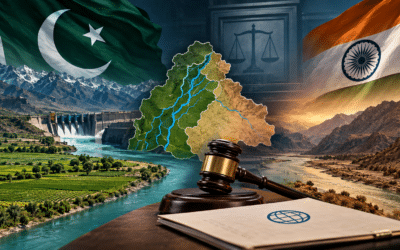





The federal government convened a round table session of the Water Security Task Force, emphasizing the urgent need for a national consensus to shift from water crisis management to ensuring long-term water security. Planning Minister Ahsan Iqbal highlighted the emerging challenges, including the “weaponization” of water by India, and called for a unified approach to address Pakistan’s water issues.
Minister Iqbal stressed that water security is a national security issue, encompassing irrigation, agriculture, provincial concerns, infrastructure, and climate. He noted India’s attempts to use water as a pressure tactic, posing a significant threat to Pakistan’s agriculture, food systems, livelihoods, hydropower potential, environmental flows, and ecological stability.
In a powerful address, Planning Minister Ahsan Iqbal outlines a clear national direction:
From fragmented responses → to a unified, technology-driven water security strategy.Planning Minister Ahsan Iqbal calls for:
✔ National consensus on water storage
✔ Efficient and… pic.twitter.com/bZhS8siZBe— Ministry of Planning and Development (@PlanComPakistan) April 29, 2026
Key Priorities for National Water Security
- Strategic Water Storage: Building large reservoirs, medium dams, small dams, recharge dams, delay-action dams, hill torrent management, floodwater storage, and urban rainwater harvesting.
- Institutional and Financing Reforms: Aligning the federal Public Sector Development Programme (PSDP) and provincial Annual Development Programme (ADPs) with water security priorities, mobilizing climate finance, and developing bankable projects for development partners and the private sector.
- National Water Efficiency and Conservation Mission: Modernizing irrigation, reducing conveyance losses, improving water productivity, and promoting efficient water use in agriculture, industry, and cities.
- Groundwater Governance Framework: Implementing aquifer mapping, recharge zones, extraction monitoring, regulation of high-stress areas, solar tubewell management, and community-based groundwater conservation.
- Technology-Driven Water Management: Adopting real-time telemetry, satellite-based water monitoring, AI-enabled irrigation forecasting, precision agriculture, smart metering, aquifer mapping, flood modelling, drought early warning systems, and digital water accounting.
- National Water Information System: Establishing a reliable system covering river flows, canal withdrawals, groundwater levels, reservoir storage, irrigation demand, rainfall forecasts, flood risks, water quality, and climate projections.
Minister Iqbal emphasized the importance of treating water security with the same seriousness as energy security, food security, and territorial security. He called for a shift in perspective, viewing new reservoirs as national survival assets rather than sources of controversy.
He highlighted the need to move beyond fragmented, sectoral, and politically contested approaches, urging all provinces to recognize that water insecurity affects the entire federation. He noted the specific needs of each province: Sindh’s protection from drought, floods, and seawater intrusion; Punjab’s reliable irrigation for national food security; Balochistan’s water for human development, livestock, agriculture, and drought resilience; and Khyber Pakhtunkhwa and Gilgit-Baltistan’s hydrological safety, hydropower development, and glacier-risk management.
Minister Iqbal concluded by emphasizing that in the 21st century, national security is linked with food security, energy security, climate resilience, public health, agriculture, and water security. He warned that Pakistan must prioritize water security to ensure sustainable economic growth and overall national stability.
You May Like To Read: EU VP Kaja Kallas Acknowledges Pakistan’s Role in Regional Peace
Check out our latest video: