What if you have a piece of art that you cannot hang on your wall but is worth thousands—stored on your hard drive. Or sending money across the globe without a bank, using an app that doesn’t close on weekends. Welcome to the world of digital assets—a broad, fast-evolving landscape reshaping global finance.
Digital assets are not just about cryptocurrencies like Bitcoin or Ethereum. They also include non-fungible tokens (NFTs), which represent ownership of unique items like digital art; stablecoins, which are pegged to traditional currencies; and tokenized securities, which digitize traditional stocks or bonds. At the core of all this lies blockchain technology—a decentralized ledger system that offers transparency, security, and efficiency.
Over the past decade, digital assets have gone from obscure innovations to mainstream financial instruments. With over $2 trillion in global market capitalization at their peak, they have already made a dent in how capital flows, how people save and invest, and how institutions think about the future of money.
The Global Learning Curve: Embracing the Digital Frontier
Countries around the world have taken markedly different paths in dealing with digital assets. El Salvador made headlines in 2021 by adopting Bitcoin as legal tender, hoping to attract crypto investment and reduce remittance fees. Singapore, known for its regulatory foresight, built a comprehensive framework through the Monetary Authority of Singapore (MAS), granting licenses to compliant digital asset service providers while keeping a tight rein on money laundering.
In the United Arab Emirates, free zones like Abu Dhabi Global Market (ADGM) and Dubai International Financial Centre (DIFC) have created specialized crypto regulations that attract startups and institutional players alike.
Meanwhile, the United States has taken a piecemeal approach. While innovation continues, the lack of unified federal regulation has created confusion, with agencies like the Securities Exchange Commission, SEC and Commodity Futures Trading Commission CFTC clashing over jurisdiction. This regulatory ambiguity has caused some crypto firms to relocate abroad, citing “regulatory fatigue.”
But while crypto has brought opportunities, it has also brought risks. The collapse of FTX, one of the largest global crypto exchanges, exposed the systemic risks of unregulated platforms. Luna-Terra’s crash wiped out billions overnight, showing how unstable algorithmic coins could undermine investor trust and trigger contagion.
Money laundering, terrorist financing, tax evasion, and financial instability are not hypothetical dangers. In economies where the state has limited digital surveillance capacity, unchecked crypto use can widen the informal economy and erode regulatory control over monetary policy.
Pakistan’s Slow Yet Purposeful Entry
Pakistan, like many developing countries, initially treated cryptocurrencies with caution. The State Bank of Pakistan (SBP) issued multiple circulars in 2018 discouraging the use of virtual currencies, citing volatility, illicit use, and absence of legal safeguards. Court cases soon followed, including a 2019 Sindh High Court petition that sought clarity on the legal status of digital assets.
Inconsistent judicial interpretations created a regulatory vacuum. For years, crypto operated in a grey area, accessible through global exchanges, but without local legitimacy. This legal ambiguity stifled innovation, with fintech players hesitant to engage in a sector where the risk of legal action remained ever-present.
However, the landscape began shifting in the past three years. Pakistan’s policy posture has matured, moving from prohibition to cautious exploration. In 2022, the government established the Pakistan Crypto Council (PCC), bringing together experts from finance, technology, and law to assess the sector’s economic potential. It marked the beginning of a more structured dialogue.
In 2023, the SBP clarified that while digital assets were not banned, formal licensing was necessary. This subtle shift signalled an opening for policy evolution. The Finance Division, under successive finance ministers, gradually began viewing digital assets not just as threats but as potential tools for remittance, financial inclusion, and youth employment—particularly in the freelancing sector, which heavily relies on platforms that facilitate crypto payments.
Recent Momentum: Building the Case for Regulation
The real turning point arrived in 2025, when the Virtual Assets Act was passed, laying the groundwork for regulatory oversight. The law provided for the licensing and supervision of virtual asset service providers (VASPs), including exchanges, wallets, and payment gateways.
The State Bank also announced its intention to pilot a Central Bank Digital Currency (CBDC). At the Reuters NEXT Asia summit, Governor Jameel Ahmad confirmed that the SBP was “building capacity for digital currency issuance,” reflecting a new era of policy experimentation.
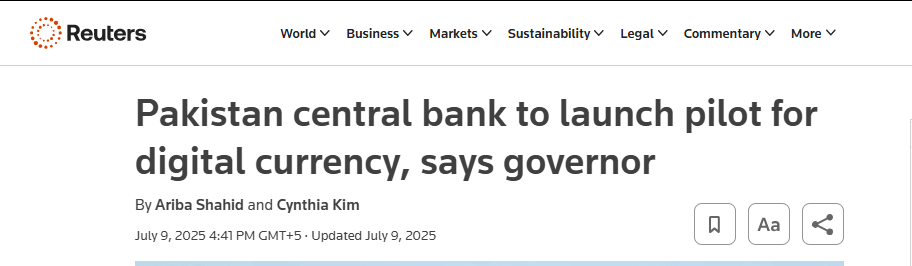
Source : Reuters
Meanwhile, Pakistan’s National IT Board and the SECP began consultations with international tech firms to create a sandbox for blockchain-based innovation. Additionally, the Federal Board of Revenue (FBR) and Financial Monitoring Unit (FMU) were brought in to ensure compliance with FATF (Financial Action Task Force) standards, minimizing the risk of blacklisting due to crypto-related laundering.
These developments underscore a measured embrace of digital assets—grounded in national interest and regulatory prudence.
The Challenges Ahead: Balancing Innovation with Security
Despite recent progress, major hurdles remain. For starters, there’s a skills gap. Regulatory bodies need specialized talent to understand the complexities of blockchain ecosystems. Without it, rulemaking can be either overly restrictive or dangerously permissive.
Secondly, there is the issue of institutional coordination. Fragmentation between SBP, SECP, FBR, and the Ministry of Finance can cause policy paralysis. For a coherent digital asset strategy, Pakistan needs a centralized regulatory framework that harmonizes compliance, taxation, innovation, and consumer protection.
Third, investor education remains low. Many Pakistanis are lured into fraudulent schemes or pump-and-dump coins due to the absence of credible platforms and awareness campaigns. Regulation must go hand-in-hand with public literacy, much like the SECP’s earlier campaigns in capital markets.
There is also the question of international alignment. As global standards emerge from the IMF, G20, and FATF, Pakistan must ensure compliance to maintain investor trust and financial credibility.
The Road Forward: Pragmatism Over Panic
Pakistan stands at an inflection point. Digital assets are here to stay—whether in the form of CBDCs, blockchain-based microfinance, or regulated stablecoins for remittance. The state’s role is not to act as a barrier, but as an arbiter of responsible innovation.
To move forward, Pakistan should:
- Finalize and enforce licensing rules for crypto exchanges and wallets.
- Launch a regulatory sandbox for startups to test digital products under close supervision.
- Invest in training regulators, auditors, and law enforcement in digital finance.
- Promote investor education campaigns through SECP and SBP.
- Ensure tax compliance without stifling startups through overregulation.
- Collaborate with global partners to stay aligned with international best practices.
The digital asset ecosystem may not replace traditional finance, but it will coexist, compete, and converge with it. Pakistan’s measured, state-led pivot—especially over the past three years—offers a template for other emerging economies navigating the crypto frontier.
With a population hungry for opportunity and innovation, the country has more to gain than lose—if it plays its cards right.