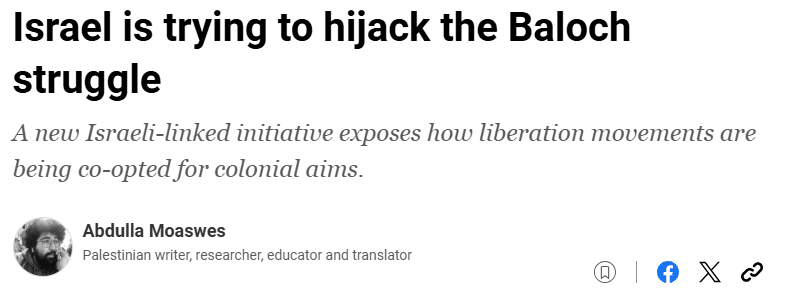
In a recent and thought-provoking analysis, Al Jazeera published an opinion piece, by Abdulla Moaswes, titled “Israel is trying to hijack the Baloch struggle,” which has unveiled new concerns within the region regarding external interest and potential interference in Pakistan’s Balochistan province. This piece, along with other analytical reports, highlights claims of Israeli attempts to hijack the Baloch Separatist Movement—already patroned by India, through its proxy militant outfit Fitna-al-Hindustan (FAH) operating in Balochistan.
Israel’s intentions to get involved in Balochistan aligns strategically with India’s motives of destabalising Pakistan. Such moves, indicative of broader geopolitical maneuvering, could significantly impact the already intricate and sensitive regional landscape, particularly in relation to Iran and Pakistan’s internal stability.
Source: Al Jazeera
External Actors in Balochistan
Discussions concerning Balochistan’s dynamics often extend to claims of external involvement. The opinion piece published by Al Jazeera posits that Israel may be attempting to “hijack” the Baloch separatist movement. This perspective suggests that any potential Israeli interest could stem from a broader strategic objective aimed at destabalizing and infiltrating Iran.
Israel-Iran have had tenuous ties for decades now, they recently engaged in a conflict with both sides attacking each other back and forth. in this context by fostering instability along Iran’s eastern borders through purported support for Baloch separatists, Israel could, create a diversion or a new front, potentially serving its strategic objectives against Tehran. This analysis points to the complex and often covert nature of geopolitical strategies in the wider region.
The narrative of an Israel-India nexus utilizing terrorist in Balochistan (FAH) articulated in regional media discourses, is not wholly fictional or a product of imagination. Rather a genuine concern that stems from the increasing affinity between Israel-India, and their mutual objectives of destabalising and Iran and Pakistan. Accordingly, these objectives become achievable if Israel becomes successful in establishing a presence in Balochistan—which is not impossible considering that India is already providing the militants in Balochistan with financial, military, and logistical support.
These reports, from Al Jazeera and other regional media sources, examine the convergence of interests among various actors to destabilize border regions, often contextualizing the Balochistan issue within a larger framework of proxy competition. Such assertions imply that foreign intelligence agencies might be attempting to exploit existing grievances and separatist movements to advance their own geopolitical agendas, rather than engaging in genuine support for local aspirations.
Israel-India Cooperation and Historical Strategic Narratives
The claims of Israeli interest in Balochistan are sometimes viewed through the lens of a historical narrative that suggests cooperation between Israel and India on strategic objectives aimed at undermining Pakistan.This perspective often points to past allegations of joint planning that reportedly sought to damage Pakistan’s military capabilities.
In the past, there have been widely reported, though unconfirmed, allegations of a covert plan, involving Israel and India, to attack Pakistan’s nuclear sites, specifically the Kahuta Research Laboratories (KRL) and other sensitive facilities. These claims, circulated during periods of heightened regional tension, suggested a coordinated effort to neutralize Pakistan’s nuclear assets. While these specific allegations have never been officially substantiated by either Israel or India. Nevertheless, these claims are based on the tip given by United State’s Central Intelligence Agency (CIA) to then President General Zia ul Haq.
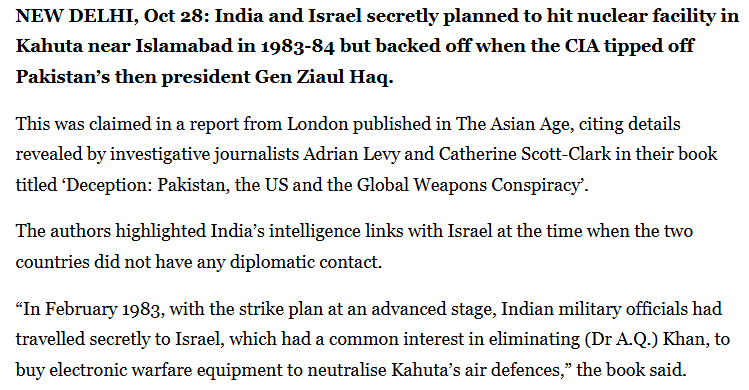
In 1983-84, India and Israel secretly planned to attack Pakistan’s nuclear facility in Kahuta, but the plan was abandoned after the CIA informed Pakistan’s President General Zia ul Haq. The information comes from a report in The Asian Age, citing details from the book ‘Deception: Pakistan, the US and the Global Weapons Conspiracy’ by Adrian Levy and Catherine Scott-Clark. The book highlights India’s intelligence connections with Israel during a time when the two countries lacked diplomatic ties. Indian military officials reportedly traveled to Israel to acquire electronic warfare equipment to neutralize Kahuta’s air defenses. India put the plans on hold after Pakistan warned it would attack Trombay if Kahuta was hit (Dawn).
Source: Dawn
Within this context, of Israel-India nexus contemporary efforts to infiltrate Balochistan could be seen as an extension of such historical strategic thinking. Given Israel’s objective to destabilize Iran by leveraging militant organizations operating in Balochistan (FAH); and India’s shared strategic interest in diminishing Pakistan’s regional influence or creating pressure points, cooperation on such a sensitive front could align with their strategic goals.
Given the existing cordial ties between India and Israel, and the fact that India is extending suport—financial, military, and logistic—to militant organizations operating in Balochistan (FAH), it could be strategically opportune for Israel to capitalize on this purported groundwork. From this perspective, a weakening of Pakistan, particularly through sustained instability in Balochistan, would serve India’s motives of destabilizing its neighbor. Concurrently, such a scenario could purportedly benefit Israel by potentially providing avenues to weaken and infiltrate Iran through Balochistan-Sistan province, thereby serving a dual strategic purpose for both nations—already sharing the extremist and anti-Muslim sentiments.
Balochistan in a Broader Regional Context
Balochistan’s critical geostrategic location, bordering Iran and Afghanistan, positions it as a significant flashpoint within complex regional dynamics. The ongoing Baloch insurgency within Pakistan is often perceived by some regional observers as vulnerable to exploitation by external powers seeking to destabilize both Pakistan and neighboring Iran.
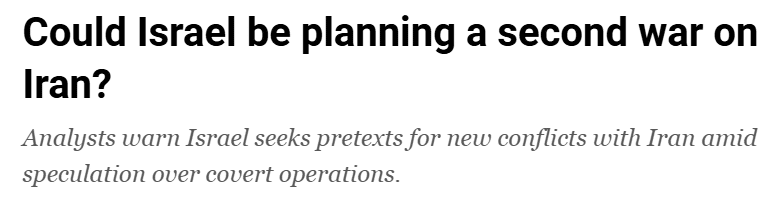
The possibility of Israel planning a “second war” on Iran is an undeniable possibility. Accordingly, the destabilization of Iran’s border regions, i.e., Balochistan, will serve as a strategic objective, and a significant milestone in the Israel-India’s collaborative effort to undermine both Pakistan and Iran. Because India has already laid the ground-work in Balochistan; Israel now only need to capitalise on the existing framework and exploit the gaps.
Source: Al Jazeera
Concerns about the destabilization of Iran and the potential emergence of a “Greater Balochistan”, encompassing Baloch-majority areas in both Pakistan and Iran, have been raised, highlighting the potential for significant challenges to regional stability. Pakistan, sharing a long and often porous border with Iran, is particularly sensitive to any efforts that could lead to increased unrest or cross-border militancy stemming from a destabilized Iranian Balochistan. The historical and ethnic ties of the Baloch people across the Iran-Pakistan border add another layer of complexity to these geopolitical considerations.

Source: Pamfleti
Pakistan’s Stance and Implications
Pakistan has consistently articulated its concerns over foreign interference in Balochistan, viewing it as a critical challenge to its sovereignty and territorial integrity. Islamabad has long asserted that certain external forces seek to fuel separatist sentiments and sponsor terrorism in the province to impede its development and the success of vital projects like the China-Pakistan Economic Corridor (CPEC). The recent discussions in various media outlets, as analyzed above, reinforce these long-standing anxieties within Pakistani policy circles.
The potential implications of such alleged foreign involvement are extensive. If external actors are indeed attempting to manipulate internal dynamics, it could lead to:
- Increased Instability: Further fueling insurgency and violence in Balochistan, potentially leading to greater loss of life and displacement.
- Regional Tensions: Exacerbating mistrust and animosity between regional states, potentially leading to overt or covert proxy conflicts.
- Hindrance to Development: Undermining critical economic development projects, including those under CPEC, which are seen as crucial for the socio-economic upliftment of Balochistan and the broader region.
- Humanitarian Concerns: A worsening security situation could further impact the humanitarian conditions for the local population.
While these concerns are currently limited to the realm of analytical discussions; nevertheless, they underscore the intricate geopolitical maneuvers at play in a critical region. For Pakistan, it is imperative to resolve the internal grievances of Balochistan through political dialogue and socio-economic development; in addition to eliminating anti-state and sponsored terrorists through continued military efforts. The stability of Balochistan is not just a Pakistani concern but a crucial factor for the broader security and peace of the entire West Asian region.