





Pakistan has reaffirmed its position as a net regional security stabilizer following a decisive and valiant success in “Mark e Haq” and “Bunyan Marsoos.” These operations, which will be remembered as a great triumph for Pakistan, saw the Indian Army admit defeat with its troops waving white flags along the Line of Control (LOC). The professionalism and skill of Pakistan’s armed forces delivered a befitting and measured response to Indian aggression, effectively shattering the so-called myth of Indian conventional superiority and their rhetoric of capturing Azad Jammu and Kashmir (AJK) and Gilgit-Baltistan (GB). The New York Times, in a recent report, acknowledged this shift, stating that any act of confrontation now plays into Pakistan’s hands, equating Delhi with Islamabad.
In a move that replaced India’s “new normal” with a powerful and strategic riposte, Pakistan launched Operation Bunyan Marsoos, targeting Indian strategic assets. This decisive action, coupled with the military’s firm resolve, has been credited with a ceasefire between the two nuclear powers, a claim repeatedly made by President Trump.
In the wake of this defeat, the Indian fascist Hindutva regime has demonstrated a clear inability to digest the outcome. This has been followed by a sudden increase in terrorist attacks orchestrated through proxies, identified as “Fitna al Khawarij” and “Fitna al Hindustan,” in Khyber Pakhtunkhwa and Balochistan. Furthermore, the PDMA has warned of a fresh flood threat as 70,000 cusecs of water are expected to be discharged from India.
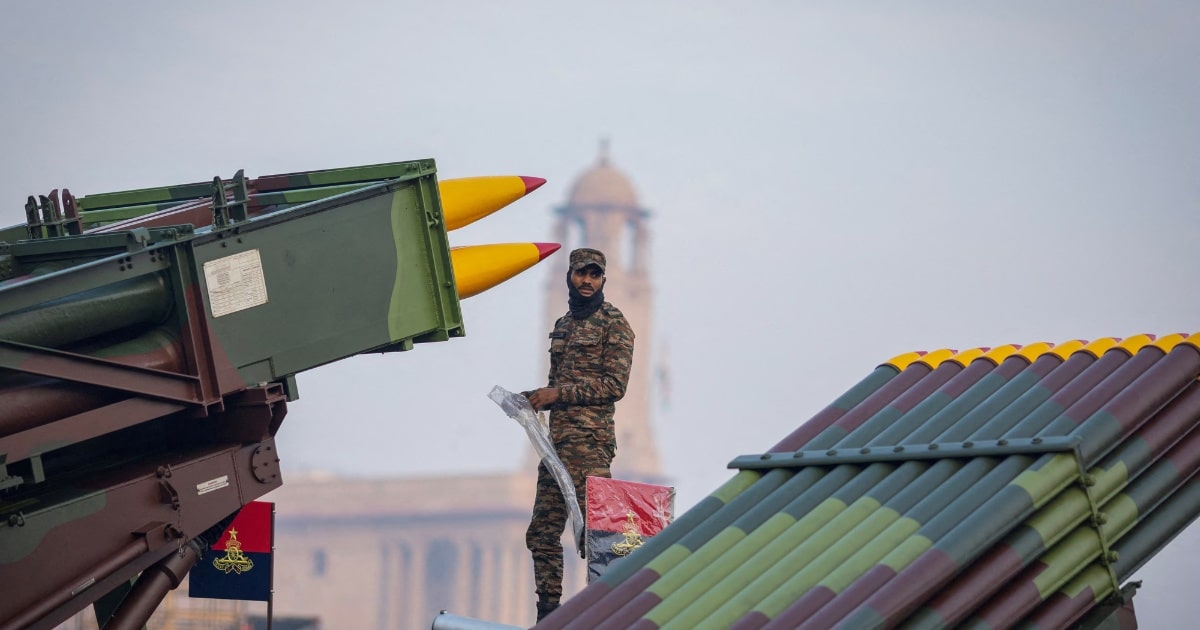
The defeat has also prompted an alarming and destabilizing military buildup by India, with a sudden surge in the procurement of advanced weapons and equipment, alongside a series of provocative missile tests. The Indian defence ministry has approved a staggering 67,000 crore (INR) for new purchases, including drones, missiles, night vision devices, and the maintenance of its C-17, C-130J, and S-400 air defence systems.
This escalation is evident in a series of recent missile tests:
- On August 20, 2025, India tested the Agni-5, a nuclear-capable intermediate-range ballistic missile with a range of 5,000 kilometers, capable of targeting all of Asia and parts of Europe.
- The Indian Defence Research and Development Organisation (DRDO) is also developing a modified version of the Agni-5 with a 2,500-kilometer range and an 8-ton conventional warhead, designed to penetrate 80 to 100 meters underground. This technology, conceptually similar to the US GBU-57 “bunker buster,” if used against Pakistan’s nuclear sites, would be considered a nuclear attack, with a high risk of disastrous escalation.
- In July, India conducted trials of the Akash Prime medium-range surface-to-air missile, and two back-to-back tests of the Pralay short-range surface-to-surface missile.
- Additional tests in July included the Prithvi short-range ballistic missile and the Agni-1.
In an interview, the Director-General of Inter-Services Public Relations (ISPR) delivered a clear message: should India ever attempt any military misadventure, Pakistan’s response would be swift and painful, targeting India from “east to west, from Arunachal Pradesh to Rajasthan.”
While India plans to develop its indigenous “Sudarshan Chakra” air defense system by 2035—a concept conceived in the aftermath of Pakistan’s Fateh 1 and Fateh 2 strikes on 26 Indian strategic targets—it is important to remember that wars are not won by weapons alone. The utter failure of Operation Sandoor has proven that the people behind the weapons, their professionalism and skill, are what truly matter. Pakistan has emerged as a net regional security stabilizer, while India’s claim of being a net security provider has been irrevocably shattered.
You May Like To Read: