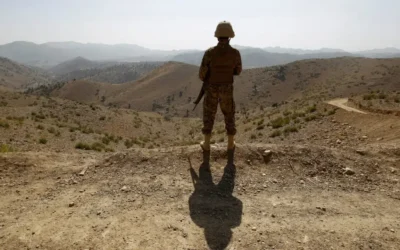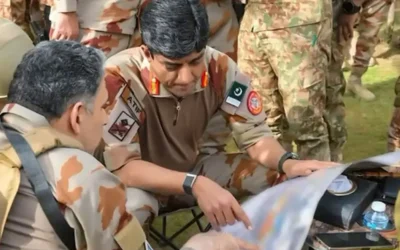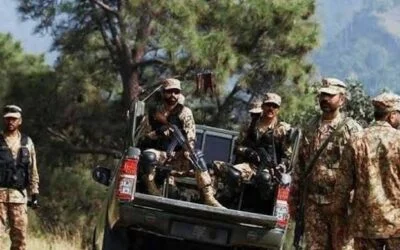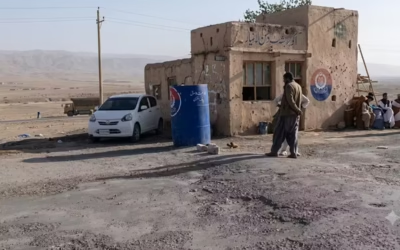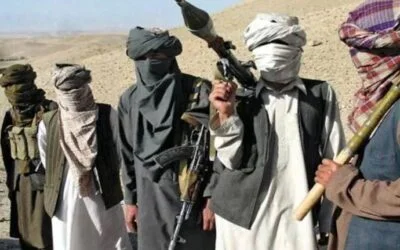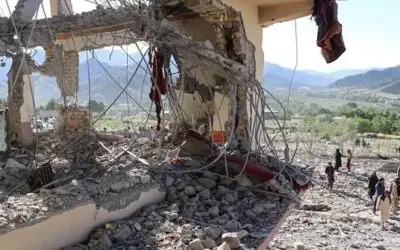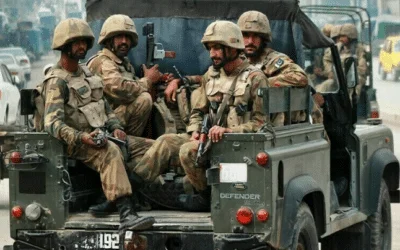



Amid renewed security challenges along Pakistan’s western frontier, a less visible but deeply entrenched threat continues to undermine both national security and economic stability. The use of narco-financing and cross-border smuggling to sustain militant operations, particularly by the Fitna-al-Khwarij (FAK) — a banned militant network responsible for armed insurgency, urban terrorism, and cross-border attacks. While kinetic counter-terrorism operations have intensified in Khyber Pakhtunkhwa and northern Balochistan, the financial arteries feeding these networks remain disturbingly active, routed through narcotics, Non-Custom Paid (NCP) items, and porous border economies.
The convergence of terror financing, informal trade, and narcotics smuggling has created an ecosystem where militancy thrives not in the shadows, but in the grey zones of under-governed spaces and neglected economic corridors. In this matrix, narcotics are not merely a crime problem — they are a strategic enabler of violence.
Narco-Financing as a Strategic Enabler
Since the fall of Kabul in 2021 and the subsequent consolidation of Taliban control, Pakistan’s western regions have witnessed a resurgence of narcotics-based revenue generation, particularly in areas with limited state presence. While Afghanistan’s interim regime has formally banned poppy cultivation, enforcement remains patchy. Reports from UNODC and regional observers indicate a surge in opium trafficking through border provinces, including Nangarhar, Helmand, Nimruz, and Paktika, which connect directly to Pakistan’s Zhob, Qila Saifullah, and North Waziristan belts.
These smuggling routes are not opportunistically used by militants — they are systematically managed. Intelligence and field reporting suggest that FAK factions operating in the merged districts (ex-FATA) levy taxes on narcotics transit and provide “protection services” for drug convoys moving across tribal borders. In some instances, they are directly involved in logistics, distribution, or coercion of local transporters.
The proceeds are used to finance arms procurement, safehouses, recruitment incentives, and urban sleeper cells. Narco-financing has given FAK the ability to regenerate despite sustained counter-terrorism pressure.
NCP Items: The Smuggling Economy as Soft Infrastructure
Running parallel to narcotics is the massive shadow trade in Non-Custom Paid (NCP) items, particularly vehicles, electronics, tyres, and fuel. These goods, largely smuggled from Iran and Afghanistan, find their way into Pakistani markets through the Chaman, Badini, and Ghulam Khan crossings, often bypassing state scrutiny through informal arrangements with local actors, including some tribal intermediaries and sympathetic networks.
FAK and elements affiliated with Fitna al Hindustan/Hind (FAH) exploit these supply chains by either imposing transit fees, extortion, or running their smuggling rings. In areas like Qilla Abdullah, Panjgur, and South Waziristan, the NCP economy is virtually unregulated, and militants tap into this infrastructure not only to raise funds but also to move personnel and arsenal without detection.
The result is a dual economy: one above the surface, taxed and monitored by the state; and another — larger, faster-moving, and dangerous — operating beneath it, reinforcing both economic leakage and insurgent resilience.
Economic Sabotage: Undermining the Tax Net and Formal Sector
Beyond its direct links to terrorism, the smuggling economy — anchored in narco-trade and NCP flows — exacts a significant toll on Pakistan’s fiscal structure. According to recent estimates by FBR and economic watchdogs, Pakistan loses Rs. 300–500 billion annually to smuggling-related revenue evasion, with a significant chunk traced to KP and Balochistan corridors.
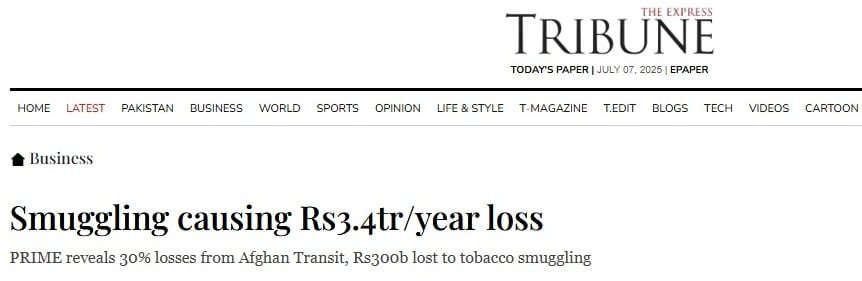
This economic bleed deprives the state of critical resources needed for public services, infrastructure development, and security sector reform. More alarmingly, it incentivises informality and weakens tax culture, as entire commercial sectors — from vehicle sales to petroleum — become dominated by untaxed, unregulated supply chains.
For militant networks like FAK and FAH, this offers a strategic advantage: not only does smuggling sustain their operations, but it erodes state legitimacy and fosters anti-state sentiment among local populations who depend on this economy for livelihoods.
Access to Capital: A Growing Threat Matrix
Perhaps the most dangerous consequence of the narco-smuggling nexus is access to large sums of untraceable cash. Unlike foreign funding, which can be monitored, or domestic donations, which require ideological outreach, narcotics and illicit trade provide clean liquidity that can be used without detection by formal financial systems.
This enables FAK and FAH operatives to:
- Fund high-value target attacks in urban areas (e.g., Peshawar, D.I. Khan, Quetta)
- Purchase advanced weaponry and communications equipment from regional black markets.
- Recruit disenfranchised youth with cash incentives.
Moreover, access to narco-capital allows for cross-network collaboration with international criminal organisations, making it harder to isolate and dismantle militant operations based solely on ideological profiling.
A Security-Economic Crisis in Tandem
The growing entanglement of narco-money and cross-border smuggling with militant financing in KP and Balochistan represents a hybrid threat, blurring the line between crime and terrorism. It requires more than just kinetic responses. Disrupting financial flows, formalising trade routes, and enhancing cross-border intelligence cooperation are necessary to sever the lifelines that keep FAK and FAH operational.
Failing to address this convergence will not only prolong Pakistan’s fight against militancy but also sabotage its economic recovery, fiscal sovereignty, and regional credibility. The fight against terrorism, it appears, now runs through trade routes as much as tribal valleys.
Terror Financing: How Hawala and Hundi Networks via Afghanistan Undermine Regional Security