




Pakistan is going through a digital revolution, but the rural population is being left behind. Although such cities as Lahore, Islamabad, and Karachi have high internet speed, access to high-tech instruments, and modern services, the rural areas are isolated. This increasing disparity between rural and urban regions is contributing to the further inequality in education, healthcare and business.
The Growing Digital Divide
Pakistan’s urban areas are rapidly embracing digital technologies, yet the rural-urban divide remains stark. As of 2024, over 90% of urban households have access to the internet, while only 40% of rural households are online.
This digital divide influences almost all the spheres of life, including online education, online shopping, and government services. The rural areas are not only falling behind, but also losing out on key opportunities that may enhance their living conditions and economic sustainability.
Impact on Education: A Virtual Classroom Divide
The effect of the digital divide on education is one of its most important effects. Students in urban areas have access to internet resources, online classrooms and virtual libraries. Nevertheless, the rural students usually find it hard to access basic internet access, much less high speed broadband to facilitate learning.
You May Like To Read: Efficient Governance vs. Citizen Rights in the Digital Age
As an illustration, in the case of the COVID-19 pandemic, urban schools managed to switch to distance learning within a short period of time, and students in rural areas were interrupted; many of them did not have an opportunity to attend classes. In 2021, it was found that 22.7 million rural students had no access to online classes due to poor internet connectivity and lack of devices.
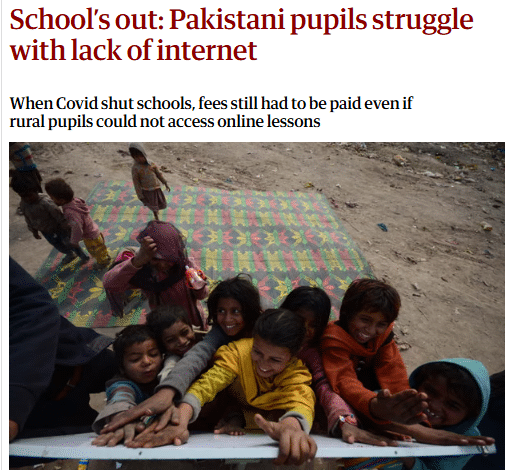
Source: The Guardian
Healthcare Disparities: Telemedicine Out of Reach
Telemedicine has been a savior to most people in the times of pandemic. Nevertheless, digital health services are unavailable in rural areas. City medical hubs have embraced online solutions such as electronic prescriptions, online check-ups, and health management applications. However, in rural settings, hospitals do not have the infrastructure to provide such services, meaning that it takes longer to travel and consult a doctor, and it is more expensive.
Digital infrastructure is inadequate one of the reasons why there exists a gap in healthcare access between rural and urban Pakistan. A large number of healthcare providers located in rural areas utilize paper records and patients are forced to go a long way to get specialized care that can be provided via telemedicine.
The Impact on Business: A Limited E-Commerce Landscape
The digital economy is flourishing in businesses in urban centres. There is access to digital payment systems, e-commerce opportunities, and access to international markets for companies in cities. In the case of rural enterprises, however, the digital tools such as online shops, digital marketing, and mobile payments remain inaccessible to a large extent.
The State Bank of Pakistan states that digital payment systems are accessible to only 20% of businesses in rural areas. The lack of access to these tools leaves rural businesses with little to no access to their market, and they are unable to compete in the increasingly online economy. Moreover, rural entrepreneurs have low digital literacy levels that constrain their capability to utilise e-commerce to grow their enterprises.
Government Measures: Are We Bridging the Gap?
Although the government has taken certain steps in its attempt to solve the digital divide, including efforts like the “Digital Pakistan Vision 2025”, there has been a lack of thorough initiatives to offer internet access and digital literacy efforts.
In the case of PTCL, the company has extended its services to the rural regions, yet most households are still unable to access high-speed internet connection. Moreover, initiatives such as the Rural Connectivity Project initiated by National Telecommunication Corporation (NTC) have not scaled well, and these programs are usually impeded by logistic and financial issues.
You May Like To Read: Bureaucratic Hurdles and Accountability Deficits
The Role of Digital Literacy: Preparing Pakistan’s Youth for the Online Economy
Digital literacy should become a national concern in order to address the digital divide. The Pakistani youth (in particular, the rural ones) require access to digital skills training to equip them for the online economy.
Programs like “DigiSkills Pakistan” have trained thousands of youth on digital skills, yet more efforts should be put into reaching out to the rural youth. This is possible through collaborating with local schools, community centres, and non-governmental organisations to offer convenient training opportunities and tools and thereby empowering youth in the underdeveloped areas to compete in the global digital market.
E-Governance in Rural Areas: Is the Push for E-Governance in Cities Neglecting Rural Regions?
As the government is planning to implement e-governance in the urban hubs to enable people to use the services such as e-payment of taxes, online registration and e-payments, the rural sector is usually not taken care of in the digital jump. Limited access to the internet, low literacy levels and the absence of basic digital infrastructure have slowed the process of the shift towards e-governance in the rural areas.
In rural areas, the government must invest in internet infrastructure and enhance digital literacy, and the services must be mobile-friendly so that they services are available in regions where broadband penetration is low.
Moving Forward: Bridging the Digital Divide
To truly bridge the digital divide, the government must adopt a multi-faceted approach:
- Improve Infrastructure: Expand high-speed internet to rural areas to make digital services accessible for all.
- Digital Literacy Campaigns: Launch nationwide campaigns focused on educating rural populations, particularly women, in basic digital skills.
- Mobile-Based Solutions: Develop mobile apps and services that can be accessed on lower-end devices, given that smartphones are often the only digital access point in rural areas.
- Incentives for Rural Entrepreneurs: Provide financial incentives and training programs to rural businesses looking to digitise their operations.
You May Like To Read: China Lauds Pakistan Army’s Pivotal Role in Regional Peace and Stability
Conclusion: Closing the Gap for a Digital Future
Digital divide in Pakistan is not a hypothetical problem but a very serious one especially between urban and rural areas. Whereas cities remain prosperous in the digital era, rural Pakistan falls behind, lacking the opportunities that technology brings to the education, medical, and commercial industries.
The government should make it a priority to close this gap, which is the only way that Pakistan can experience the full potential of the digital age. This is the only way through which all citizens will be in a position to tap and enjoy the opportunities and services that digital technologies offer irrespective of their geographical location.