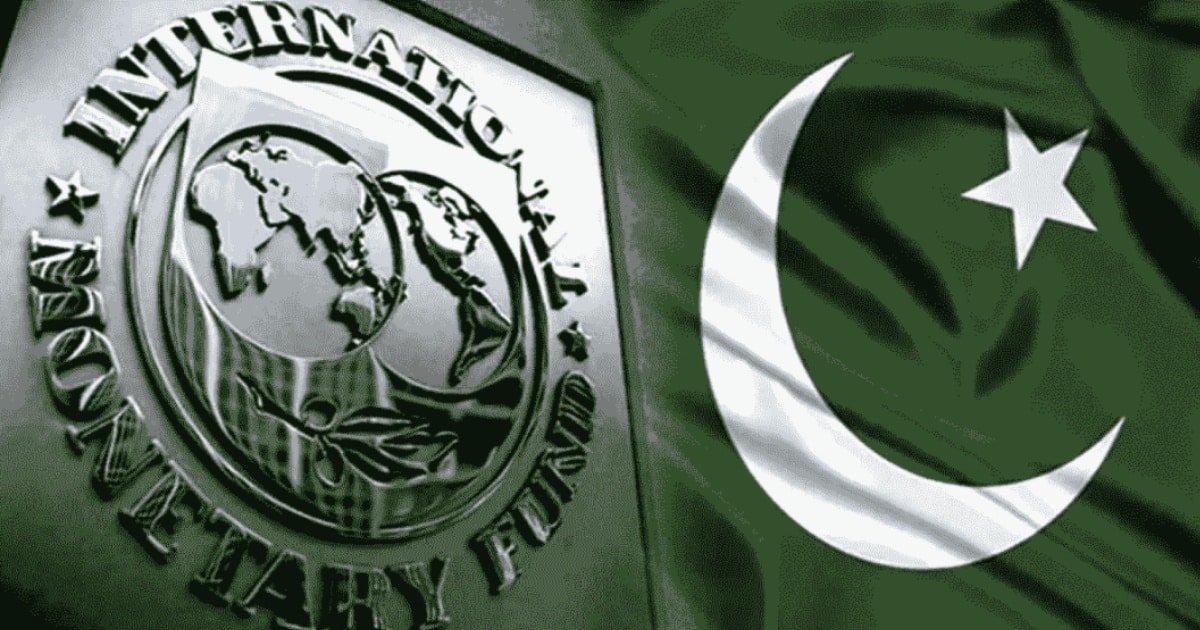



Pakistan has approached the International Monetary Fund (IMF) several times since 1958 in an attempt to resolve its ongoing economic difficulties. Such IMF programs have become a standard aspect of Pakistan’s economic policy over the decades, being initiated to prevent default or stabilize a crisis in the short term. Most of these programs have been met with censure because they usually come with harsh terms such as reduced subsidies, financial reforms, and currency devaluation, which ended up doing more harm than good to the average citizen, rather than the economy.
By 2025, Pakistan signed its 24th arrangement with the IMF way of showing the structural frailties that are seen to be present in its economy. In this article, we trace Pakistan’s long history with the IMF and how lump sum monies given in the first deal in 1958 and subsequent bailouts in 2025 were used in these 67 years.
The First: IMF First Entry of Pakistan (1958-1970s)
The official entry of Pakistan in economic relationship with the IMF started in 1958 when the country entered its first Stand-By Arrangement (SBA) with the IMF of 25 million dollars under the rule of General Ayub Khan. It was a time of modernization and industrialization of the economy, but it was also the time of increasing Trade imbalances as well as the pressure of external debts. The nation was struggling with the issue of funding its imports and inflation, leading to the country turning to the IMF in the first place.
During the 1960s, the IMF provided sporadic assistance to Pakistan, and such loans were intended to assist the Second and Third Five-Year Plans in Pakistan. Nevertheless, the provision of IMF funds frequently resulted in no significant policy shift in structuring the economy. Although there was a period of relative economic growth under the Ayub Khan regime, which was more or less due to aid and developmental activities, the fruits were not distributed evenly and contributed to future unrest. In 1971, the division of East Pakistan and the war with India caused an enormous cost on the economy of the nation.
During the Zulfikar Ali Bhutto government in the 1970s, Pakistan joined new IMF arrangements against economic downturn due to the oil shock economic crisis, the effects of nationalization, and the increased inflation rates. Pakistan signed a second SBA in 1972, and then in 1974, it tapped the Extended Fund Facility (EFF) (first time) to promote wider reforms. Bhutto, however, had generalised socialist policies and the state played a key role in the economy, causing tensions with IMF pressure to liberalize and tighten its incomes. The pattern that was formed during this period was that Pakistan turned closely to the IMF in crises without introducing lasting changes on a long-term basis.
The Period of Instability, Structural Reforms (1980s-1990s)
The period of the 1980s and 1990s became a critical part in the IMF’s historical journey of Pakistan when the nation moved into the phase of a sequence of programs, which was fuelled by the factors of increasing fiscal deficits, graver foreign debt issues, and more frequent balance of payments crises. The changes in governments, especially political instability, further undermined the process of economic policy continuity. Pakistan entered into nine different agreements with the IMF during this period, which indicates the increasing dependency of Pakistan on outside sources of finance.
Pakistan joined the Structural Adjustment Program (SAP) in 1988, during the rule of the Prime Minister Benazir Bhutto, which created a major change in IMF interaction. The program used the enhancement of fiscal consolidation, trade liberalization, privatization of state-owned enterprises, and reform of taxation. There were, however, austerity measures with the cuts on public spending, removal of subsidies, as well as devaluation of the currency, which caused social unrest and elevated levels of poverty.
Suspension and re-negotiations of IMF programs took place during both the terms of Nawaz Sharif and later Benazir Bhutto. Although several agreements had been brokered, especially involving an important Extended Structural Adjustment Facility (ESAF) in the year 1993, the structural adjustments were half-baked. The tax-to-GDP ratio held up, and industrial growth slowed.
Global Financial Crisis and Post-9/11 Period (2001-2013)
The new post 9/11 world brought a new geopolitical reality that had a significant impact on Pakistan in terms of its economic and IMF relations. After it aligned in the War on Terror with the United States, Pakistan received large amounts of foreign aid, debt rescheduling, and concessional financing, temporarily getting it out of the stranglehold of the IMF.
By the year 2001, Pakistan was no longer under an IMF scheme, and it even succeeded in creating a small back-up of foreign exchange reserves. There were signs of recovery in the economy, which were facilitated by remittances, foreign investment, and the expansion of consumer credit.
Nevertheless, this span of relative stability was not very long. In 2008, Pakistan was going through a very bad balance of payments due to the escalating oil prices, the increasing current account deficits, inflation, and the global financial crisis, which resulted in its reentry into the IMF framework in 2008. Pakistan has signed a five-year $7.6 billion stand-by arrangement with the IMF under President Asif Ali Zardari, though the amount has now been raised to US$11.3 billion, one of its biggest packages to Pakistan ever.
You May Like To Read: The Economic Survey Paradox: Why Macro Gains Fail to Help Citizens
Nonetheless, suspension of the program was witnessed in 2011 following a lack of achievement by Pakistan in meeting revenue and energy reform targets. The Federal Board of Revenue (FBR) did not manage to carry out the delayed broad-based tax reform, and the power circular debt kept increasing.
Not long after being re-elected, in 2013, another economic crunch happened, and the new PML-N government led by Nawaz Sharif turned to the IMF once again. Pakistan this time signed a 6.6 billion dollar Extended Fund Facility (EFF), which was aimed at stabilizing the economy and increasing the confidence of investors. In the program, there was some level of success; the inflation declined, there was a better reserve situation, and growth made modest gains.
Nevertheless, structural adjustment, especially in the areas of taxation, governance, and the energy sector, once more failed to live up to its expectations. The economic beneficiary was largely temporary and very dependent on borrowing and remittances as opposed to sustainable productivity or exports.
COVID-19, CPEC, and the IMF Program (2019-2022)
The inauguration of the China-Pakistan Economic Corridor (CPEC) in 2015 had at first given a sense of optimism in the eventuality of economic change on a long-term basis with a giant infusion of money investments in infrastructure. CPEC during the early years under the Prime Minister Nawaz Sharif concentrated on energy and transportation, but also augmented the amount of external debts and the current account deficit of Pakistan.
As of 2018, the country was once again in a balance of payments crisis with the remaining foreign reserves and an increasing fiscal deficit. In that respect, the newly elected Imran Khan (Pakistan Tehreek-e-Insaf) government had no choice but to go to the IMF, after lying during the political campaign about never needing to be dependent on the IMF.
Pakistan signed a 22nd program with the IMF in July 2019, totalling 6 billion dollars as an Extended Fund Facility (EFF). The objective of the program was to stabilize the macroeconomic framework through the implementation of a market-based exchange rate, better revenue collection, improvement in public debt, and the elimination of inefficiencies in the energy sector.
Being pressured by the IMF, the government took some painful steps: electricity and gas tariffs were increased, the rupee was devalued drastically, the interest rates shot up, and the Federal Board of Revenue (FBR) was charged with the duty to meet historically record-breaking tax levels.
The social and economic effects were instant. Inflation exceeded 10 percent, Gross Domestic Product (GDP) growth dropped to-0.4 percent in 2020, and the unemployment rates increased. When the first signs of stabilization became evident, another blow was delivered by COVID-19 at the beginning of 2020. Millions of people have been driven into poverty and aggravated the financial situation due to the pandemic.
As aftermath, the IMF provided an emergency support amounting to 1.4 billion dollars to Pakistan under the Rapid Financing Instrument (RFI) in addition to the EFF. The EFF was reinstated in 2021 but was once more suspended several times because of failure to meet structural milestones, uncertainty in politics, and escalating fuel prices in the world.
The Latest Bailout and New Trends (2023-2025)
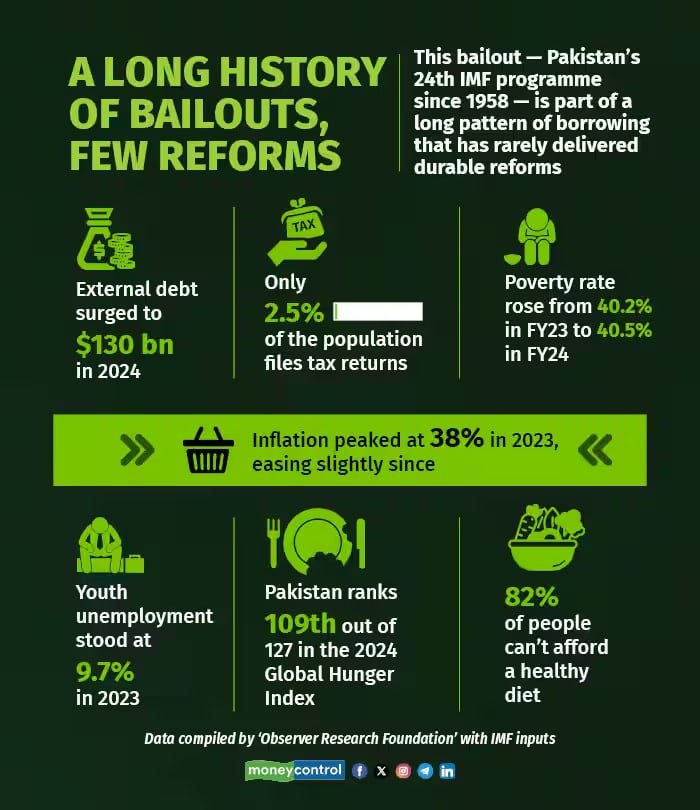
By the middle of 2023, the country of Pakistan was again on the precipice of a sovereign default. The country was in a severe economic crisis as the level of foreign reserves dropped to less than three billion dollars, just high enough to finance three weeks of imports, and the external debts were piling up. Pakistan resorted to rising negotiations and missed deadlines in July 2023 when it received a $3 billion Stand-By Arrangement (SBA) package offered by the IMF. SBA was accompanied by hard precedent actions.
The government was mandated to remove fuel and electricity subsidies, use market-determined exchange rates, increase interest rates, and widen the tax base. These actions led to a new round of inflation where prices increased by more than 28% on average, and fuel prices reached all-time highs. There was a significant uptake in the burden on low- and middle-income earning households, and economic growth remained at an average level of less than 2%. In spite of the pain that it caused to the economy, the program has allowed the rupee to remain stable, narrowing the trade deficit and increasing the foreign exchange marginally in the short run.
You May Like To Read: A New Chapter in Pak-US Strategic Trade
Midway through 2024, negotiations were underway on a larger, long-term Extended Fund Facility (EFF), which is expected to be larger than $6-7 billion, which would become what would be Pakistan’s 25th IMF program. This new consensus focuses on the structural reforms, especially in the energy pricing, taxing the elite, civil service, and the reformation of SOE (State-Owned Enterprises). There are, nevertheless, doubts in Pakistan and by outsiders that Pakistan will ever be able to carry out these reforms successfully and permanently.
By 2025, we are bound to understand that just as the SBA prevented a default, it failed to address the real weaknesses of the country, sluggish revenue levels, structural fiscal deficit, and the unwillingness to enact reforms on the part of the political classes. The IMF itself has cautioned the country that unless the ownership and further strengthening in the form of long-term reforms are maintained, Pakistan may end up seeking other assistance once again.
Conclusion: Breaking the Cycle, or Repeating History?
It can be seen that the long-term association of Pakistan with the IMF reflects the cycle of volatility, temporary bailouts, and redundant reformation. Although IMF programs have succeeded in preventing the immediate financial collapse, they have not been successful in initiating an economic transformation that is sustainable. The constant borrowing of money outside the country and the failure to tackle the structural weaknesses, such as a poor tax regime, long-running trade deficits, and ineffective government sectors, have kept Pakistan in a vulnerable economic situation. Every given program was associated with harsh arrangements, austerity actions, and citizen and people disappointment, which were then translated to incomplete reform and eventual reversion to crisis.
Sustainable stability cannot be achieved using borrowed funds only, but through adventurous high domestic world-grown reform prioritizing fiscal accountability, institutional boost, and inclusive growth. There must be political will and accountability of the masses, and equitable sharing of the burden of the reform, so that the subsequent program of the IMF becomes the final one. Unless the situation is changed in a meaningful way, there is a risk that Pakistan can continue to live in a vicious circle of economic firefighting and borrowing money.