



The Punjab Defamation Law 2024: A Controversial Legislative Move
In June 2024, the Punjab Defamation Act 2024 came into force after the Punjab Assembly’s vote on May 20, 2024, with the Governor assenting on June 7, 2024. The law was introduced by Parliamentary Affairs Minister Mian Mujtaba Shuja‑ur‑Rehman to address what the government characterized as the “spread of fake news” across print, electronic, and digital platforms. Yet since its passing, it has ignited fierce debate praised by state officials as vital for protecting reputations and screeners for falsehoods, while fiercely criticized by journalists, civil rights groups, and legal experts as a thinly veiled instrument for suppressing free speech.
Critics contend that the law’s vague language, expansive scope, and punitive mechanisms could be used to target dissenting voices and silence journalists, whistleblowers, and even ordinary citizens expressing views on social media. Multiple national and international observers, including The Human Rights Commission of Pakistan (HRCP), Digital Rights Monitor, and Committee to Protect Journalists (CPJ), have warned that the act mirrors a broader trend of digital authoritarianism taking root under the guise of national security and reputation management.
Source: CPJ
Comprehensive Law with Broad Powers
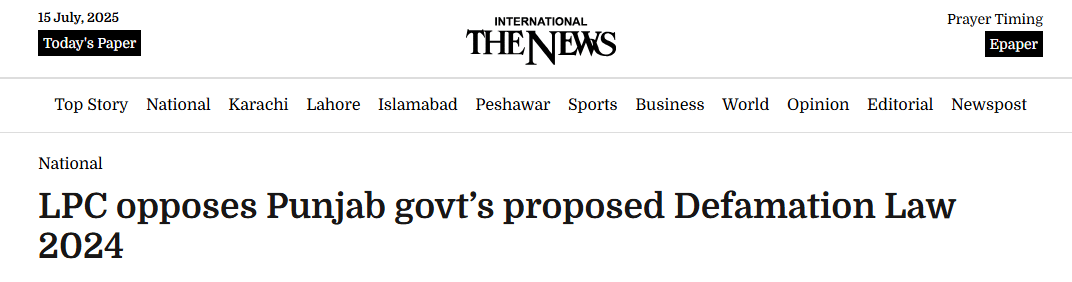
The law extends defamation protections across traditional and digital media and expands the definition of who counts as a “journalist” or “editor” including anyone involved in sharing or publishing content, even via social media holding them both individually and institutionally liable. It establishes special defamation tribunals empowered to issue steep fines; up to Rs 3 million, mandate public apologies, and order prompt removal or blocking of online content. Decisions are required within six months, with defendants bearing the burden of proof a stark departure from existing norms. Notably, claims involving high‑ranking public officials such as judges, prime minister, or military chiefs must be heard by specially appointed single-member tribunals from the Lahore High Court. The law also sidelines Pakistan’s traditional Law of Evidence Qanun‑e‑Shahadat, allowing tribunals to act on allegations without due regard for established evidentiary standards.
Criticism & Legal Challenges
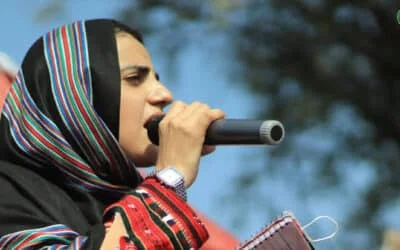
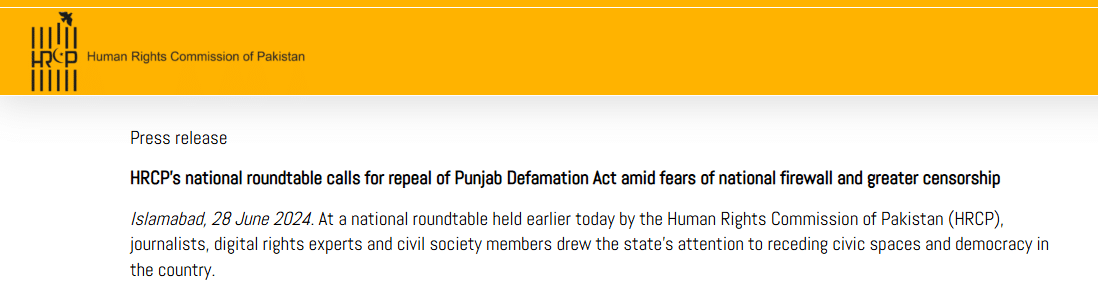
The backlash was swift and decisive. Within a day of passage, over 80 civil society organizations, media associations, and press freedom advocates called the law “draconian and regressive,” staging walkouts and protests in the Punjab Assembly. Leading bodies including PFUJ, APNS, CPNE, PBA, and AEMEND released statements expressing alarm that the law empowers elites and dilutes free expression. The Human Rights Commission of Pakistan (HRCP) held a national roundtable in June 2024, urging repeal and warning that the law legalizes censorship through “parallel judicial structures” and vague defamation definitions, especially targeting social media users.
HRCP raised red flags over clauses allowing preliminary fines without trial, burden-shifting, and the potential creation of a national firewall that threatens digital freedoms. Legal experts point to deep flaws: the expansion of defamation definitions to include statements that “may” harm reputation, the replacement of due-process safeguards, and preferential treatment enabling elites to use “special tribunals” as shields.
Supreme Court advocate Basil Nabi Malik described the redefinition of defamation and burden-shifting as deliberately overbroad, while Barrister Ali Tahir warned the Act could create a chilling effect by silencing government critics. Journalists across Punjab have protested across multiple cities, staging press club-led demonstrations and raising black flags in symbolic rejection. The Lahore Press Club declared it a “black law” and vowed continued resistance.
Source: The News
Impact on Press Freedom
The effects have been immediate. Journalists report increased self-censorship driven by fear of hefty penalties or gag orders. Wide-ranging definitions threaten social media users, content creators, and even viewers with liability undermining free dialogue and exacerbating distrust in digital communication. The Defamation Act’s unchecked powers, combined with its exemption of evidence law, may exacerbate this trend.
Security Imperative or Censorship Tactic?
Supporters of the Punjab Defamation Act 2024 argue that the legislation contributes to national security by curbing the deliberate spread of misinformation, particularly on digital platforms where false narratives can go viral within minutes. In a time when information warfare and hybrid threats are increasingly used by hostile foreign actors, the government views the regulation of defamatory or destabilizing content as essential to maintaining social cohesion, public confidence in institutions, and state stability.
Defamatory attacks against military leadership, judiciary, or top civilian officials are often framed as attempts to weaken the moral authority and legitimacy of key state pillars thus justifying the law’s special provisions for high-ranking individuals. Proponents also highlight how social media platforms have increasingly become tools for orchestrated disinformation campaigns often by non-state actors or political groups that exploit polarizing issues, incite sectarian or political violence, or challenge constitutional authorities.
In this context, the law is presented as part of a national resilience strategy against digital subversion and cyber-hostility, with swift tribunals enabling quick damage control in real-time media cycles.
Conclusion
The Punjab Defamation Act 2024 is positioned by the government as a modern shield against misinformation, a tool they argue is essential in today’s fast-moving digital milieu. However, its sweeping definitions, special tribunals, burden-shifting, and punitive thresholds threaten to chill legitimate criticism and press reporting. Civil society and journalists see it as a new frontier in legal overreach. Preventing the misuse of this law as a shield for vested interests will require robust judicial scrutiny, civil society vigilance, and possibly legislative reform. All eyes, for now, are on the High court’s decision, anticipated by late 2025.