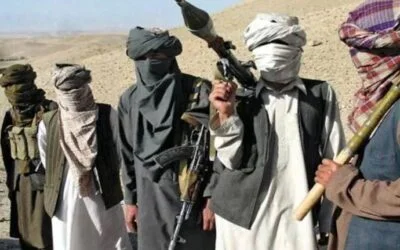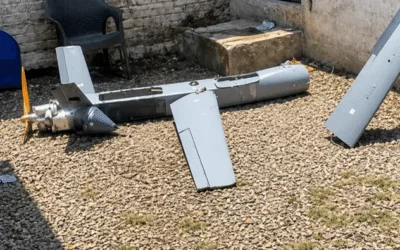


When American forces left Afghanistan in 2021, they left behind billions of dollars’ worth of military weaponry. When the Taliban gained control, they seized the weaponry without firing a shot. Since then, Afghanistan has become one of the world’s greatest sources of US-made weapons.
President Donald Trump, taking notice of the massive smuggling of weapons in the black market, claimed that $85 billion worth of advanced U.S. military equipment was abandoned. he cache includes M4 and M16 rifles, hundreds of Humvees, MRAPs (Mine-Resistant Ambush Protected vehicles), and Black Hawk helicopters, many of which still sit in warehouses in Kandahar.
According to the UN report, groups like Fitna-al-Khawarij (FAK), Al-Qaeda affiliates, the East Turkestan Islamic Movement, and even Yemen’s Ansarullah have either accessed Taliban-captured weapons or bought them on the black market.
Weapons meant to combat terror are now fuelling it, and they’re spreading across regions, borders, and into new hands, with the most serious repercussions for Pakistan.
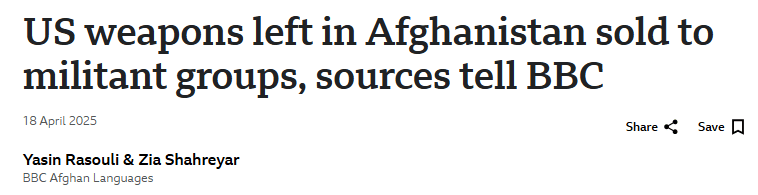
Source: BBC
What Was Left Behind?
According to a report published in ICCT, the Taliban now possess a vast cache of advanced U.S.-supplied military equipment, including 70 Mine-Resistant Ambush Protected vehicles (MRAPs), 27 Humvees, 70 sniper rifles, over 900 other firearms, and more than 160,000 radios and communication devices. They also control approximately 16,000 night-vision goggles, various machine guns, mortars, and artillery systems. In the air, their arsenal includes 13 airplanes, 44 helicopters, and seven unmanned aerial vehicles (UAVs). These weapons are not only used against adversaries but have also become tools for asserting control and maintaining internal order as the Taliban positions itself as Afghanistan’s de facto government.
Smuggling Of Arms In Pakistan and Consequences
A key concern is whether the Taliban will share its captured U.S. military equipment with allied jihadist groups like al-Qaeda and ISIS-K, raising the stakes if advanced weaponry ends up in the hands of global terrorists. Reports suggest that some civilians and low-ranking Taliban fighters have already sold weapons, many of which have surfaced in Pakistani arms markets. In response, the Taliban has taken limited action, they have been patrolling border areas, arresting arms traffickers, seizing illegal stockpiles, and imposing a temporary ban on weapons trading. However, the long-term effectiveness and intent behind these efforts remain uncertain.
You May Like To Read: FAH Recruiting Baloch Youth Through Brainwashing and Coercion
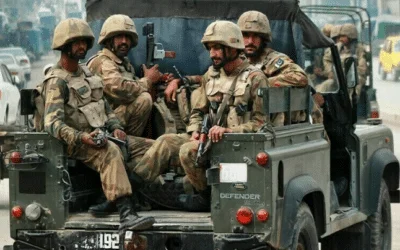
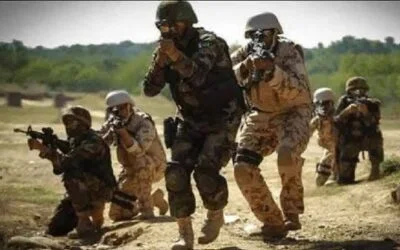
In 2022, Pakistani officials highlighted concerns about Fitna-al-Khawarij (FAK) militants employing advanced NATO weapons diverted from Afghanistan, providing them a lethal advantage over Pakistani forces and contributing to disproportionate losses along the border. The problem has spread regionally, with separatist insurgents in Balochistan, Baloch militants in Iran, and even fighters in Tajikistan reportedly using US-made weapons.
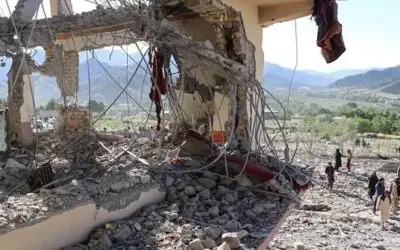
Nowhere are the consequences more severe than in Pakistan, where terrorist attacks in border areas have surged by 73% since 2021. Groups like the FAK, Islamic State Khorasan Province (ISKP), and Fitna-al-Hindustan (FAH) have exploited this influx of modern weaponry, with Pakistani forces recovering M16 rifles, grenade launchers, and encrypted radios from militants which is the clear evidence of cross-border trafficking. The Biden administration’s failure to secure abandoned U.S. equipment has indirectly fueled violence against a nuclear-armed ally, worsening U.S- Pakistan relations and deepening regional instability.
Meanwhile, beyond South Asia, U.S. made arms are surfacing in Kashmir, Iran, and parts of Africa, flowing through an unregulated black market sustained by corrupt networks and the Taliban’s passive complicity which is creating a global threat landscape shaped, in part, by America’s unfinished war.
You May Like To Read: Pakistan’s Unfinished War: Why the NAP against Terrorism Falters
How State Is Dealing With It
Pakistan must confront the growing threat posed by U.S. weapons abandoned in Afghanistan, now in the hands of groups like the FAK and ISKP. This challenge cannot be tackled in isolation because it requires a multi-layered, regional strategy.
First, Pakistan must enhance intelligence sharing with the U.S., India, and Central Asian states to trace and neutralize smuggled weapons.
Strengthening border control with Afghanistan is essential; surveillance, patrols, and coordination with international actors must be scaled up to stem the flow of small arms and light weapons (SALW).
Diplomatically, Islamabad should continue linking its cooperation with Kabul to verifiable counterterrorism steps. Its decision to halt advocacy for the Taliban on the world stage, and to condition Afghan trade access on anti-FAK action, represents valuable leverage.
Pakistan’s expulsion of undocumented Afghan nationals, while controversial, sends a clear signal to Kabul about the costs of inaction. However, such actions must be paired with humanitarian safeguards to avoid exacerbating instability.
Pakistan should also support the formation of a UN-backed regional task force to address arms proliferation and cross-border militancy. Targeted sanctions on arms traffickers and corrupt officials would disrupt key nodes in the illicit trade.
Finally, Pakistan must document and publicize the security fallout from these abandoned arsenals to galvanize global action. In the absence of sustained international engagement, the burden of managing this crisis will fall squarely on Pakistan that is already stretched thin by economic and security challenges.
Conclusion
Pakistan stands at the frontline of a growing regional crisis fueled by abandoned U.S. weapons in Afghanistan. As militant groups gain access to advanced arms, the country faces escalating security threats and rising casualties. To counter this, Pakistan must strengthen border control, leverage diplomatic pressure on Kabul, and push for regional cooperation under UN oversight. Intelligence-sharing, targeted sanctions, and careful use of economic tools are critical. Without coordinated global action, these weapons will continue to destabilize Pakistan and beyond, turning yesterday’s war remnants into tomorrow’s terrorist arsenals.