



The Growth–Green Dilemma is Real, not Rhetorical
Pakistan’s economy needs industry to grow jobs, exports, and tax revenues. At the same time, climate shocks and degraded air, water and land are already costing lives and money. The question in 2025 is no longer whether Pakistan can balance both, it must. The 2022 floods alone caused over $30 billion in damages and losses and left huge recovery needs, a reminder that unchecked climate risk can wipe out years of development in a single season.
You May Like to Read: Climate Change as an Economic Crisis: Is Pakistan Ready for Green Industrialisation?
What the Latest Numbers Say About Energy, and Industry
Industrial growth rides on reliable, affordable power. As of FY2025, Pakistan’s installed electricity capacity crossed 46,600 MW, yet the power sector is strained by inefficiencies and high costs. Circular debt in the power chain climbed to roughly Rs 2.39 trillion by 30 June 2024, undermining investment and pushing tariffs higher for factories and households.
There is a bright spot. 2025 has brought a surprise solar surge. By the first four months of the year, utility-scale solar supplied roughly a quarter of Pakistan’s monthly electricity; fewer than 20 countries have ever hit that mark. Massive imports of low-cost Chinese panels helped drive the boom. This shift lowers fuel imports, eases pressure on the current account, and offers cheaper daytime power for industry, if grid and market reforms keep pace.
Pakistan’s Climate Pledges, and the Price Tag
Pakistan’s updated climate pledge commits to cutting 50% of projected 2030 emissions compared to business-as-usual, with 15% from domestic effort and 35% contingent on international grant finance and technology transfer. The energy transition component alone will need tens of billions of dollars this decade. These targets anchor policy signals for cleaner industry, transport, and power, but they hinge on concessional finance and credible project pipelines.
You May Like to Read: The West’s Climate Diplomacy: Structural Inequality Disguised as Global Cooperation
Financing is starting to move, but must scale faster
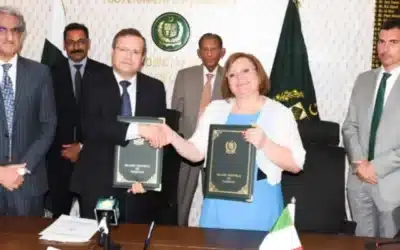
In January 2025, the World Bank and Pakistan outlined a 10-year plan targeting up to $20 billion in lending focused on climate resilience, clean energy, and private-sector growth. Such long-horizon finance can de-risk industrial decarbonisation, grid upgrades, efficiency in textiles and cement, and electrification of captive power. But loans come with reform conditions and add to debt if not paired with grants and private capital.
Concessional flows are gathering. The Green Climate Fund approved a $50 million program to back home-grown climate solutions through Pakistan’s startup ecosystem, a useful lever for industrial innovation in cooling, materials, and process efficiency. Meanwhile, UN agencies and partners have mapped large climate-finance gaps and policy fixes, from carbon pricing readiness to better project prep at provincial levels.
A New Market Tool: Carbon Trading
In 2025, Pakistan began issuing approvals for projects under Article 6.2 of the Paris Agreement, enabling international carbon credit transactions. Early approvals include waste-to-green-space rehabilitation in Lahore, with more projects advancing through government channels. If integrity is kept high, these credits can crowd in foreign exchange and pay for methane cuts, industrial efficiency and renewable heat, areas where factories can reduce costs and emissions together.
You May Like to Read: Organised Crime and the Climate Crisis: Illegal Logging, Sand Mining, and Pakistan’s Environment
Can Industry Grow, and Clean-up at the same time?
First, fix the grid and the cash cycle. No industrial strategy can succeed when utilities leak revenues and payments stall. Cutting line losses, improving billing, and clearing receivables are climate actions too: they allow cheaper renewable power to displace imported fuels without worsening tariffs. The regulator’s own reports underline how circular debt undercuts investment; resolving it unlocks cleaner capacity and lowers unit costs for manufacturers.
Second, double down on the solar moment with storage and market reform. The 2025 solar wave can power export sectors during the day. Adding battery storage at industrial clusters and allowing time-of-day pricing and wheeling will let factories buy the cheapest clean electrons directly, while helping the grid manage variability at night. Recent planning documents already anticipate more renewables; the task now is execution, connections, dispatch, and fair settlement.
Third, scale concessional finance where it bites. Textiles, cement, steel and cold-chains need affordable capital for efficient motors, waste-heat recovery, electrified boilers and heat pumps. The new World Bank partnership and GCF programs should earmark a clear pipeline for industrial decarbonisation with local banks, so SMEs can access simple, low-collateral green loans tied to verified energy savings.
Fourth, use Article 6 to lower the cost of cutting methane and process emissions. High-integrity carbon deals can fund landfill gas capture, rice methane reduction, and clinker substitution in cement. With approvals now rolling, standard contracts and safeguards can help Pakistani firms monetise real, measurable cuts without reputational risk.
The Investment Window is Open
Pakistan’s Special Investment Facilitation Council has pitched agriculture, mining, energy and IT to investors while promising faster approvals. To convert memoranda into factories and jobs, environmental standards must be applied consistently and predictably. Clear, timely permits shorten project timelines and lower financing costs; weak enforcement does the opposite and invites trade barriers from export markets moving to carbon border rules.
The Bottom Line
Pakistan does not have to choose between smokestacks and clean air. The 2025 data show a pathway where solar, efficiency, and smarter finance can lower industrial power costs, reduce fuel imports, and cut emissions together. But success depends on disciplined power-sector reforms, scaled concessional capital, credible carbon markets, and consistent environmental enforcement. Done right, climate-smart industry can be Pakistan’s competitive edge, protecting people from climate shocks while powering growth that lasts.