





Pakistan is undergoing a significant transformation of its internal security apparatus with the decision to convert the erstwhile Frontier Constabulary (FC) into a nationwide federal force, now to be known as the Federal Constabulary. This strategic move, formalized through the Frontier Constabulary (Re-organization) Ordinance, 2025, marks a pivotal shift aimed at addressing the nation’s evolving security challenges and consolidating law enforcement efforts across all regions.
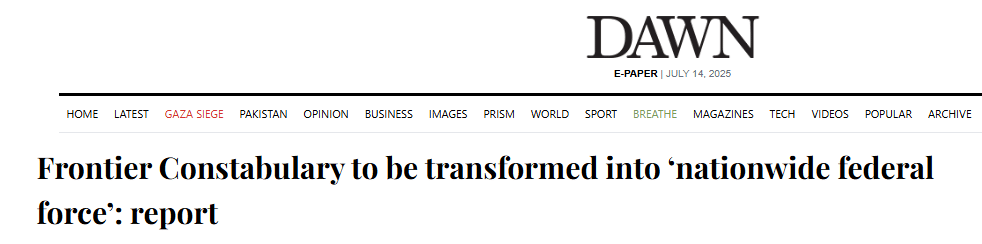
Source: Dawn
From Frontier Guards to National Guardians
For over a century, the Frontier Constabulary operated as a specialized federal paramilitary force, deeply rooted in the Khyber Pakhtunkhwa (KP) province, FATA and PATA regions—federally and provincially administered tribal areas respectively. Its existence was intrinsically linked to the historical dynamics of the region, particularly its border with the tribal areas.
Federal Government Decides to Transform Frontier Constabulary into Nationwide Federal Force
The federal government has decided to expand the Frontier Constabulary (FC) into a countrywide federal force, sources reveal.
To implement this, an ordinance will be issued to extend the… pic.twitter.com/ck7UHJ93mj
— Eagle Eye (@zarrar_11PK) July 13, 2025
Former Duties, Scope, and Jurisdictional Limitations
Historically, the FC’s primary mandate was to police the volatile border between the settled districts of KP and the semi-autonomous tribal areas (FATA, now merged with KP). Its duties were robust and specialized, including:
- Guarding against tribal incursions: A critical role in preventing cross-border movements of hostile elements.
- Countering criminal gangs and contraband smuggling: Battling illicit trade and organized crime that thrived along the porous borders.
- Maintaining law and order: Stepping in where civilian police capabilities were insufficient, often in complex security situations.
- Fort-based Operations: Operating from strategic forts, posts, and pickets established along the tribal-settled boundary, these fortifications served as crucial operational bases and deterrents.
Administered by the federal Ministry of Interior and headquartered in Peshawar, the FC was governed by the Frontier Constabulary Act of 1915 and the North-West Frontier Constabulary Rules of 1958. While a federal entity, its operational functioning was often supervised by provincial Home Departments, particularly within KP. Its recruitment traditionally focused on the youth from Khyber Pakhtunkhwa, reflecting its localized operational focus.
Despite this regional nexus, FC platoons were deployed in other provinces, for specialized tasks like guarding sensitive installations and VVIP security, showcasing its nascent capacity for wider deployment, albeit on a limited scale.
Crucially, the FC was officered by professionals from the Police Service of Pakistan (PSP), distinguishing it from military units and aligning it more closely with policing duties. This localized, border-centric mandate, limited its effective deployment and uniform application across the diverse security landscapes of the entire nation.
The Transformation: Structure, Mandate, and Operational Shift
The conversion of the FC into the Federal Constabulary represents a strategic overhaul, driven by the need for a more cohesive and versatile security force capable of addressing contemporary threats. The newly promulgated ordinance paves the way for a truly national security entity. Radio Pakistan, to this effect, reported;
The Federal Government has decided to convert the Frontier Constabulary into a countrywide federal force.
According to sources, the force will be renamed as the Federal Constabulary.
It will be empowered to operate in all four provinces, including Islamabad Capital Territory, Azad Kashmir, and Gilgit-Baltistan.
Officers of the Police Service of Pakistan will command the Federal Constabulary under the reorganization framework.
The source said the establishment of the Federal Constabulary will provide substantial support in ensuring internal security and public order in the country.
Key Amendments and Structural Changes
- Renaming and Identity: The force will shed its historical “Frontier” identity, becoming the “Federal Constabulary,” symbolizing its expanded nationwide mandate.
- Broadened Jurisdiction: A fundamental shift is the expansion of its operational reach to all four provinces, the Islamabad Capital Territory, Azad Jammu and Kashmir (AJK), and Gilgit-Baltistan (GB). This empowers the force to intervene and assist in security operations across the entire country, transcending previous geographical limitations.
- Legal Formalization: The transformation is being solidified through amendments to the Frontier Constabulary Act of 1915, ensuring a robust legal framework for its new nationwide role.
- Centralized Command: While continuing to be officered by PSP officers, the force will be led by an Inspector General appointed directly by the federal government, underscoring its federal nature and centralized command structure.
- Nationwide Recruitment: A pivotal change will be the initiation of nationwide recruitment, opening up opportunities for youth from all regions of Pakistan. This move will enhance the force’s diversity and local intelligence capabilities in various provinces. New offices will be established across the country to facilitate this broader outreach.
- Specialized Divisions: The ordinance outlines the creation of dedicated divisions for specialized tasks, including a Special Protection Division and a Riot Control Division. This formalizes and enhances the FC’s capacity for specific roles beyond traditional border policing.
- New Role as Reserve Force: The Federal Constabulary will function as a reserve force, capable of performing specialized duties in aid of the ICT Police, provincial police forces, and other security and law enforcement agencies. This includes responsibilities for internal security, counter-terrorism operations, and protection duties, further dividing its operational scope into a Security Division and a Federal Reserve Division.
Impact and Implications: A New Era for Internal Security
The conversion of the FC into a nationwide force carries significant implications for Pakistan’s internal security, governance, and federal structure.
Strategic Rationale and Operational Advantages
The decision reflects a pressing need to centralize and enhance Pakistan’s internal security infrastructure in response to the escalating threat of militancy and terrorism across the country. By transforming the FC into a federal force with nationwide jurisdiction, the government aims to create a cohesive and readily deployable unit that can swiftly respond to threats anywhere in the country.
This will improve coordination among various law enforcement agencies and fill critical operational gaps, particularly in areas where provincial police forces may be stretched or lack specialized training. The ability to deploy a well-trained, federally controlled force can be crucial in counter-terrorism operations, maintaining public order, and protecting vital installations.
Challenges and Concerns
Despite the strategic advantages, the transformation is not without potential challenges.
- Provincial Autonomy: Concerns might arise from provinces regarding potential federal overreach into areas traditionally managed by provincial law enforcement, potentially challenging the spirit of devolution and provincial autonomy. Clear lines of command and cooperation protocols will be essential to avoid friction.
- Recruitment, Training and Resources: Expanding the force nationwide will necessitate massive investments in recruitment, training, equipment, and infrastructure to ensure uniform standards and capabilities across diverse operational environments.
- Mission Creep: There’s a potential risk of “mission creep,” where the Federal Constabulary might be increasingly used for tasks traditionally falling under provincial police, leading to a dilution of their core responsibilities, over-reliance on federal forces.
- Civilian Oversight: Ensuring robust civilian oversight and accountability mechanisms will be critical to prevent any misuse of the expanded powers and to maintain public trust.
Implications for Governance and Federalism
The move subtly redefines the balance of power in internal security, tilting it slightly towards the federal government. While provinces retain their policing powers, the presence of a strong federal constabulary with nationwide deployment capabilities can alter the dynamics of security operations. This could streamline responses to inter-provincial threats but also necessitate careful negotiation and coordination to respect provincial mandates.
Socio-Economic Impact
Nationwide recruitment will bring socio-economic benefits by creating employment opportunities across the country, potentially fostering national cohesion within the force itself. However, it also means adapting the traditional FC culture to accommodate diverse regional backgrounds and training needs.
Summing it up
This transformation is not unprecedented; previous governments, under then-Interior Minister Ahsan Iqbal in 2018, had also considered upgrading the FC to a “Pakistan Constabulary,” highlighting a persistent vision for a more centralized national security force. The current promulgation of the ordinance signifies a decisive step in this direction, granting the federal government comprehensive legal authority to utilize the Federal Constabulary for any security purpose across the country, including VIP security, thereby playing a crucial role in maintaining law and order and strengthening national peace and security mechanisms.