




Why Minority Women are ‘Doubly’ Marginalized
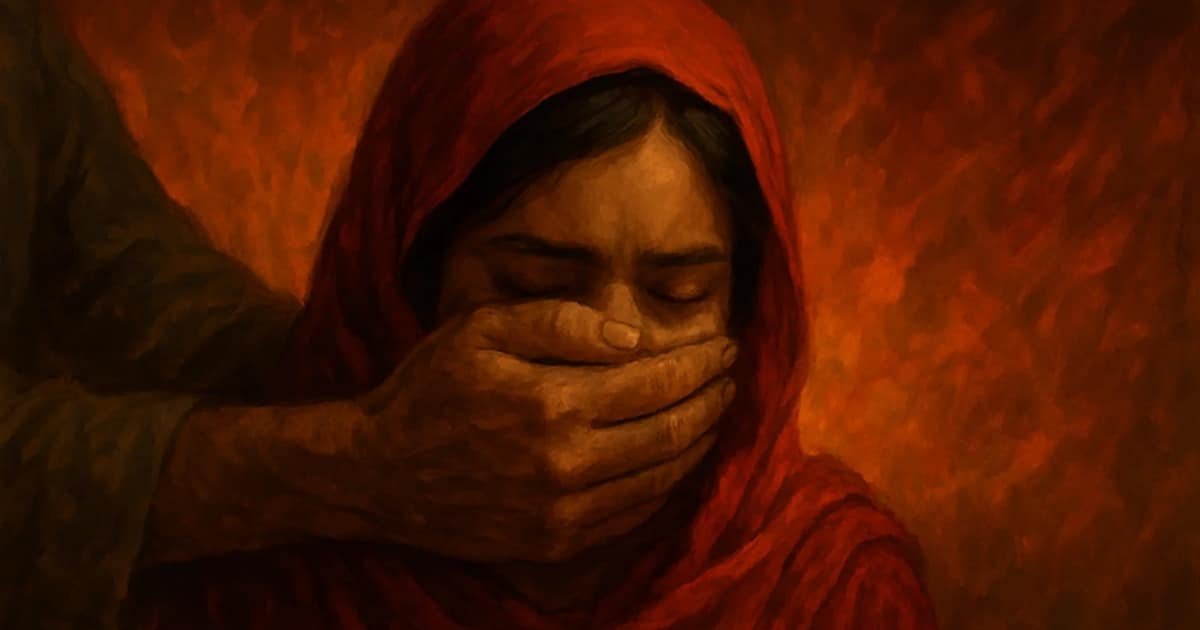
For minor girls from Pakistan’s non-Muslim communities, the experience of being abducted often follows a very difficult pattern. First, they are taken, and then a quick conversion certificate and marriage contract (nikahnama) are produced. This leads to months of court battles where their families must fight to prove their daughter’s age and lack of consent to the marriage. This issue is particularly hard for minority women and girls because they face two distinct problems; religious bias that sees forced conversion as a solution, and social structures that don’t respect a girl’s ability to consent.
This combination of religious intolerance and patriarchal attitudes is why these cases are constantly in the courts, police stations, and news. Organizations that monitor human rights, like the Human Rights Commission of Pakistan (HRCP), have consistently warned that forced conversions and underage marriages are not just rare events. In fact, they are part of a larger climate of fear for minorities. The HRCP’s 2024/25 report on freedom of religion highlighted these growing threats, including forced conversions and attacks on religious sites, and called for stronger protections and accountability to be put in place.
What the Data, and Silence Tell Us
Accurate national data are thin because families often stay silent under social pressure or fear of retaliation. Even so, snapshots are stark. The National Commission on the Rights of Child (NCRC) recorded dozens of complaints from April 2023 to December 2024 involving murder, abduction, forced religious conversion and underage marriage of minority children, numbers that rights groups say likely understate the scale. Civil society monitors such as the Centre for Social Justice (CSJ) have compiled year-on-year case lists to map the trend, while independent coverage continues to report fresh cases in Sindh and Punjab. HRCP’s 2025 brief on religion-related offences also collates datasets on forced conversions that reinforce the pattern of coercion and impunity.
International observers echo the concern. UN experts in 2024 warned that Hindu and Christian girls remain particularly vulnerable to abduction, forced conversion and child, early and forced marriage, urging Pakistan to ensure age-verification and genuine consent standards in courts and police practice. Country assessments by the UK Home Office and others note that while many Christians can practise freely, converts and families facing blasphemy allegations struggle to secure effective protection or safe relocation.
Law, and Loopholes
The law has started to move in the right direction. In May 2025, Parliament passed, and the President assented to, the Islamabad Capital Territory Child Marriage Restraint Act, setting 18 as the minimum marriage age for girls and boys and introducing prison terms for facilitators, a long-sought reform by women’s and child-rights advocates. The measure, praised by international and local groups, replaces colonial-era provisions and aligns the federal capital with global standards.
You May Like to Read: Abductions and Forced Conversions
Sindh remains the only province with a dedicated law since 2013 setting 18 as the minimum marriage age for both sexes, in force since 2014. Yet attempts to legislate specifically against forced religious conversions in Sindh stalled after political pushback in 2016–19, leaving a legal vacuum around coercion at the point of conversion and marriage. Punjab, which still operates under an amended version of the 1929 Act, has not uniformly raised the minimum age to 18, though advocates and officials have publicly renewed calls to do so this year. Without harmonised provincial reforms and clear rules on age verification, guardianship, and the legal threshold for “free consent,” protection remains uneven.
The Court Corridor: Consent vs. Coercion
In many petitions, the decisive questions are the girl’s age and the authenticity of consent. Where age is disputed, producing NADRA records or school certificates becomes critical. UN experts have urged standardised, child-sensitive procedures, including medical age assessments when documents are missing, and protection from intimidation in courtrooms. HRCP’s latest review calls out the broader context: blasphemy-related threats, harassment of families, and community pressure that can make “consent” illusory. The Supreme Court’s 2014 minority-rights judgment mandated a national council for minorities and protection protocols, but implementation remains partial, and trial-level consistency is still a challenge.
Patriarchy at the Core: How Gender Multiplies the Risk
The gendered drivers are familiar, and stubborn. Early marriage remains both a social practice and an economic coping strategy, especially in climate-impacted, low-income districts. Studies have linked disaster-related displacement and poverty to spikes in child marriage, shrinking girls’ bargaining power within households. Even outside minority contexts, health and education outcomes for child brides are worse, which compounds vulnerability when religion is layered onto the equation. For minority girls, the risk calculus is harsher; the fear of communal reprisal can deter police from robust action, while families weigh safety against publicity.
You May Like to Read: The “Justice Gap”
What Would a Solutions-First Approach Look Like?
Recent progress in Islamabad offers a workable template. First, harmonise the minimum marriage age at 18 nationwide and standardise penalties across provinces. Second, legislate narrowly but firmly on coercion: require conversion petitions involving minors to be heard by specialised courts, mandate in-camera testimonies with child-protection officers present, and place the burden of proof on adult “spouses” and facilitators to demonstrate free, informed consent. Third, operationalise the Supreme Court’s 2014 directives: activate a functional National Council for Minorities, train police and prosecutors on child- and minority-rights standards, and ensure safe houses for at-risk girls pending adjudication. HRCP’s 2025 findings on the scale of religion-related offences should guide prosecutorial priorities, while civil registries and NADRA can deploy fast-track age-verification to prevent sham marriages.
Finally, invest in prevention: school retention stipends for girls in high-risk districts, targeted support for minority communities, and climate-resilience programmes that ease the economic triggers behind early marriage. Pakistan’s rights infrastructure has the bones for this: the NCRC, provincial women’s departments, and an active civil society that already documents cases and supports survivors. With Islamabad’s law as a floor, not a ceiling, Pakistan can make a credible, home-grown case that forced conversions and child, early and forced marriage are neither tolerated by the state nor excused by society. The goal is simple but urgent: to replace the script of silence with one of protection, due process and dignity for every child, especially those at the intersection of minority status and patriarchy.