




Significance of Article 370 & Article 35A
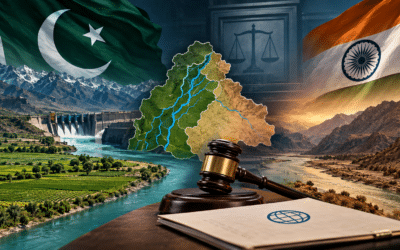
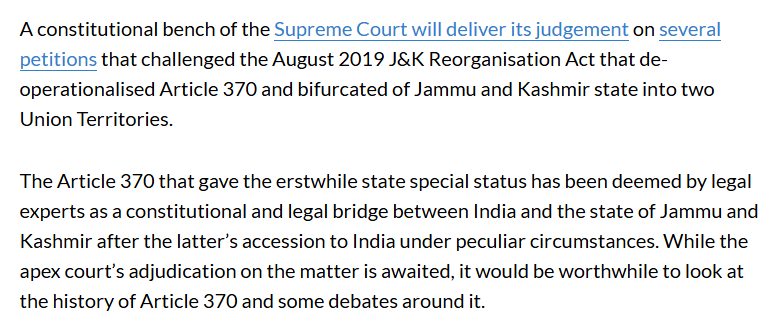
The princely state of Jammu and Kashmir (J&K) joined India after its Independence in 1947. These special conditions were enshrined in Article 370 of the Indian Constitution, making J&K a special autonomous state. This implied that, unlike the other states of India, J&K had its constitution, its flag, and could enact laws on all issues except foreign affairs, defense, and communications.
It is also stated in Article 370 that Indian legislation would only be implemented in J&K, leaving it to the mercy of the state government. This maintained the uniqueness of the relationship between J&K and India with the rest of the country. It was supposed to safeguard the cultural and political identity of the region.
Source: Kashmir Times
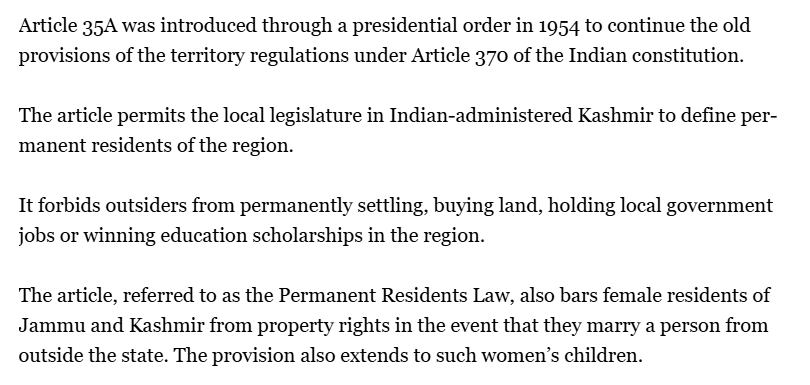
Yet another special condition was introduced later in 1954, known as Article 35A. It empowered the J&K legislature to define that there were certain people who could be considered permanent residents of the state. These permanent citizens enjoyed privileged rights, and the rights included exclusive rights to land purchase, application to government jobs, scholarships, and benefits, among others. These Articles enabled Jammu and Kashmir to act with a certain degree of autonomy to safeguard the identity of the people and their rights.
Source: Al Jazeera
The Revocation of Article
The Government of India, on August 5, 2019, abrogated Article 370 that conferred special status to Jammu and Kashmir for more than 70 years. This implied that J&K would cease to exist as a state that was governed by its constitution and instead, Indian laws will henceforth be fully applicable to the region, just like any other territory in India.
A vote was taken in Parliament, and a presidential order was issued to remove them. First, the government itself, through Article 370, issued another order with the name Presidential Order C.O. 272, which enabled the Indian Parliament to make laws applicable to J&K without its state consent. Later, Article 370 was repealed with a resolution made by the Parliament, which said that it would not be applicable anymore.
You May Like To Read: Tragedy Strikes Off Yemen Coast as Migrant Boat Sinks, 76 Dead
Meanwhile, the Jammu and Kashmir Reorganisation Act, 2019, was also promulgated by the government. In this law, the state was bifurcated into two Union Territories, Jammu and Kashmir, and Ladakh, where one had a legislative assembly and the other had none. The changes implied that J&K ceased to be a state and was now directly under the central government.
The Indian government claimed that such a move would bring both development, good governance to the region and peace. Prime Minister Narendra Modi proclaimed it to be a move towards achieving one nation, one constitution, and that it would aid in bringing J&K completely into the mainstream of India. This decision by the Government, without the approval of the people of J&K, was undemocratic and unconstitutional.
Consequences of the Revocation
Changes in Jammu and Kashmir were witnessed in terms of its political and administrative dynamics since August 2019, when Articles 370 and 35A were revoked. When it was transformed into a Union Territory, its local authority was diminished, and most of the Indian laws were applied in J&K, which had not been done previously.
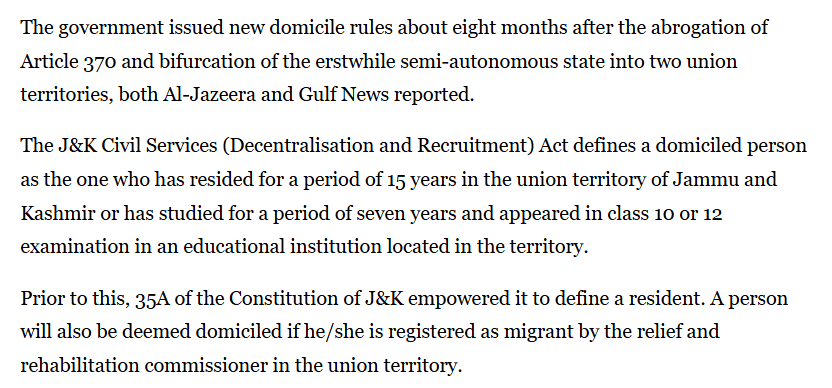
The national government boasted that this would result in the unification of laws, quicker development, and improved governance. There was an announcement of some infrastructure projects, investment plans, and the introduction of new education reforms. In 2020, the government also passed a new domicile law that enabled non-residents in the area to apply for jobs and land, and this act was interpreted by many citizens in the area as an attack on their identity.
Source: Dawn
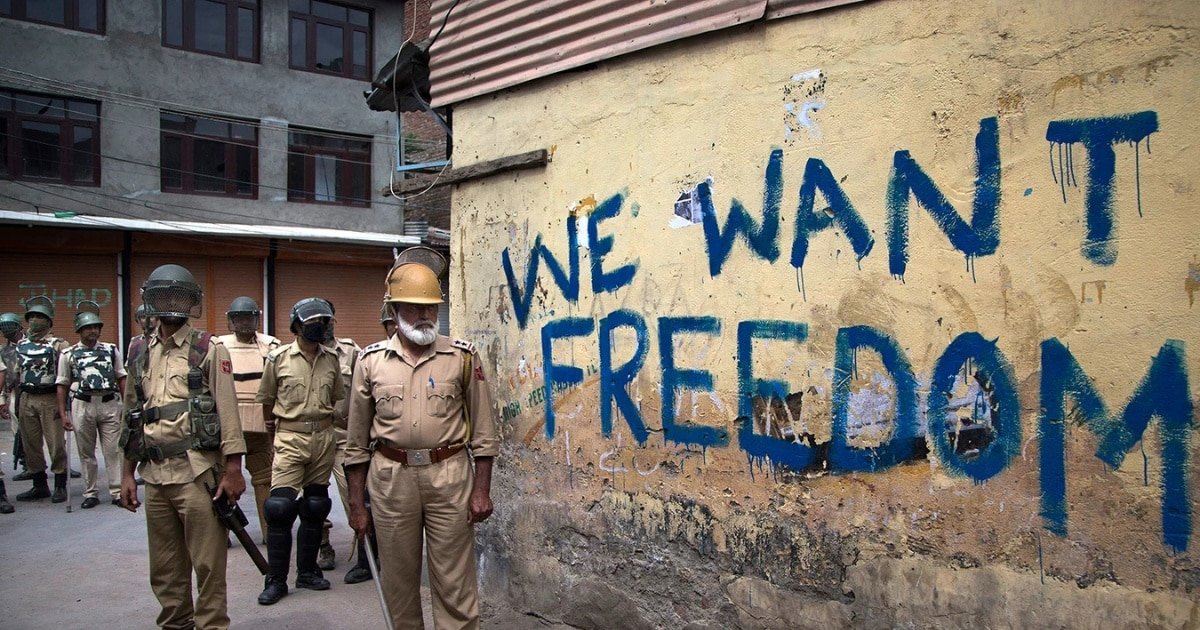
Conversely, numerous grave causes of concern have also been voiced. Internet and phone codes were blocked out for months, and political leaders, including former chief ministers, were house-arrested. There was still a state of strict security in the country, and the people were hardly allowed to hold any demonstrations. Despite the pretense of normalcy back into some form, there is a lot of sense of mistrust and political alienation among the people of Kashmir. The elections to the legislative assembly of the region have not yet been held, and political dialogue is not guaranteed.
You May Like To Read: The Decline of U.S. and China’s Soft Power in a Multipolar World
Six Years of Uncertainty, and Seige
India was considered to be acting unilaterally and seriously by revoking Article 370 in August 2019, which was contrary to the resolutions of the UN Security Council and International laws. On its part, Pakistan feels that Jammu and Kashmir is a disputed state and no action should be taken on any decision changing its status unless a fair and free plebiscite, as provided under the UN resolutions, is taken.
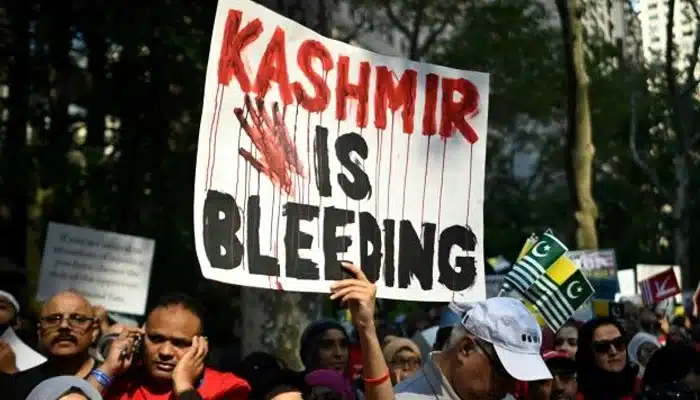
In the case of Pakistan, the resolution of India to revoke the special status of J&K and transform it into Union Territories was considered an act of trying to alter the demographics of the region and suppress its citizens using violence and legal exploitation, possibly to orchestrate an apartheid in the longer run.
In the last six years, Pakistan has kept on bringing the issue into the international forums, such as the UN General Assembly, the OIC, and other international human rights organs. Leaders of Pakistan and the subsequent governments, highly criticized the blocking of communication, arrest of Kashmiri leaders, and military lockdown that followed the abolishment. The introduction of domicile laws was another source of concern expressed by Pakistan, because according to it, others want to settle in the region, and the introduction of the domicile laws is meant to alter the Muslim-majority nature of the region.
Although Pakistan continues to spearhead the right of the Kashmiri people to self-determination, there is still tension on the ground. The cross-border conflict and breakage of truce had been witnessed in the previous years, but a new ceasefire agreement in 2021 brought back a momentary calm. Nevertheless, Pakistan says that until the rights and voice of the people of Kashmir have been restored, there can be no genuine peace and development in the area. Abrogation of Article 370, in the opinion of Pakistan, has merely fueled mistrust, stifled protest, and caused people in Kashmir to become even farther from getting a peaceful solution.